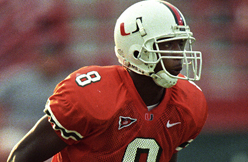
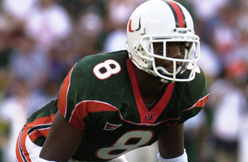
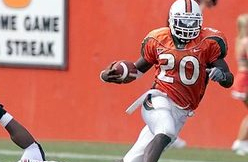
Tracking proCanes

Tracking proCanes - Robert Bailey

TrackingproCanes

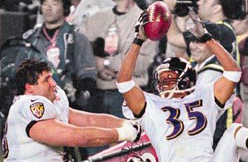
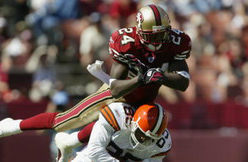
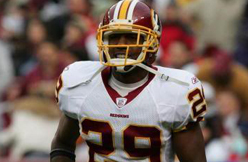
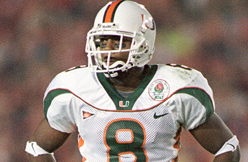
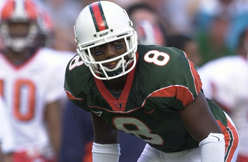
proCanes.com is continuing our “Tracking proCanes” feature with former University of Miami, and NFL defensive back Robert Bailey. Bailey played eleven seasons for six teams, the Los Angeles Rams, the Dallas Cowboys, the Washington Redskins, the Detroit Lions, and the Baltimore Ravens from 1991 to 2001 in the NFL Bailey was drafted in the fourth round of the 1991 NFL Draft by the Rams. He was nicknamed "Beetle" after comic strip character.

RobertBailey4
On October 23, 1994 as a member with the Rams, Bailey made the longest punt return in NFL history when he ran 103 yards for a touchdown in a game against the New Orleans Saints.What makes this return stand out is that every single player on the field assumed the ball was going to bounce through the end zone after the punt. Everyone, that is, except Bailey, who was the only person to see that the ball never bounced out of the end zone and was lying in the end zone still in play. He ran up, scooped the ball up, and returned it for a touchdown before anyone realized what had happened. A broken neck against the Green Bay Packers ended Bailey's NFL career in 2001. Bailey currently works in the sports marketing business with Rosenhaus Sports' agency.

proCanes.com: You're down here in Miami working with Drew Rosenhaus, talk about what you do for his firm and how you ended up working with him?
Robert Bailey: I started with Drew as a player, he was my agent. I was one of his first clients and finished my career with him which is unusual these days with more than 50% of players changing agents. When I retired after 11 years I had a good understanding of the business so he decided to bring me on board. Ten years later, I am the President of RSR.

pC: At what age did you start playing football, and did you play any other sports?
RB: I started playing football when I was ten years old. I played all sports but football I mastered.

pC: Were you a Hurricane fan growing up? If not, who did you like? If you were which former Hurricane player did you really like?
RB: I really did not watch college ball growing up but I did watch the NFL a little. My favorite player as a young kid was Tony Dorsett.

RobertBailey5
pC: Who recruited you out of High School?
RB: Coach Soldinger and Jimmy Johnson [recruited me]. Jimmy came to my house and said" You should want to be with us, not we want to be with you" I was sold right then.

pC: You're a Cane but you almost went to....
RB: U of Minnesota

pC: What was the toughest thing about playing at the U?
RB: There was nothing tough about playing at “The U,” that was all I knew.

pC: What's your favorite memory of your time at Miami?
RB: Running out of the tunnel with the smoke.

pC: You covered some great wide receivers during your days at Miami who was the toughest to go up against in practice?
RB: They were all tough and that made me a better player in the NFL.

pC: You won 2 National Championships talk about those experiences.
RB: They were great but truthfully it was common place back then. It was expected every year.

pC: Talk about Dennis Erickson and Jimmy Johnson as coaches. Jimmy. What was the difference between the two coaches?
RB: I loved Jimmy. He was the Principle to us and Erickson was a substitute teacher.

RobertBailey6
pC: Talk about the whole U is Family and the tight bonds players make and keep. Has that helped you in your job with your Hurricane clients?
RB: All Hurricanes stick together. That’s why when Jimmy was at Miami we weren’t allowed to be in fraternities. We were all we had. That lasts forever.

pC: Talk about your NFL days and the transition from the U. You were a 4th round pick by the Rams. What was the biggest adjustment when you first entered the NFL?
RB: The politics. I always competed on the field but there is a business off the field behind closed doors and salary and politics played a big part. In college, the best played and you had 4 yrs to prove you were one of the best.

pC: What was the key to your success and longevity as an NFL player?
RB: Physically, I was an above average player but mentally I was a Pro Bowler. I felt like I was the smartest player on the field and I knew everything that was happening.

pC: You won two Super Bowl rings, one with the Cowboys and one with the Ravens. Would you say one was more memorable than the other?
RB: They were both great memories. Many Hurricanes played with me on both those teams so I have to give them equal value.

RobertBailey1
pC: How was it playing on such a great defense like the Ravens' defense of 2000 which included fellow Canes Duane Starks and Ray Lewis?
RB: It felt great to play with guys who were very talented and knew how to play together. Our defense was the reason we won the Super Bowl.

pC: You hold the record for the longest punt return in NFL History. Talk about that play, and do you every think the record will be broken?
RB: As I said before, I was the smartest person on the field and I knew every rule. I took advantage of 11 other players that did not know that particular rule. Now every coach is showing that play so it won't happen again.

pC: Who was the toughest NFL receiver you had to go up against and why?
RB: Joey Galloway in his prime. That guy had speed, speed and more speed.

pC: What do you think about the last couple of years and the current state of Hurricane football and why do you think Miami hasn't been able to develop top defensive backs like yourself more consistently?
RB: I believe in college football the four year plan helps every school to eventually be good. When a school becomes good, high school athletes eventually start to go to other schools so they won't have to wait a long time to finally play. Eventually, the bad school becomes good and the good school becomes bad.

pC: What is a misconception people have about the University of Miami?
RB: That we were thugs all the time. We were thugs on the field but pretty smart guys off of it.

RobertBailey2
Word Asssociations: give me the first thing that pops in your head when you read the following:
Randy Shannon: Positive Larry Coker: Nice Orange Bowl: Legendary Dolphins Stadium: Business Sebastian the Ibis: huh? Jimmy Johnson: Leader Art Kehoe: Friend Ray Lewis: Boss Warren Sapp: Stud Coral Gables: Safe The Fiesta Bowl: Incredible Ohio State: Bitter

pC: Favorite NFL Team?
RB: I like all the NFL teams.

pC: Favorite NBA Team?
RB: The Heat.

pC: Favorite Baseball Team?
RB: The Marlins.

pC: Favorite Food?
RB: Fruit.

pC: What Band/Group I would find most of on your iPod?
RB: All old school/R&B.

pC: One movie you could watch over and over?
RB: The Book of Eli.

RobertBailey3
pC: One TV show you cannot miss?
RB: Spartacus.

pC: You didn't say Young and the Restless soap opera. You appeared once on the Young and the Restless, talk about how that came about. Do people still tease you about that one?
RB: I knew the executive producer, so that’s how I got on. Sometimes they still tease me.

pC: What do you do in your spare time?
RB: I spend time with the family.

We at proCanes.com would like to thank Robert Bailey for being so gracious with his time to do this very insightful interview for our new feature "Tracking proCanes." Click here to check out our past interviews with Leon Searcy, Steve Walsh, Frank Costa, John Routh, Chad Wilson, Mike Rumph and more!


Bookmark and Share

Tracking proCanes - Carlos Huerta - Part II

TrackingproCanes

In Part II of our interview with Carlos Huerta he talks about the differences between Coach Johnson and Coach Erickson, how he got the number 27, where he thought the toughest place to play was, what he thinks of the current state of Hurricane football and much more! Click here to read Part I of our EXCLUSIVE interview with Carlos Huerta.

pC: So what would you say was the toughest part about playing at Miami?
CH: Once I made the team it wasn’t tough. It was earning the starting position. After that, I would say what kept me focused was you know, we had such great athletes on offense and defense, leading scoring team in the nation just about, number one defense almost every year. I always felt like alright, “I can’t lag behind those guys, I don’t want to be the weak link” so I kind of made it a point to really be on top of my game, but once you’re a starter you’re given every opportunity to succeed and coming from that position that I told you about where I was kind of treated like garbage, I never wanted to go back there. I kept clean, I went to class, I tried to keep my mouth shut usually and work hard so I’d perform well. But you know the coaching staff and this team definitely seemed to always put me in a position to succeed and I didn’t want to let them down, but making the team was the toughest.
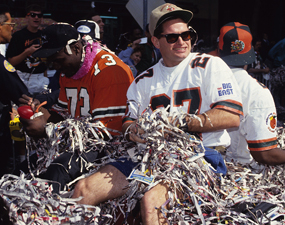
CarlosHuerta2
pC: What would you say was your favorite memory? Does it come down to a specific kick you made or the National Championships?
CH: My favorite memories are winning those very high profile games. Beating Florida State when they were ranked number one, my first game ever.

pC: The was the game FSU made the rap video for. . .
CH: Correct. 1988 and it was prime time TV, I think it was a Monday night game. We were on ABC prime time. Winning at Michigan, beating Notre Dame here, beating the Nebraskas, LSU, Alabama and the Sugar Bowl, Texas and the Cotton Bowl. You know I used to watch those games as a fan and it was surreal to actually be on the team and win, I thought I was in fantasy land. So it wasn’t so much my individual performances. The way I looked at it is, if I made a game winning field goal or an important kick, I HAD to do that or I’d be letting my team down so you know you can’t win by yourself so it was the team aspect and winning those big games that is indescribable when you grow up being the fan of a hometown school and being in that position.

pC: Talk about being in the room when Jimmy Johnson popped in the FSU’s rap video for all of you to see.
CH: The one thing about our teams as intense as they were, great players, great athletes, and I’m sure it’s similar in a lot of other places, but I specifically remember those UM teams, we had a lot of very funny guys on the team so anytime anything outrageous occurred the reactions of our teammates was what I always looked for because they were hilarious. The shock factor was good in and of itself, but to see the reactions of the players; they just went off. When that video was shown to us and then to see the reaction of these players was funny but it almost made me think there’s no way we’re losing that game because these guys are going to go bonkers on Monday night. It almost, in my head, took the pressure off because I saw everybody was ready.

pC: You played with a bunch of greats to say the least, if you could name one who would you say was the top player you played with at UM?
CH: There are so many and it’s so difficult, but I’m kind of also the typical fan that’s impressed with the premier players, the wide receiver and the running back that make such exciting plays so I’m not going to give the Russell Marylands and the Cortex Kennedys and the Greg Marks, the line backers [Jesse} Armstead, [Michael]Barrow, [Darrin] Smith, what they deserve. There just are so many. I just have to say this; one thing that amazes me is the kick off coverage team. This is what amazes me, when we beat Alabama in the Sugar Bowl in 89-90, usually in college you could travel a lot of players and it’s the younger players who do the special teams. I think that there were eight eventual NFL Pro Bowl players covering kickoffs for our team at the time, so how can you pick? If you start going down the line they may not have made the Pro Bowl every year, but they at least made the Pro Bowl once. That same team set a record, I wasn’t the punter, but the total return yardage against our team that year all season, not average, was 4 yards TOTAL.
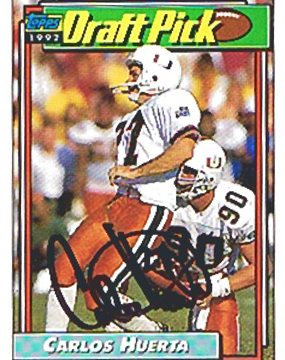
CarlosHuerta9
pC: On punt returns?
CH: Yeah, punt returns those are basically the same guys covering punts. So Darrin Smith was an absolute freak of nature because he was so fast. Darryl Williams, the safety, was amazing. There were some younger players that amazed me talent-wise that maybe aren’t as great in everybody’s mind but, Horace Copeland was such a freak of nature so fast, so strong. Chris T. Jones was amazing, Steve McGuiire before his knee injury was phenomenal. Gino was a great quarterback but in terms of prototype college quarterback for me, Walsh was incredible, he just always made the right decisions.

pC: He didn’t have the strongest arm but.
CH: Right and that’s probably why he didn’t start in the NFL for as long as he could have. We had some great running backs, I don’t feel I was a teammate of Melvin Bratton, I was a redshirt that year, and I was only with him for that season, but he was incredible to see play. One of my roommates that blew out his knee and later never started as much but in practice as a linebacker was one of the most amazing players I ever saw was Matt Britton. He was number 99, he ended up backing up Michael Barrow and playing a lot when they played the four linebackers. He just wasn’t the same after his knee injury but what he would do in practice, he would just terrorize the offense, and not just because he was my roommate. There were just so many players. To watch Brett Perriman and Randall Hill run they would look like they weren’t human, so I could just go on and on. There were just some really, really talented guys.

pC: Who were you closest with? Your best friends?
CH: I’d say Mario Cristobal, Matt Britton were probably my two closest friends, we were roommates and Eric Miller.

pC: Any coaches you still talk to?
CH: Rob Chudzinski, he’s a coach now, he was my teammate. I’m still real close with him. He’s out west. I speak with him. You know, I run into Jimmy Johnson here and there, it’s not like I call him up on the phone but its really good to see him during our functions, but there aren’t many of them that I really call up on the phone, but I actually was thinking about giving Dennis Erickson a call recently.

pC: You played under Jimmy and Dennis. Jimmy is the fiery type and kept everybody in line and Dennis is perceived as kind of loose and let the players run the show. Many people say Dennis was given the keys to the Porsche told not to wreck it. Talk about that difference and was it as a loose as it’s portrayed under Dennis?
CH: That’s a good question. When I think back on those two coaches, they are extremely different, no doubt. I kind of think of Jimmy Johnson as a more defensive and special teams kind of coach. He always preached to win all three phases and we were really good at winning all three phases when he was here and he really monitored those two aspects of the game. It seems like he really didn’t touch the offense at all that was Gary Stevens’ domain. It was a brilliant thing to do because Gary Stevens was a great offensive coordinator. Jimmy was brilliant for doing that and letting the right guy do that yet I think after that Penn State loss, which I was just a fan I wasn’t on the team, I don’t know how he was before that but Jimmy Johnson just would not let you breathe on special teams if you weren’t doing it right. I think we had the best special teams in the country. I think that Penn State game was lost not because of Vinny Testaverde. I think they got whipped on special teams. Granted Vinny did not have his usual game, but if they would have played well on special teams, they still would have won that game and Johnson was a fanatic about it and it showed on the field, we were phenomenal.

Dennis was an offensive genius. He really was great on offense and again he was also pretty smart in letting Sonny Lubick run the defense. He was a really good defensive coordinator and he kind of let him do that and we had an amazing defense. My senior year we were number one in the country and it wasn’t because of Dennis, I mean he oversaw it, but he let the right guy run it. So in terms of giving the keys to the Porsche, I’ve heard that statement too, I think that’s probably true. While I was here with Dennis, did we have some problems and issues? Yeah, we had some disciplinary issues, we did some things that were incorrect but on the field I thought that we were a disciplined football team. I think that a lot of the players at the time were Johnsons’ and we had been educated under that system and we were a well oiled machine but you’ve got to give Erickson credit for not coming and putting in a different oil and ruining the engine. I mean you’ve got to give him the credit. They were polar opposites in style and method though. I thought they both worked, I considered Johnson one of the most influential people I’ve ever been exposed to though. He is a genius in a lot of ways and an incredible talent. Dennis I think did an amazing job, but Johnson I think was just an incredibly talented guy.
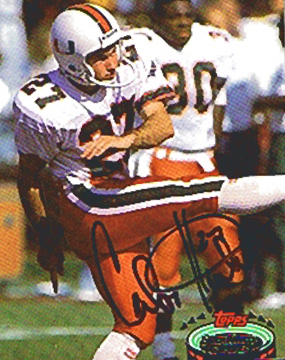
CarlosHuerta10
pC: So were you one of the players actively asking for Gary Stevens after Jimmy Johnson left?
CH: Yes.

pC: Talk a little bit about that. Was it a group of players that went to then Athletic Director Sam Jankovich’s office?
CH: You know I didn’t do that, I think there was a group that did that, but I was definitely vocal in the local newspapers and in interviews. I was once referred to as the team spokesperson, which I don’t think I was, but I was really lobbying for Gary Stevens. Gary had proven himself as offensive coordinator and we wanted him he was our own guy.

pC: Why the number 27?
CH: Do you know that story?

pC: No
CH: Oh. That’s pretty funny. For me it is. Johnson’s management style was that he really kind of kept you guessing lots of times. Now it’s less, but we had like 95 scholarship players and we had like 18 substantial walk-ons. So we’re already over 110. So I was just this walk-on that nobody expected to ever do anything, so I didn’t have a number. Our largest offensive lineman was 6’9 and he moved to tightend for the Oklahoma game because he was going to be a special blocker as a dual tightend and so they gave me his jersey, 6 foot 9, 300 pound guy’s jersey. I wore that jersey at that Orange Bowl and it was beyond a long sleeve shirt. Well, I tucked it in, I think they ripped the name off the back so I wasn’t Schaffer, but I was number 78. So I never really had a number, I was a piece of garbage. So I told you that whole story about how I got a little bit of a shot during spring and Kim and I competed for the job and I didn’t even know I was going to be the starting kicker. I had my head down, showing up to work everyday doing the best I could, none of the coaches ever told me I was going to be the starting kicker.

pC: Until when?
CH: None of them ever did! So we had our orange and white game and I had a very good scrimmage and Edgar’s leg was done, he could barely kick and he didn’t. It was starting to get close to the time where the coaches would pin down all our starters so I’m optimistic and hoping I get the job. Jimmy Johnson’s office used to be where the academic offices are now and I was walking by his office and I never really wanted to hang out by his office, I needed to go by his office because I had to get to a meeting or something and he saw me flying by and he yelled at me and he said ‘hey Carlos!’ and I went and took a couple of steps back and said “yeah coach.” He says ‘you did really well last night’ and I said, “ok thanks I felt pretty good.” I missed the 55-yarder by a little bit and said “I wish I would have got the 55-yarder but thanks” and that was it. So I think there were five days before the Florida State game and I think the next morning or something Rich Davenport who I think is still with the Dallas Cowboys asks me to go do an interview. I was in his office and he says ‘here, by the way, here’s your jersey. You’re number 27.’ Not ‘hey you’re playing in the game’ but I didn’t want to ask the question because if you’re doing well you just want to act like you are the guy, so I kind of looked up at him and Rich was always great to me, he really looked out for me I thought, and he’s a great guy. I remember he was standing and I was sitting and I kind of looked up and go “I don’t even get a chance to choose a number?” and he says ‘nope, because the only other number left is number 55 and its just way too big for you, so you’re number 27.’ And that’s how I found out I was playing in the game. It was obviously a really, really huge moment for me, I wanted that job and worked really hard for it.

pC: And you kept the number. I’m sure maybe you could have changed it later on if you had a choice?
CH: Remember, I was very superstitious my first two years, I wasn’t about to change that number, it was working! [Laughter]

pC: Were you an All-American your senior and your junior years?
CH: As a freshman I was a freshman All-American and then sophomore and junior I was either honorable mention or third team or something. Then my senior year I think I was consensus All-American. I’m pretty sure, but yeah I was Walter Camp, and AP and Kodak which I think at the time were the All-American teams.

pC: Did you have a nickname?
CH: Just ‘The Ice Man.’ Still to this day, it stuck. I mean I don’t think they would all call me that but yeah, my high school coach gave me that name.

pC: What would you say was the toughest place to play?
CH: The toughest place to kick in terms of conditions that I ever played in was Missouri because I remember there were 40 something mile an hour winds coming off the plains and you just didn’t know what the ball was going to do. You could kick it perfectly and totally miss or kick it kind of bad and the wind would carry it in. In terms of stadiums, and irritating crowds, I’d say Florida State and Notre Dame are rough, really rough.

pC: Would they taunt you a lot?
CH: Oh everybody would. I mean they were just right on top of you. The screaming and the yelling right on top of you because once they get a little bit of distance from you it all kind of sounds the same but it was just a real tight stadium and they kind of get in your ear and you can hear what they’re saying.

pC: Who would you say was the most influential person in developing your kicking game specifically?
CH: I never had a coach in kicking. Nobody really worked with me technically. I was just a soccer player that knew how to kick.

pC: No formal training?
CH: Zero.

pC: I thought they got special outside coaches?
CH: They do, but on most staffs there are no knowledgeable kicking personnel. They’re just on their own. ‘Hey you’re good, you’re talented, you figure it out.’ But I never had a technical kicking conversation with my high school coach, or Jimmy Johnson, or my special teams coach. You know maybe the special teams coach at the time might have noticed my plant foot might have gone too far and pointed something out every once in a while but no one really ever coached me in that regard. I practiced a lot and I had a natural stroke. I could kick a ball at 6 years old further than most 13 year olds. It wasn’t that I was strong I just had technique, like I said I played soccer every season since I was seven years old and I’d always take the free kicks and just knew how to do it. My high school coach really taught me the mental aspect of kicking and whatever he did worked. He put me in game-like situations everyday and Jimmy Johnson did the same thing and that’s the key because if you don’t make it like a game-like situation, you get into a game and it’s very different. It’s like shooting darts or being out there in war and having to kill somebody is different, you know it’s not that extreme, but kind of. Anybody can leisurely go out and just kick the ball but everybody’s rushing at you and you’ve got to get it off real fast and you’re dealing with the movement of the ball from the holder, the intensity and then a real line jumping up to try and block your kick where you’ve got to get accustomed to getting it up quickly or if not, you’re going to get stuffed. So what they did in practice in making everybody work really hard and making sure that the line wasn’t taking reps off during field goal drills, that really made a big difference
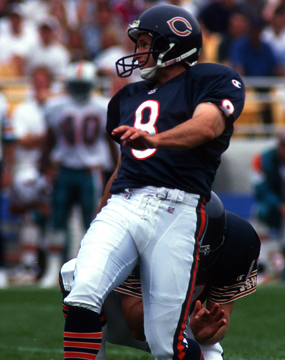
CarlosHuerta5
pC: What would you say was the toughest transition for you going professional? I would imagine kicking is the same anywhere you do it.
CH: Yeah, you know a lot of people say that the ball is different and it doesn’t have stripes versus it having stripes.

pC: Isn’t it a little bigger?
CH: The ball is slightly different but it doesn’t affect the kick to me at all. It weighs the same, it feels the same. Again it was that transition of being in such a well run top program and all the pro franchises are not and dealing with the different management and how things are run. When it runs poorly that trickles down to every phase of the game, the players, their attitude and I felt like in the NFL or at least when I was there, a lot of these coaching staffs [were not very impressive] except Marv Leevy’s. Marv Leevy’s team was impressive. He had been there for so long, his coaching staff was excellent, he was excellent. I would have loved to have made that team because of him, but I felt like on the other teams I was on, everyone was either so paranoid to lose their job that they were so stressed out that it was unhealthy, it was an unhealthy mental environment and it was counterproductive to being a really top performer. So that was pretty tough because everybody around you is on edge, it’s almost like they assume the worst and that’s not a good environment.

pC: It just seems that it’s more of a business.
CH: Yeah, we felt it was a business in college but maybe it’s more, it’s just more pressure you know? I think the fact that there’s a mentality that the pros are being paid and its okay to rag on them and boo them, not that you don’t get ragged on as a college player, but I think there’s more empathy from the fans and the media when you’re just a college kid and not being paid. People don’t get on you as much; I think that does kind of add to the tension you know.

pC: Did you have any other Hurricane teammates when you were with the Bears?
CH: Pat Riley. I think that was it.

pC: Talk about the whole U family. It sounds like you stay well connected. Talk about that bond.
CH: Well we said back then that playing here and being a part of this program may be the most fortunate and best opportunity that we ever would have in our lives. To be a part of a number one program in anything, especially something that you care about and work at, you consider yourself really fortunate and I think that there was some tension at times and everything didn’t always go smoothly but once you get to a level where you’re performing that well and things go that well and you’re that successful, you form bonds that last forever and I think that’s the way it is. We all knew that pushing each other would lead to great success and we knew how to push each other’s buttons for the most part in the right way and it was just a unique situation that I don’t think many of us ever experienced again. You know I think Jimmy Johnson did it with the Dallas Cowboys and I was lucky enough to do it in the Canadian League but it was only for one year and then the team was broken up. We had you five years of continuous success. Those bonds you form, the people that you end up trusting those times usually its something that you don’t lose and that’s the way we are and even those older players that I didn’t play with when they see me they remember me and they know that I affected things positively. You just don’t let that go.

pC: Would you come back soon after you left? Would you help your successor Dane Pruitt?
CH: A lot. I worked with Dane quite a bit. I got cut and I was living here. I was still training because I was still getting tryouts and workouts quite frequently and then signing again so I was taking my workouts really seriously, I would work out in the gym too.

pC: At UM?
CH: Yeah they’d let me workout there, I’d use their fields. The equipment manager would let me use the balls still and I would work with Dane quite a bit, not necessarily during their practice because that was an NCAA violation. I couldn’t go out there and practice but on his off-time, or we’d even meet and go over concepts. Dane was smart and he did a pretty good job, it’s not like he needed me. There was one point where they changed the blocking line and the scheme and did some things differently and that kind of threw his momentum off, but he had a really good career all in all.

pC: He obviously had some pretty big shoes to fill in yours but he did pretty well.
CH: He did. I remember his junior year he missed one field goal all year and he was 3rd team All-American so he did really well.

pC: What do you think about the last couple of years of Hurricane football?
CH: I don’t know if it’s on the right track or going back up. I don’t know enough, but it definitely is much, much better. For the first season in a long time as a fan now and watching, it was exciting to watch them play and you had hope that when they needed to score, Jacory Harris could get it done. I mean they’re explosive, they’re a little young and maybe made a few mistakes that next year they won’t make, but it was exciting to watch them and you had hope. In prior years I don’t know what happened with the offense. It was just so stagnant. I think that the reason they may have dropped off a bit was I kind of felt they had such amazing success with Butch and Larry Coker and then that game against Ohio State, which I still think they got hosed on the call, but they were a great, great team. I think they just kind of rested on their laurels a little bit and stopped working, stopped looking to be that great team. I think they thought ‘hey we’re so good now, we just are on automatic pilot’ and I think that caught up with them.
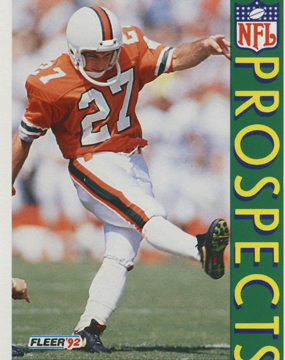
CarlosHuerta11
Word Asssociations: give me the first thing that pops in your head when you read the following:
Jimmy Johnson: Flawless
Larry Coker: I didn’t know him that well. Classy
Orange Bowl: Mythical
Dennis Erickson: High Scoring
The Ibis: John Routh? John Routh was the best mascot I’ve ever seen. Yeah he was the best
Art Kehoe: Hilarious
The Fiesta Bowl: Motivating
Ohio State: Over achievers
The Sugar Bowl: Which one? We were national champs but people don’t think about that for some reason, everyone thinks of the George Teague one. But I don’t think of that one, I think of the one we won. I want to say trailblazing and the reason I say that, I mean Erickson came in his first year and we won a National Championship, who does that?
Dolphin Stadium, or Landshark Stadium:Jimmy Buffet

pC: Have you been to a game there yet?
CH: No, no I didn’t go all season.

pC: What do you think about that, what do you think about the move from the Orange Bowl?
CH: Financially I’m sure it’s the right decision, but it will never be the same. You can’t create what was at the Orange Bowl. So ultimately, I don’t think that we will have the same success because going to play at that Orange Bowl for opposing teams was awful. We just had such a huge, huge advantage I thought.

pC: Your Favorite NFL team?
CH: I don’t really have one. I mean I follow the NFL, I don’t root for anybody. I’m fascinated with the successful programs. I know the Steelers weren’t great this year but I like that [Chuck] Noll, [Bill] Cowher, [Mike] Tomlin, how the franchise stands behind them, supports them and each of them has won a Super Bowl. There’s something in those organizations and obviously the Patriots are up there every year, you’re not going to win every year, but I’m fascinated by that.

pC: The NBA? Any particular affinity toward that league?
CH: Although I think LeBron James is almost at or will be almost at a Michael Jordan level, the most exciting thing about the NBA to me is Dwayne Wade.

pC: Favorite food?
CH: Ice cream, that’s easy.

pC: What band or group or music would we be most likely to find on your Ipod?
CH: The Beatles

pC: What movie could you watch over and over?
CH: Stripes.

pC: TV show you can’t miss?
CH: It was Seinfeld.

pC: What do you do in your spare time?
CH: Work.

pC: Two websites you have to check daily?
CH: Daily? I don’t have that.

pC: I think we’ve covered everything. Thank you for this.
CH: My pleasure, I like reliving the old days.

We at proCanes.com would like to thank Carlos Huerta for being so gracious with his time to do this very insightful interview for our new feature "Tracking proCanes." Click here to check out our past interviews with Leon Searcy, Steve Walsh, Frank Costa, John Routh, Chad Wilson, Mike Rumph and more! Click here to read Part I of our EXCLUSIVE interview with Carlos Huerta.

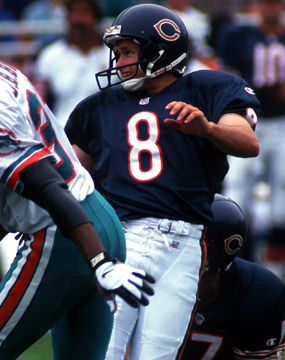
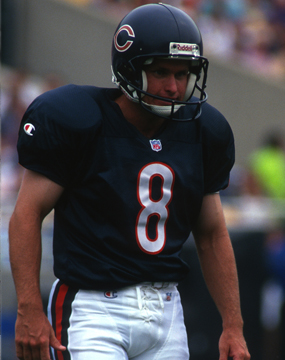
We would like to thank JC Ridley of www.caneshooter.com and dailycaneshooter.blogspot.com for providing us with Carlos Huerta's Chicago Bears photos.

Click here to order Carlos Huerta's proCane Rookie Card.


Bookmark and Share

Tracking proCanes - Carlos Huerta - Part I

TrackingproCanes

proCanes.com is continuing our “Tracking proCanes” feature with former University of Miami, Chicago Bear, Las Vegas Posse and AFL kicker Carlos Huerta. Huerta, the starting kicker on Miami's 1991 National Championship team, emerged as a walk-on and became a consensus All-American and First-Team All-BIG EAST selection. Huerta, who later played with the San Diego Chargers and Chicago Bears, established an NCAA record with his 157 consecutive point after attempts (PATs) during his career as a four-year starter (1988-91). He ranks second on the NCAAs all-time scoring list with 397 career points, including 73 field goals. Additionally, Huerta still holds Miami records for career PATs, career field goals, career points, the top three records for consecutive PATs in a season, the top four records for field goals in a season, the top three records for points scored kicking in a season and field goals in a game. During his four years as a starter Huerta led the team in scoring each season. His foot was a significant reason in historic victories, such as hitting a field goal with 43 seconds remaining to give UM the 31-30 edge over the Michigan Wolverines in Ann Arbor in 1988. Huerta also hit game-winning field goals over Arkansas in 1988 and Michigan State in 1989.

CarlosHuerta4
After playing his college football at the University of Miami, Huerta joined the Las Vegas Posse, a Canadian Football League expansion franchise. He was one of the lone bright lights, kicking 38 of 46 field goal attempts and scoring 154 points, and winning the Jackie Parker Trophy, which was good for runner up for the CFL's Most Outstanding Rookie Award. After Las Vegas folded he moved to the Baltimore Stallions, where he hit 57 of 72 field goals and scored 228 points, and was part of their 1995 Grey Cup championship season.

The National Football League followed in 1996 and 1997. Huerta played 3 games with the Chicago Bears in 96, hitting 4 of 7 field goals, and one game with the St. Louis Rams in 1997, scoring 2 converts.

From 1998 to 2001 he played in the Arena Football League, with the Florida Bobcats in 1998 and the remainder with the San Jose SaberCats. He would connect on 37 of 85 field goals in the AFL. Also in 1998, Huerta appeared in a playoff game with the Toronto Argonauts of the Canadian Football League.

proCanes.com: Let’s first give an idea to proCanes.com fans as to what you are doing in Las Vegas.
Carlos Huerta: I have a real estate and development investment company. I’m also a licensed real estate broker, but I don’t really broker real estate for commissions more so for trading them and buying them for portfolio or investment for future sale or income. Most of my investors are from Israel and I do have investors in the US as well. I’ve been living in Vegas since 1994 and have had my real estate company for a little over 14 years.

pC: How did you get into real estate?
CH: I always wanted to get into real estate since I was in college or before and when I was in the MBA program at the University of Miami, I was still playing football, but I was kind of looking at a future career and I knew that the west was where the growth was and knew that they needed finance people. I have a finance background so I kind of went out there with a mission to get into that.

pC: So you grew up in Coral Gables?
CH: No, I wish. Coral Gables is one of my favorite places in the world. I love it here. I was born in South Miami hospital, but before I turned one [years old] my father started a business in central Florida so we moved to Orlando and lived there for 11 years and then we moved back after he got a job offer here. I went to junior high, high school and college here so I mean I partly grew up here, obviously throughout my five years at UM and one year we lived in Coral Gables before I went to UM. I went to Christopher Columbus high school and Belen before that. So 7th, 8th and 9th grades, I went to Belen and then Columbus after that.

CarlosHuerta1
pC: So were you always a Miami Hurricane fan growing up?
CH: I became a huge Hurricane fan when we moved back and that was the Jim Kelly era. I started getting into that and then when Kosar came in, I was an off the chart Hurricanes fan and would go to the Orange Bowl for games. I liked to sit in the student section and do that whole thing. I would sneak down there when I was in high school, it was just off the charts. Prior to that when we lived in central Florida, believe it or not, I was kind of a Seminole fan because we had the Bobby Bowden show and they were pretty good and I didn’t really know about the Hurricanes actually. I was a Dolphin fan always and then an FSU fan but when we moved here for junior high I started becoming a huge Hurricane fan. So, when I was in high school I played some football as a kicker, I really didn’t play any other position. I was playing soccer and I actually thought I was going to go and be a soccer player in college and I had some scholarship offers but none in football and my soccer coach, who I respected a lot and kind of looked out for me, suggested I try to go play football in college. He was kind of saying; ‘hey you’re not good enough in soccer.’ [Laughter] Actually I got hurt a lot, I just kept getting my ankles hurt, so I kind of took his advice and I considered a bunch of different schools. I was kind of a recruited walk-on from a bunch of different schools; Oklahoma State, Tulane, Colgate. I just said, if I’m going to play and I’m going to make the sacrifice and have to pay for school and be a walk-on, I might as well go for the gusto. If I play, I only want to play for UM which ended being the best decision I ever made. But it was a naive and dumb decision. Dumb. Dumb. I was naïve and young because I really was very, very fortunate that I even ever had a shot to play here.

pC: How did that happen?
CH: I was a walk-on. I was on the scout team. I used to have to run plays and call plays and I felt like a slave my first year. I would get beat up on by the lineman in drills and they outweighed me by over 100 lbs. It was crazy and I never dealt with that before so that first year I was a redshirt. Our kicker in Miami was a second team All-American. Greg Cox. He had a phenomenal season and no one was going to beat him out and it was not even a consideration. So, it was kind of like pay your dues, hang out, and maybe next year you’ll get a shot. I did that kind of reluctantly, I wanted to quit like three times. I think one time I was so pissed I didn’t come to practice.

pC: Were you the scout team quarterback?
CH: No they just used bodies for drills. They make you run plays against their…

pC: First team defense [Laughter]
CH: Yeah and I used to have to hold up chains for the first down marker. When Gary Stevens was doing his offensive play calling and scrimmaging during the practices they would want someone to speak into the microphone and record what the play was on microphone before the play so that when they’re watching video someone would be saying this is whatever play. I used to have to do that every drill and Gary Stevens was a hard ass, so he wanted you to do it into the mic and he wanted all the players who were not in the play to know what the play was so they could track it. So, he’d want you to go up and tell them what the play was, but they’re standing the width of the field, 63 yards, and you’re having to go tell them all but then if you said it too loud he’d yell at you because he didn’t want the defense to hear what it was so that they could stump the play. So, sometimes you’d kind of be in a hurry and you’d have to go say it and you’d say it too loud and he’d curse at you ‘don’t say it so loud!’ There would be times when I was just so mad from being told what to do. I had a huge chip on my shoulder and I just wanted to go out there and kick but I couldn’t, so I had to deal with that. The only times I could actually practice kicking was when everybody went inside then they’d give me the balls so I could kick and practice.

pC: So you didn’t practice the whole season?
CH: The whole season, never. Ever, I mean a little bit during two-a-days because they would give everybody a try but no one is really paying attention unless you’re the starting kicker.

CarlosHuerta6
pC: So that was the first year?
CH: That was my redshirt season which was 1987 and they were National Champs and undefeated. So it was a phenomenal team and season. After that season there were three kickers on scholarship. One of them which came from Ft. Lauderdale Eli high school, Sum Kim was his name, and he was the scholarship guy and the heir apparent to Greg Cox. He was very talented and had a strong leg and everything and really wanted to play football and was really into it. He had received a scholarship by Miami after he had hurt his knee playing soccer and had a reconstructive knee surgery. He was still really good in high school went to the surgery and passed all the tests and they said his knee had fully recovered. The first season during our redshirt season he was fine and kicking well but something happened toward the end of that year where his knee started to get really aggravated again so come spring ball, I don’t even think he was able to kick or he was half of what he was, so now they were kind of looking. There was still another scholarship kicker they had brought in and they had a returning kicker who was earning a scholarship who was the kickoff specialist who was a really good kicker as well. So, when Kim kind of started hurting, they kind of started giving me a shot to compete with the other guy and it ended up that I ended up battling it out with the kick off specialist and it was probably the hardest thing I ever did in my life.

pC: Who was that?
CH: Edgar Benes. He had an extremely strong leg. He could kick the ball a lot further than I could especially on kickoffs, but I worked real hard, I was very intense and I kind of convinced Coach Johnson one day to give me a chance because I felt they would kind of look at me, but not really give me a chance. You know I was undersized, Cuban, not on scholarship, they don’t want to give up a scholarship kid for a walk-on, it doesn’t make business sense and then they didn’t want to have to give me a scholarship on top of that. I kind of convinced him to give me a shot. I got in his face one day and nobody really did that, and I think he was kind of impressed by that and so he nodded kind of with this nervous chuckling nod and said ‘okay I’ll put you in’ because I think he kind of thought he would call me on my bluff. He put me in during a scrimmage and I did really well in the scrimmage and everybody kind of got excited and from that day forward I wasn’t the favorite or anything in spring ball, but now they started giving me looks. Come two-a-day practices before the season they needed to find a kicker, our opening game was against number one ranked Florida State. We started competing for the job and it became very clear then that Kim could not even kick. I don’t even think he could even make it out to the field; his knee was pretty much done, so I ended competing against Edgar. I ended up getting in really, really, really good shape that off-season and the competition was so intense that it was almost a war of attrition. Whoever’s leg gave out on him first lost and I got with the training staff to help me a lot and I just was able to last longer than he was.

Everybody kind of laughs at kickers and I know all the jokes, but you really can compare it to a professional pitcher or a college pitcher that can only pitch a certain amount of pitches. Well they don’t have that concept for kickers even though it’s the same thing because your hip joint takes all the abuse and it’s only got a certain amount of tendons and ligaments that can handle it. Edgar was really competitive so his leg just tired out on him and mine was kind of like rubber at that point, and I could just keep going. I really credit Jimmy Johnson, though. I think I owe him my career. He taught me how to really focus, which was crucial for what I did later on as the field goal kicker because I was a four-year starter. He was so determined to have the best guy out on the field where he was willing to even give the walk-on the job, reluctantly, but he was willing to do it. Other coaches wouldn’t even look at you, so I really respect him for that and I kind of owe him my career

pC: So, you did kickoffs and field goals or did they keep Edgar on as the kick off specialist that first year?
CH: As a redshirt freshman I only did field goals and extra points and Edgar still did the kickoffs. He did very well. He went on to law school and then the next year I did everything.

CarlosHuerta7
pC: Is that a lot more difficult? In those days we were scoring a lot more points so it adds a lot and tires your leg out more doesn’t it?
CH: Yes it taxed me. I’m not that big and strong to begin with so I had to really use all the power or strength I could muster to kind of be adequate, so it’s tough and then it’s a bit different because field goals you’re really kicking for accuracy. I know it’s still kicking but it really is kind of a different motion unless you’re so strong. You know, NFL kickers today are 6 feet 6’2 [tall], one guy is 6’5. They’re extremely powerful but unless you can go to the ball like those guys can, where they just go into it easy and can make a 50 yard field goal without blinking, it s not that easy to do . It’s harder than it looks.

pC: You look at a guy like Matt Bosher, currently UM’s kicker, who does everything. That’s got to be really hard especially because punting is totally different, right?
CH: Oh, way different. And one negatively affects the other. Punting actually hurts your kicking. The motion is so different and it’s kind of muscle memory and its still similar enough where I think there are times when you actually go to kick and your muscle takes over and you do a punt and you could absolutely blow your kick. It takes a whole lot of dedication, concentration, focus and talent to be able to go out there and effectively do all three of those things. He’s a very strong kid, he’s very talented and yeah it requires a unique guy to be able to do all that and at the same time you’ve got to avoid injury because one little pull of a muscle, you lose everything. I mean if it’s the wrong muscle you can’t do anything.

pC: So the kicker situation had to be pretty bad for them since it’s so difficult for a kicker to do all three.
CH: Either that or he’s that good. I mean the guy was the MVP of the team last year.

pC: You think he could make it in the pros?
CH: Yes, I think he’s prototype. One of the things that the pro scouts used to say about me is that I was too small. You wouldn’t think that’s an issue but it is for them. He definitely has the size and the strength and now the resume. You know he’s not an NFL kicker yet but he’s got the right resume to get those kinds of looks. I actually am banking on him being a pro.

pC: Have you talked to him?
CH: Minimally. If I see him I do. Every once in a while I’ll email him. I haven’t this season actually, but he doesn’t need much help, I don’t think. Yeah I might mess him up, so I stay away from him.

pC: Are you superstitious or were you superstitious because a lot of times they say how superstitious kickers are? Did you have a certain ritual a cross?
CH: No, not a cross guy. No, I’m Cuban and a catholic, but no. Well first of all I learned later on after my UM career, that rituals are actually a very good thing and they’re recommended by the top sports psychologists. So, ritual is one thing, it’s different from superstition. As a freshman and sophomore I would say I was ritualistic and superstitious as much as anybody. Like I didn’t want to step on white lines or I had all kinds of crazy things. I also felt balancing was important, so if I did something with my left hand, I had to do it with my right hand or my energy would be thrown and then I started to realize or somebody pointed out how I was and I thought this is really ridiculous, I’ve got to get over this stuff! My last couple of years, I was obviously having success on the field, so I had a little bit more confidence and I started to make a point that I was going to rid myself [of the superstitions]. I made a point to try and get rid of every single superstition I had and it was kind of tough, but in a way I kind of enjoyed it and took it up as a personal challenge. I said I’m going to stay in good shape, I’m going to kick well and I’m not going to be superstitious anymore. So I rid myself of those and it was kind of fun actually.

pC: And you started rituals instead?
CH: No, not really but I mean I think athletes and especially lets say a kicker or quarterback that has to do the same motion again and again they actually recommend that you get in the same habits so it becomes the same to you and you take every situation [the same] and keep it as close to the same as they can. Obviously if it’s very windy or if it’s very cold outside you’re going to have to make an adjustment or if the field is slippery you might have to wear different shoes to get traction, so you can’t be in a bubble, but you want to keep it the same as much as possible. You want to warm up in the same way as you usually do so your body is used to it, so it’s all familiar. Familiarity is good, having been there before in your mind increases your confidence which normally increases your peak performance so all those things are considered very prudent things. So, I started getting into those things and then I got into sports psychology, not for a career, but learning about it and I read some books and one specific book made a huge impact on my performance. I didn’t read it till after I left college but it took me to a whole other level kicking wise when I was playing in the pros and it was amazing.

CarlosHuerta8
pC: In what way? How did it take you to another level? Not physically right?
CH: Even physically. Both. The book was written by a PhD but he was also a pro tennis player before that. The book’s concept is for an athlete to reach peak performance. It was recommended to me by a friend of mine. I didn’t even know about it and then I’ve since recommended it to other people. It breaks away the accepted schools of thought on a lot of things you take for granted growing up; that all coaches are correct, a lot of them are really crazy and it validated a lot of the right things to do and what to focus on.

One really interesting concept to me is the ability to be graceful under pressure or to be clutch as people call it. Well, my high school coach started calling me the ‘Ice Man’ because I did well under pressure but then that kind of became something that I kind of believed myself and other people started to know and started taking that for granted saying ‘the guy is good under pressure’ and so I said “okay I’m good under pressure” and started thinking that and normally I was. Well, the thing that a lot of people will say is you’re born with that and I also believe that. So, I was experiencing success and I accepted this school of thought, but I started learning in this book that that’s the furthest thing from the truth. You actually learn how to be good under pressure. And it turns out that I had experiences in my athletic career that taught me how to deal with it and how to channel it properly, it wasn’t that I was born with it. So, that was I guess one of my talents that I did perform well in really important situations not that I was such a talented athlete or an amazingly strong leg kicker but that was one of my attributes. I always had a strong leg, relatively speaking, so I took free kicks all the time in soccer when the game was on the line and I started learning how to do that and my high school coach was also really good and would train me in practice and put a lot of pressure on me so by the time you got to the game the game was easy compared to having some maniac yelling in your ear telling you he was going to cut you or kill you if you don’t make it.

Then I got here and Jimmy Johnson would do the same thing, the training was so intense he was screaming and yelling you need to make this kick or we’re going to lose the national championship. Every practice was intense but when I got out in the game and he was far away on the sideline; it was easy, he’s not screaming in my ear. It was something that was learned but actually learning about the fact that that’s actually something learned and then being able to take steps to practice it and be okay with it. So that took me to a whole other level performance wise but then the book also focused on that you can be the most cool cat in the world but if your fundamentals stink you’re going to stink, so I really started focusing more on my fundamentals and on my physical well being. I started learning that when my body fat was down and I was doing well in the weight room and I was doing my sprints [I would perform better]. My body was really toned and the ball really flew of my leg. I got to the CFL, well I first was cut a couple of times in the NFL and then I got to the CFL and especially on away games where we would go to opposing teams’ stadiums to practice, usually we’d practice after their walk through and the other team started stopping in shock to watch me kick in warm ups because I’d be kicking 60 and 65 yard field goals down the middle and here I am this 5’8 skinny guy, well I was a little muscular but overall I’m not a very big guy, and it was kind of a freak thing to watch. So I just really learned a lot and that book kind of did it applying the concepts and focusing on things that were only going to make me better at what I did. So I’m all into that.

pC: You were a clutch kicker, as they call it, so when you got into those situations, coaches would call a time out try and ice you, does that actually work?
CH: Let me ask you a question. If you’re in a physics class and your very advanced physics professor says look I need you to really analyze the theory of relativity and prove Einstein is wrong, would you rather have a day to do that or would you rather have 40 days?

pC: I’d take 40.
CH: If you’re going to make a game winning field goal against Notre Dame and it’s from a pretty good distance, would you rather have time to properly center yourself, take the right steps, make sure you’re aligned properly, make sure that your center is comfortable, and not off balance so he can center the ball back appropriately, that you’re holder is ready to take the ball? You always want more time.

That icing the kicker thing is the dumbest thing ever. But there aren’t any kickers who are head coaches and most of the coaches believe this false fallacy and they continue to do it and I just roll my eyes. If you’re a kicker that’s worth anything you want to be out there and be able to set up, make sure you’re understanding the wind, check you’re plant foot and make sure the grass isn’t going to give out from under you and other things. It’s just asinine.

pC: At least someone puts that to rest.
CH: Nobody will listen.

pC: I guess if you’re a current kicker you’d never admit to it because you want the opposing team to keep using timeouts.
CH: I hated to be rushed because then, it isn’t like you’re practice. You want to do it like the practice.

CarlosHuerta3
pC: What was the longest field goal you’ve ever made?
CH: In Canada I made a 59 yarder, in college a 54 yarder. In the NFL I think was like a 46 yarder or something. I didn’t play long in the NFL though.

pC: You were with the Bears and your stay with them ended in controversy. Talk about that.
CH: First of all Dave Wanstedt didn’t really know what he was doing when it came to special teams and he kind of screwed a lot of things up, but that’s a long story. The other controversy, I mean I was a good kicker I should have lasted longer than I did, but the other controversy was that the Bears in 1985 they won their Super Bowl. They are still legendary in that town and I took the place of Kevin Butler who was the last remaining Chicago Bear from the ‘85 Super Bowl and everybody loved ‘butthead.’ I took his job and they hated me because of it, even my teammates.

pC: So that must have made it pretty miserable for you.
CH: Yeah I hated going to work everyday.

pC: Obviously your performance isn’t going to be very good on game day either, or as good as it could be let’s say.
CH: At that point it was Adam Vinatieri’s first year. We all know what he became. I used to train with Vinatieri. He has a much stronger leg than I do, but at that time there was no comparison on who was more accurate. When we went on the field he might have the stronger leg but I would blow him away kick after kick. He was I think 2 for 7 and had missed 3 extra points and they didn’t cut him. I think I had missed 3 field goals no extra points, two of the field goals I’d made I shouldn’t have even kicked because the snap was so bad I had to stop mid stride on a 44-yard field goal I remember. Wanstedt had won the first game against the Cowboys and I kicked two field goals in the 4th quarter to kind of ice the game. It was Monday night football and they were Super Bowl champs. But then we lose two games and Wanstedt was the type of guy that when he was feeling the heat, he always found a scapegoat and I was the scapegoat for the week. Sometimes it was his quarterback and that’s what he was. But whatever, you don’t have much of a chance to make it, that was my chance. I then I played for the Rams and then never played again.

pC: Did you want to keep playing? Was it tough to stop?
CH: I wanted to keep playing. I went to the World League after that and went to the training camp with the Buffalo Bills and had a great training camp. But Steve Cristie was like an all-pro kicker, I didn’t make it. In my career I went up against John Carney, who still was kicking until this season till he was 45 years old, made it to the Pro Bowl a lot of times. I went up against Al Del Greco who when I was up against him, was probably kicking better than he ever has. Butler and then Steve Cristie and in the NFL there’s no back up kicker, you’re either a starter or you’re gone. So all these guys were really, really, great kickers and I just wasn’t in the right place at the right time and I’m not so talented where I can just show up and make the coaches say ‘wow I want this guy.’ I was just a guy that performed really steadily all the time. I think to this day I’m still the most accurate kicker in the history of the Canadian Football League. I did get hurt too.

pC: What did you injure?
CH: I injured my kicking leg and I didn’t quite come back until it was kind of too late. I wanted to keep playing but I got into a situation where I felt that I was in the best possible situation in college that anybody could actually dream of being in. It was my hometown, my favorite team, we were champs every other year and I was kind of a star player towards the end. I knew what success was. To go to some of these pro franchises and win three, four, five games and be under coaches who were not a Jimmy Johnson, not a Dennis Erickson and then the Canadian League, where we were Grey Cup Champions. They were so amazing to work under and I’d go to guys that weren’t that and think I don’t want to be here. I was spoiled. I’m not going to get to really perform like I should under theses guys, so I was kind of starting to try and look for the right situation where I could be under a coach that I felt was worth playing for but I wasn’t good enough to necessarily always get that opportunity. But it’s tough to take a step back like that.

We would like to thank JC Ridley of www.caneshooter.com and dailycaneshooter.blogspot.com for providing us with Carlos Huerta's Chicago Bears photos.

Click here to read Part II of our exclusive interview with Carlos Huerta to read what Huerta has to say about Coach Johnson and Coach Erickson, how he got the number 27, where he thought the toughest place to play was, what he thinks of the current state of Hurricane football and much more!

Click here to order Carlos Huerta's proCane Rookie Card.


Bookmark and Share

Tracking proCanes - Mike Rumph - Part II

TrackingproCanes

In Part II of our interview with Mike Rumph he talks about the differences between Coach Davis and Coach Coker, Terrell Owens, what the Hurricanes need to do to get back on top, "The U" Documentary and much more! Click here to read Part I of our EXCLUSIVE interview with Mike Rumph.

MikeRumphTracking7
proCanes: Talk about Butch Davis and Larry Coker as coaches. They say Butch was a disciplinarian and Larry was loose. Talk about that difference and was it that obvious of a difference between the two and did Larry have as much control as Butch?
Mike Rumph: The good thing that Coach Coker had was great assistants. When you’ve got great assistants you’re always going to look good and I think that really helped him. I think he did a good job when he came in. I was a senior he didn’t bother the seniors really, but he would get on the young guys and I think that’s smart. Just overall discipline of how things go kind of changed when Coker became the coach. We did a lot of initiations and stuff like that [with Butch Davis] but he came in and stopped it. I thought that was important because that made me and my class really close because we had to stick together. We had to earn our respect with the older guys and I think that’s very important, but it comes to a point when you’re getting too physical with the guys when there’s fights and stuff. It comes to a point where you don’t want injuries, but I think there’s still got to be something. You’ve got to make those freshman earn it. The freshmen felt like they didn’t have to earn it, they felt like I’ve already arrived I’m here and nobody will give them a bother. With Butch Davis though, he was like turning the other shoulder, like I don’t know what’s going on and in the meantime we were fighting for our lives in there. [Laughter]

pC: What sort of initiations?
MR: You had to shave your head. If you play slick and go home and shave it without us doing it they try to do your eyebrows so you’ve got to deal with that. We had to jump off the big platform diving board off the pool. One day we were out there stretching, it was two-a-days, hot, it was like day 10 and he’s like ‘hey go over there and take those pants off and go to the pool.’ We were like 'awe here we go again,' but we didn’t know they were going to make the freshman jump off the tallest diving boards and I’m afraid of heights! We had two guys that couldn’t swim and they had to jump anyways. Kenny Dangerfield and Anthony Fisher, they had to jump anyway and they had the lifeguard waiting for them at the bottom. Shaving your head, singing, sing at lunchtime. That’s as far as I can get into all that. But like taping your locker up, that’s one thing that got me as a freshman. You would practice and get a little break in between practice and you didn’t want to hang around so you would go somewhere else because if you stayed in the facilities there would be horsing around and you would get no rest and you might have to fight somebody, so you would disappear until five minutes before it’s time to go back to meeting. We would come in and five minutes before the meeting your locker has so much tape around your lock. So, you’re like oh shit, you don’t want to be late and you’re trying to undo this tape and they’re just dying laughing. Other times, five minutes before practice you come and get dressed and your helmet is missing and they’re like I don’t know and you’re the like last one in there and another guy in there says ‘you might want to check the ceiling’ and you go up and check and find your helmet there. Can you imagine that as a freshman? You don’t want to mess up, you don’t know nobody, you’re coming in and you’ve got this much tape (Rumph shows two inches of tape with his hand) on your lock and the meeting is in two minutes.

MikeRumphTracking8
pC: Did former players come back and train you?
MR: Ryan McNeill. Duane Starks. To this day I still get mentored by Duane. He’s a good business man too. But Duane Starks, we did a lot of drills together. Reggie [Wayne] and all of them always came back. Edgerrin is one of the guys who started all that stuff. I look at him as one of the god fathers of going through the probation years and then coming and being one of the first guys that started the first round draft pick streak. He was one of the first guys of being a first round pick and one of the first guys that said I’m not going work out at the combine. Why train in Indianapolis and go through the combine there when next week they are going to be doing the same thing in South Florida in the sun with the fans behind your back. So, we all decided were not going to work out up there and we’re going to train in Miami. Edgerrin was one of the first guys to do that, so I always look at him as one of the god fathers. He’s a really smart guy as business man and as a football player and most people don’t know that but he helped me understand how things were going to be as a junior and senior and what to look forward to. Al Blades too. He was a crazy guy but really emotional leader and the big brother on the team. You would always go to him if you had a problem because he had your back no matter what. He was a good guy to be on the field with because he intimidated a lot of the other players.

pC: He was one of my favorite players to come through “The U.”
MR: He was a great, hard hitter. Really pretty athletic guy. Understood the defense but really good on the motivation and intensity he brought to the game, like a Ray Lewis. When I went to the 49ers, Dorsey went there and Al Blades was there already and he had gotten so much better. I could just remember watching film and I was like “that’s Al?” His footwork was so much better. He got so much better being out there with the 49ers. He passed you know at such a young age.

pC: Why the number 8?
MR: I was 4 in high school. So I figured I was going to be 4 but it wasn’t available. Najeh [Davenport] had it. So I got 8.

pC: Any nicknames?
MR: When I was at UM, “eight ball.” When I played the 49ers they called me Old G. That’s because I was one of the oldest players in the locker room I was like 24.

pC: Really?
MR: 25 is old man!

MikeRumphTracking12
pC: You were drafted in '02 and you were the last Hurricane drafted in the 1st round. Talk about how a lot of people might call you a bust. You went through a lot of injuries and they tried to move you to safety. What was the hard part of transitioning and did you play as long as you would have liked?
MR: The tide changes in the NFL a lot just like the ocean. I was in a lot of rough tides. I went through three different coaches in the 49ers in the last four years and that’s tough even in the business. If you’re in the business and you got a new boss every year it’s hard to adapt and most new bosses want to bring in their own employees. I went from Mariucci and the playoffs. He got fired the day after the playoffs which was stupid. Then to Dennis Erickson for one year, then to Mike Nolan for two years and with Nolan he moved me to safety so I said, “great here we go I’m going to show you how I can play safety” and in the first day he moved me to safety I tore a ligament in my foot. So I came back a year later as a safety. I was jacking people up every game, I was player of the week, I was jacked up killing people as safety and he moved me back to corner. Right after that they traded me to the Redskins. I was upset but the Redskins just came off of second playoffs in ‘05 so I was like okay. I’m playing with Sean [Taylor], I’m playing with Rocky McIntosh, Santana [Moss], all my guys are there so I’m good. So when I went to the Redskins I had what’s called a cage locker. Its not a real locker it’s just a moveable one for guys that are not going to last. I had that locker, I had never had that being a first round pick, I never had a locker like that so I just took that to build my fire and I went out there and had one of the best pre-seasons of my team.

So right away I made a team, they brought me to replace Shawn Springs who was hurt but he came off his injury like midway through the season and they deactivated me right when he got healthy. That means you could watch but you can’t play. They deactivated me for six games. I had a knee bursa which means that there’s fluid in my knee but I had that week one and I played all seven games with that and my stats weren’t bad. I had good stats. I didn’t get scored on and that game he came back I got scored on with Peyton Manning and Marvin Harrison on a five yard slant for a touchdown. That’s the only time I got scored on the whole year. All the other guys got scored on every game and Shawn came back and they deactivated me, so after that I went to free agency as a guy who only played seven games in the season and people want to know why I only played that much. That was messed up. It’s hard to come home and explain to your son because he was like ‘why you not playing’ and whatever so it was kind of tough but then I went into free agency and I went to the Rams and that was one of the worst mistakes. That’s like leaving UM to go to Florida State.

pC: Did you have a choice?
MR: Yeah, but my agent was saying that’s the best position for me and the whole time he was the best agent but at the end it kind of faded away and he couldn’t get too much going for me. So I was just upset with the unloyalty of the league and jumping from team to team. I was always like I bleed for whatever team I’m on that’s my team. I hated moving around and I had to move my family like three times and my kids leaving school every few months. I just told myself I can make more money if I really work hard, I can make more money without football and as a business man instead. I really believe that. It’s taking me a little long but who knew that the recession was going to come up. I retired in ‘07 and the recession hit right there. So it was hard to start my puppy business and Play Fast in the middle of a recession.

MikeRumphTracking10
pC: Was it a hard transition to safety?
MR: It is. The change from corner safety is tough but what helped me is, being a corner I knew what I wanted my safety to do. I knew what I would like in my safety because I had some really good safeties playing with me so I instantly became that guy who I wanted my safeties to be; a communicator, and intimidator, a guy that could cover, a guy that could come up with plays against the run and that’s pretty much it as a safety. You could call all the plays but you’ve got to be thinking on the run but it wasn’t a hard transition for me because I played it. I had so much success I knew what I would want a safety to be. I never shut up. I was always talking. Watch this one, watch that one, when the motion comes they’re going to do this, when they switch covers and all that stuff. I was just constantly talking and that way we would always know what’s going on and we might be wrong but when we’re wrong everybody’s wrong not I’m wrong and you’re right. The communication aspect of it, that’s what I brought to the game and I think I didn’t have enough time as a safety because I told Reed, I always messed with Reed a lot saying "I’ll be a better safety than you in the league man." But he has really good hands. It wasn’t a bad transition for me at all and I shocked a lot of my teammates and a lot of my coaches how I came up and was really aggressive with the run.

pC: Who was one person that was influential in developing your game?
MR: I've got to say Nick Ward was the guy. I just couldn’t understand. I thought he was one of the best corners out there but I think he got into Butch Davis’ doghouse and they didn’t play him. In practice he was outstanding but in games it never really turned on in the games. But he was a guy that taught me a lot. Jeff Popovich was a guy who I trained with a lot my sophomore year that helped me improve. He was the guy where we worked out for two hours with Swasey and then I'd say "Jeff let’s do 30 more minutes of football drills" and he was like ‘let’s go!’ That same guy that Jeff was for me in college I had guys like that in high school. I always picked the guy that I knew they didn’t mind working. If I was going to work out, I was going to work out with the hardest worker, Delvin Brown. If I’m going to run sprints, I’m next to Santana. If I’m going against a receiver, I’m trying to go against the best, so I was always putting myself with people that were going to push me to the next level. Influential players Nate Webster, the tenacity, everybody knows Nate. Nate was an inspirational player, Al [Blades] was, Coach Pagano, Coach Shannon.

pC: Do you have any game day traditions? Songs?
MR: Yeah, Sade. That’s my girl. She’s like my girl that my wife don’t know, but she don’t know either. [Laughter] But that’s my favorite, man. As a corner you gotta manage the rah, rah, rah, to be really focused and calm. I would warm up real intense but when I got into the locker room right before the game I’d kinda put on my Sade and mellow out. Just relax and start really mentally focusing on my technique and how I’m going to place my receiver. I would listen to her, Sade’s greatest hits, and Lover’s Rock. When I got a little older Lover’s rock became my one and I’d play between tracks #2 thru #4 and I’d fall asleep sometimes in my locker. You know you’re so nervous and you’re just like already relaxing and you fall asleep. But that’s my girl before the game I always listen to her.

pC: What do you think is the biggest difference between playing in NFL and college?
MR: The overall speed of the game. People say the speed of the receiver or corner. I didn’t see a big difference because I had going up against a lot of talent but those offensive lineman and defensive lineman, they’re so fast and so agile . The first game in the NFL I see a lineman come in and I was like I’ll do a little move like this and the lineman did the same thing and I was like how’d he get me like that? Those big guys, they’re just so agile like that and those big guys as soon the quarter back says hut they’re already at you. You gotta learn to hit them low. When you hit them in the knees they have to fall anyway.

MikeRumphTracking13
pC: You were TO’s (Terrell Owens) teammate he wasn’t as crazy in San Francisco as when he went to the Eagles, and Cowboys. How was he as a teammate?
MR: TO was a good teammate. He’s great to have on your team. He has his circle of people who he really trusts, that he deals with on a daily basis and sometimes he may not let everybody in on his circle. He’s from a country town, grew up with his grandma just like me and I guess he just didn’t have a lot and once he got the money they say money doesn’t really change you it just brings out who you really are, so he was just like a damn country boy with an attitude and what people don’t understand is TO played under Jerry Rice and that’s where he gets that work ethic from. He has great work ethic but at the same time, I think he just talks himself out of a lot of money. If TO just shut up and played, he’d probably be one of the richest, best players in the league, but he talks his teammates and coaches under the bus sometimes and that just gets him into trouble. But this guy, he never worked out with us. He has his own little workout regimen. I call him a genetic freak. I saw a picture when he was 14, he looked the same. We’re all in the gym going hard and TO doesn’t work out or anything he’s just all ripped up. [Laughter]

pC: He tore up the locker room in Dallas, can one guy really do that?
MR: Yeah. TO would come in like, if the meeting is at 8 he would come in at 7:59 and I think he did that on purpose, like to say this is me. He would always be like I’m the last one, always the last one to come into meetings. He’ll be in practice and the quarterback might misthrow a ball and he’d be like ‘give me the damn ball! Get the ball to me!’ You’re like, man it’s not that serious you know? That’s the guy who’s going to help you make more money. Who’s going to help you with the longevity of the game. Why are you yelling at him? Talk to him and tell him what you want and he’ll get it to you. Be professional too. So I just think in those instances he could have been more diplomatic and he probably would have stuck with a team a lot longer. But he always had those days. Some days he was cool and some days he’s TO. Some days he’s Terrell some days he’s TO. But I can tell you one thing he was probably one of the hardest workers I played with in the NFL and the thing with him, he was always injured but he would go for like 8 weeks without practicing but every single week he would have 150 yards, 155 yards, 160 yards and it was like the most amazing thing. I’m seeing this guy never practice and he’s just putting up 100 yards every game, so I just think he’s probably one of the best receivers; if he just went out there and played.

pC: You think he was faking the injuries?
MR: No, I think he was injured and he had a whole medical staff come in and take care of him and stuff and San Francisco is just so much more advanced compared to other cities. As far as training-wise, so we had the best, I had acupuncture. I had an old lady 100 yeas old that would rub a special oil on my leg and my hamstring would be better in two days. They were so serious about the training. That’s the technology area so they got all the technology. But he had all his little teams flying in, his personal trainer and a guy that got his food to make sure he was eating the right food. I think if you’re eating right and living like that you’re going to have an advantage over most guys any day.

MikeRumphTracking16
pC: Going back to Hurricane football, the last few years the program has been down, why do you think it got like that, are we on the right track, do you think Randy is the right man?
MR: Great Question. Randy is the man.

pC: You think he can do it?
MR: In my heart I think he’s the guy because he reached out to a couple of former players and asked us stuff like how can he get more former players to be involved with the guys. He picked me, I was one out of five guys that he asked to go to that meeting to see how he can get things back on track. So I think he’s the guy being that he’s reaching out and trying to understand it. I think right now he’s still a young head coach and it’s tough trying to be the coordinator and the head coach. I know he has somebody with the title of defensive coordinator but you know who’s making those calls. I think that if he just simplified himself and just was the head coach, address the team, call timeouts, be the head coach and let your coordinators do their thing. Every once in a while be like 'hey run that blitz we did in practice,' but you need to get two good coordinators that are better than you are and you’re always going to look good. I think that’s what we’ve got to do. Butch Davis had a great staff, Coker had a great staff .

pC: Jimmy Johnson had the greatest staff
MR: And recruiting. Recruiting is so important. You’ve got to get your Florida guys and I think he believes in that. We were letting Louisville, West Virginia, Rutgers take all our players from down here and UM should be getting them man. I think we’re missing out on a few players like that. We should be in the top three recruiting classes every year. I think that’s one of the goals that we’ve got to set and then your seniors seeing that you've got good talent coming in this year they’ve got to be able to set the tone and groom these younger guys into something special. We’ve got to set our sights high we’ve got to know we’re going to a BCS bowl game this year. Without a doubt we’re going to a BCS bowl game and I think things are starting to turn around. They are start trusting him, I just hate that the season ended 9 and 4 instead of 10 and 3. 10 and 3 would have looked so much better.

pC: We were just manhandled against Wisconsin.
MR: They dominated every aspect of the game. We’ve got to get those big boys up front. Coach Shannon told me one time he’ll go anywhere for a defensive tackle , anywhere in the country, but everything else he’ll stay in Florida for. But we have to see that. Go get us a defensive tackle that’s going to help stop that run. My defensive line my senior year was so good we barely blitzed and until you get that, it’s hard to compete man. You’ve got to have that defense that’s going to set the tone. Defense wins championships.

pC: Why do you think the program went down the way it did?
MR: I just think recruiting took a hit. That whole Brock Berlin era. I love Brock, but that was just tough to swallow man because the whole look of the team really changed in that era and that was due to recruiting, due to the newness of the team and the new coaches, it takes time. See Miami fans want wins right now and that’s not going to happen. I heard it on the radio this morning. ‘Why do these guys keep switching coaches every two to three years?’ You’re not going to win like that and we went through so many coaches in the last few years we’ve got to get one guy and believe in him for at least five years and let him do what he can do. If you’re switching every two years you’re never going to have stability. It’s hard.

pC: Talk about Butch. Did he say I’m not going anywhere and then left for the Cleveland Browns?
MR: Yeah he said that and it bothered a lot of players, but it never really bothered me because I understood him. I just put myself in his shoes. I got kids and a family and somebody offered me 11 million dollars, I’m going to be gone too. I’m going to pack my bags up too. Now the way he did it? That wasn’t right. As a coach, you’ve got to have that leadership position and show yourself as a leader and he was saying with his words that he wasn’t going to go anywhere, but when it came down to it, those guys offered him that money and they offered him that job and his plans kind of changed but until the end he was being Butch Davis and being the leader of the team. What kind of coach is going to come in and say ‘oh I’m thinking about going to Cleveland.’ He can’t say that. That would have been worse. He was just playing the politics of it and he made a decision and went with it. I wasn’t mad at him but a lot of guys were pissed about that and I guess how it ties into the recruiting process and he left right before the recruiting process and it was in shambles because Pete Garcia wasn’t there. We took a hit because of that.

pC: The story goes that a bunch of seniors went to Paul Dee and told him to hire Larry Coker, because the rumors were that UM was looking at Barry Alvarez.
MR: Yeah. That didn’t sit good with us, that didn’t sit good in our mouth. We didn’t like the sound of him [Alvarez] coming in and we knew coach Coker and we felt like he could do it. So we vouched for him. I wasn’t the guy that went over there and talked to Paul Dee but we all pretty much said that’s how we felt. We didn’t want Alvarez we wanted Coach Coker somebody from our house.

MikeRumphTracking9
pC: As far as let’s say corners, why do you think we haven’t developed some good corners since you left other than maybe Antrel Rolle who is now a safety? Brandon Harris looks good, but what do you see in their development or lack of, when you watch them play. Does something jump out at you?
MR: I think they just don’t have a lot of pride and they’re not taking full pride in what Miami football should be. Is that the coaches job to get them like that? I don’t know. I can honestly say that all that stuff reflects on the coaches. As far as how the secondary is playing and how the defense is playing that’s a true reflection on the coaches and the coaches understand that, so I just think maybe they need to be more tenacious, intimidating, how Wisconsin played is how we should have played, they looked how we should’ve looked, when they were hitting our quarterback late and giving those hard hits on the sidelines, that’s UM football and I was getting excited at how they were playing but UM wasn’t playing like that. When they’re quarterback is falling they were easy on him, they were helping guys up and all that crap. I’m like you’re in war time like Kellen Winslow said. After the game I’m you’re best friend but during the game… They’ve got to get that tenacity back. When we were on the field we felt like we were going to intimidate those guys and we were going to make those guys quit. That’s how we felt when we came out the smoke, but I don’t know if they feel like that. They feel like oh we’re just playing a game of football. There’s more to it than that I think. I don’t know, I like the staff but like I said you better have people under you that are going to make you look like a good head coach and as a coordinator you’ve got to have some good assistants too, but it takes a while to get that stuff going together, to get to know each other and stuff, but I think to get it back, the coaches have to set goals for themselves and look at themselves in the mirror and say, ‘is this enough?’ ‘We’re not going to sit here and point fingers at these players, we’ve got to hold ourselves accountable and we’re not going to stop fighting until we win, we get to a BCS bowl game or win a National Championship. We’re not settling for a 9 and 4 [season] no more. They’ve got to take that attitude to the players and that attitude the players will pick it up because that’s what young guys want, they want that, but you’ve got to instill that in them.

pC: You mention running out of the smoke. You ran out of the smoke in the Orange Bowl. Now we’re playing at, this week it’s called Land Shark stadium. What do you think of that move?
MR: I get chills right now when I think about coming out of the smoke. Honestly. It’s just, money cant buy running out of the smoke. You can’t compare sex to running out of the smoke. [Laughter] I mean you never, it’s just a feeling you can’t imagine it’s like you’re on top of the world, you’re anticipating the game, you’re warming up and getting ready and you know you’re so psyched and it goes back to me seeing Tony Gaiter play and watching the guys in the tunnel, shake the tunnel, jumping around. I’m seeing Dan Morgan as a freshman and all these young guys and they’ve got their shirts folded up and it’s just the energy and when the smoke starts and you run through the smoke and there’s a point you can’t see and when you finally can see, there’s the band and 60,000 people screaming. There’s nothing like it man, nothing like it. I just went from feeling like I was a good player to a great player when I came out of that smoke. And the Orange Bowl in itself is history. I was sad they tore it down but I understand the politics and the economics of the game so I think Landshark is great but it’s nothing like coming out of that smoke. It’s unbelievable.

pC: Have you been to a game at Landshark?
MR: Yeah

pC: What do you think?
MR: I like it. Like I said, you gotta sell tickets. You gotta sell tickets.

pC: And that’s another thing you’ve got the fans in Miami that are fair-weather! When you’re not winning they’re not going!
MR: Yup and I went through that. I went through both. I went through when we didn’t have a lot of fans. I went through the point where I used to go to the clubs and say “I play for UM” and they’d say ‘the line is over there.’ And then when we were winning they’d say ‘Oh Mike come in!’ and I didn’t even say anything. So we went through all that. We saw the total transition even like the girls on campus. When we were losing I would say I played for the team and they would say ‘so what, my dad owns or works on Wall Street.’ But, once we started winning the tides kind of changed. Winning helps everything. When a team is winning it helps the whole economy. Look at the Heat when they won the championship, the economy changed. If the Dolphins would have gone to the Super Bowl you know how much money would have come into this city?!

MikeRumphTracking14
pC: Did you watch “The U” Documentary and what did you think?
MR: I thought it was really great man. I thought it was really good, but in the end it kind of left me hanging because I expected it to be a little more and to go more into the best UM team of all time! The team people were saying could play against the Bengals and stuff like that, the undefeated Canes. That’s got to be part two man!

pC: They apparently do want to do a Part II.
MR: Really? They’re telling the story half way man because the UM that they told, most people don’t know that UM but the UM that we presented, most people know about that and they’ve got to show that side of it. But, I will say this, a lot of my friends that hate UM, they called me and said look I’ve got more respect for you all now.

pC: Really?
MR: Yeah, a lot of people respect UM more because they saw what we went through. They thought we were always just cocky and arrogant but we had earned that stuff. Russell Maryland and Melvin Bratton and them boys they set the foundation for us. It thought it was great.

pC: Word Associations, give me the first thing that pops in your head when you read the following:
Randy Shannon: I knew that was the first one! Determined.
Larry Coker: Coker? Ah, he’s aight, motivation.
The Orange Bowl: Legendary
Sebastian the Ibis: Comedy [Laughter]
Butch Davis: Discipline
Coral Gables: Beautiful
Fiesta Bowl: History, history.
Ohio State: Hate is a strong word, but Hate. Hate. [Laughter]

pC: Favorite NFL team?
MR: Dolphins

pC: When you played professionally would you still follow the Dolphins
MR: Actually I would and we [49ers] played against the Dolphins but I was hurt so I actually never played against the Dolphins. But yeah, I always watched to see what was going on and I couldn’t wait to play them but it never came around and even when I was a free agent when I left the Redskins, I tried to come on with Cameron and thank God I didn’t because that would have been a terrible mistake, but he didn’t want me man. I live right here and I couldn’t even get a work out. He didn’t even give me a workout. I was kind of bitter because I’m a home town guy, a great story, I live around the corner and I’m a Dolphin fan and you won’t even give me a work out? It just really behooved me.

pC: Favorite NBA Team?
MR: Heat.

pC: Favorite Baseball team?
MR: Marlins. [Laughter]

pC: You’re a hometown guy! [Laughter]

pC: Favorite food?
MR: Lobster.

pC: At Red Lobster?
MR: Hell yea! [Laughter]

pC: What band or group would I most commonly find on your IPod other than Sade?
MR: Gucci Man [Laughter]

pC: Movie you can watch over and over?
MR: Rudy.

pC: TV show you got to DVR you can’t miss?
MR: Shit. NFL Network. I’m recording it right now! [Laughter]

pC: What do you do in your spare time?
MR: I go fishing, yeah I fish and read, ride bike. All that stuff.

pC: You have a family right?
MR: Yeah, my son’s 8, my daughter’s 3.

pC: Two website you got to check daily?
MR: proCanes.com and facebook.com

MikeRumphTracking15
pC: You work with young kids right now, what advice would you give him growing up and wanting to go to the NFL?
MR: Listen and work hard. That’s two of the best pieces of advice I can give a kid because by listening you learn a lot talk is cheap. If you could learn to pay attention to what people are telling you, especially when it’s good, it’s a great weapon. And hard work, I’m not saying that it will get you everywhere but if you work hard enough and you’re smart about things, they say preparation with opportunity equals luck. So if you’re prepared and you work hard and the opportunity comes around, you create your own luck. So I would just tell kids to listen and outwork people no matter what it is. Be persistent with it. I’m learning that now. See football and life are congruent, they run hand in hand and I try to get the kids to understand that in life sometimes you don’t get that second chance like you do in football and do the play over but it’s so, so similar. With my kids, they’re learning accountability at a young age, they’re learning discipline at a young age, they’re learning how to be on time at a young age, they’re understanding teamwork. If it’s just them they may not want to do it, but if they see 15 other kids that they admire and are their peers doing it the right way, they’re going to really push to do it the right way also. So, I think football prepares you for the game of life. Even for business, if I attack my business how I did football, I should be a billionaire by now! [Laughter] But I can honestly say I haven’t. With my business I probably gave 70% but with everything, you got to give 110% that’s why I can’t sit here and pout and moan about my business because I knew I wasn’t putting all my effort into it. And that’s the same thing with football and the same thing with life. Why complain if you know you’re not really giving the effort. So that’s how I look at it.

We at proCanes.com would like to thank Mike Rumph for being so gracious with his time to do this very insightful interview for our new feature "Tracking proCanes." Click here to check out our past interviews with Leon Searcy, Steve Walsh, Frank Costa, John Routh, Chad Wilson and more!


Bookmark and Share

Tracking proCanes - Mike Rumph - Part I

TrackingproCanes

proCanes.com is continuing our “Tracking proCanes” feature with former University of Miami, San Francisco 49er, Washington Redskin and St. Louis Ram defensive back Mike Rumph. Rumph attended Atlantic Community High School in Delray Beach, Florida. He was among the SuperPrep National Top 50 players and was a SuperPrep All-American. Rumph was a productive player during his career at the University of Miami which culminated with a National Championship in his senior year. Rumph compiled 117 tackles (117 solo), 2 forced fumbles and 6 interceptions (returning one for a touchdown) during his time at Miami. He was a second team Big East selection his sophomore and senior years and a first team selection his junior year. Rumph was drafted by the San Francisco 49ers in the 1st round of the 2002 NFL Draft, with the 27th overall selection. He was originally a cornerback, but the 49ers switched him to safety. He missed large parts of the 2004 and 2005 seasons due to injuries. On August 14, 2006, Rumph was traded to the Redskins for wide receiver Taylor Jacobs. On December 27, 2006 the Redskins waived him. Rumph was signed to the St. Louis Rams on March 20, 2007, but was released on August 3, 2007. He retired in July 2008.

Part I: Rumph talks about what he is up to since he retied from the NFL, his mentoring of current Hurricane DeMarcus Van Dyke, How he got recruited to play at Miami, and what his playing days at Miami were like.

MikeRumphCamp
proCanes: So I guess let’s first let proCanes.com fan know what you’ve been up to since you retired from the NFL.
Mike Rumph: I’ve been teaching football in kids’ camps and I was also running a private store but I just closed it.

When I first got out of the NFL one of the toughest things was the fear of what I was going to do next and I always wanted to do what I love, I always had dogs, I always loved dogs so I got a puppy store for my wife and I. I always loved training I was always amazed at how the body works and how everything moves on the body, the movement of the body, I was always amazed at that as a kid. I think that’s why I enjoy training kids so much because I understand being that I’ve been to the NFL and college, I understand my body more. It’s just so important to keep its shape for longevity. One thing people know about me is they know if I know it, you know it. I’m going to teach you what I know and just being around me I think the kids have an edge because they get to learn from my mistakes. Most people say they learn from their mistakes but the smart ones learn from other people’s mistakes. That’s what I try to do with the kids here. I Play Fast, that’s my company where I train my kids. I have my Mike Rumph camp that I do once or twice a year and my Le Chic puppies was my store for almost two years that I recently closed. We haven’t decided on relocating anything yet, I’m just going keep on with trying to do commentating and getting into coaching and continuing with my training.

pC: Would you like to get into official coaching maybe be graduate assistant at a college or do you like teaching younger kids better?
MR: I would love to work with college kids and be a college coach. I know it’s time consuming but anything is time consuming if you really want to do it. At night when I go to sleep I think about football, I’m thinking about plays, I’m thinking about defenses, I’m always watching the NFL on TV any kind of football I watch it. I think I’m a really good coach because I am able to explain and help kids relate to what I’m talking about so, I could be a great coach. In a perfect world I would be a high school head coach, but I would love to coach at a college level, or even the NFL.

pC: Right now what are the ages you coach?
MR: I coach ages eight up until pretty much college right now. Eight to like DeMarcus’ [Van Dyke] age who is 20. That’s kind of the age group that I’ve worked with.

pC: So I guess talk a little bit about how you came to start coaching DeMarcus?
MR: Because he wore the #8 I always watched him and because I wore #8 when he saw me, we always had some sort of conversation. I think when he came down in the spring I got a chance to talk to him a little bit and when they came to my Mike Rump camp in 2009 in Boyton Beach they had a bunch of the University of Miami players come out and my community opened their hands and the players really came and opened their hands and did a good thing for my community and I never forgot that and I told DeMarcus “if you want to work, you can always come to me to get some work done, I’m always up for that.” So, I think he kept that in mind and we stayed in touch talking and the part that impressed me the most about him was the day after the game in Orlando against Wisconsin he called me up and said as soon as he got back he wanted to work. That to me says a lot about his character. He’s not willing to take a break, he’s ready to get out there and get better so with that said I knew I could do something with him.

MikeRumphTracking2
pC: What do you see in DeMarcus? Strengths? Weaknesses?
MR: I see a lot of me in him. He has to get that confidence and that comes with games DeMarcus hasn’t played as much as [Sam] Shields and the other corner Brandon [Harris] did. So I think he needs more reps and that will come now that he’s a senior. Those guys, Sheilds he’s a senior, and Brandon is an outstanding young player but I think that once DeMarcus gets some more reps he can turn out to be a really a top player in the ACC. What I see in him, he’s just like me. He’s a lanky guy, he can be physical, he’s a really fast and quick guy for his size. I see a great tackler. That’s a forgotten skill, the tackling, and he’s got really good ball skills. He can catch the ball really well. On the negative side, I think he just has to be confident when he gets out there and I think that comes with more reps like just playing the ball and running with the receiver. He has to get confident enough to turn around and find the ball. He could have had a couple more interceptions if he would have just done that alone, so he just has to get the confidence in himself and once you get that you might not be the best athlete but once you’re confident you understand what’s going on and it makes the game slow down a lot for you.

pC: At what age did you start playing? Were you always on defense?
MR: I started playing football at 8 years old and I was on offense. I played tightend and then I stopped football for a little while and I played baseball, basketball and I did a little track and I didn’t come back [to football] till I was 14. I kind of feel like sometimes that’s good for a young guy because playing every single year takes a toll on your body if you’re playing from eight until your 29 years old your body is going to be tired of football and I know guys who have actually done that, but I took a break so I played from 14 to 28. When I was 14 I was a real physical player. I would run it a lot and I was really competitive. I hated to lose. Where I’m from, if you don’t play football you’re nobody. So it was just something to do and what helped me excel at football was being a good listener and being a really hard worker. I had guys that wanted the skip practice and guys that didn’t want to go to school but I was the one that said look I’m going to go to school I’m not going to miss class and to this day I have guys come to me and say I should have gone to practice or I shouldn’t have skipped school so it made me feel good that I was able to make those decisions at a young age. The best thing I did I was able to surround myself with good people. I lost a lot of friends at a young age because I couldn’t’ walk the same path they walked at a young age so it helped me steer clear of it because I was always with somebody who could study, I was always with somebody who loved to practice, I was always with somebody who liked going to the movies on the weekends versus hanging out in the streets. So it helped me walk the clear path and I set goal at a young age also. I think those things helped me get through.

Another thing is I knew my counselor while I was in school. A lot of kids don’t know who their guidance counselor is so they don’t know where they need to get to and what goals they need to set to get there . If you notice I made DeMarcus write down his goals. That’s what he gave me in the paper. The first thing he gave me is his goals and that’s so important because you know the mind can be tricky. If you tell your mind you want to do something and everyday you see what you want to do, most likely that’s going to happen. So that’s why I had him set goals and I was setting goals while I was in high school because I knew where I wanted to get to and it paid off for me. Me getting into the NFL was easy, it wasn’t that hard. And I could tell kids all the time it’s not really that hard. You know, I was blessed and I’m a phenomenal athlete that’s from my dad and from my mom. I’ve got a strong heart that can’t be coached but I think that it wasn’t a hard route I just had to really stay my course and I was blessed to go to UM, [University of Miami] that God gave me the decision to go to the University of Miami when they just came off of probation so when I got there I aligned myself with some of the best athletes in the world and look at us now.

MikeRumphTracking1
pC: So in high school were you defensive back and you were recruited as a DB?
MR: Yeah when I was in high school I played safety up until my junior year. My senior year I played safety and receiver and I was recruited as the best safety in Florida when I came out in 1998 and the second best free safety in the country next to Chris Holden. The day that I got to UM they were like let’s try you as a corner, and I was like okay and I stuck to corner ever since. I was always a safety man and I moved to corner and they liked it because I was big and I could move pretty quick so I stuck with it and I always liked corner personally because it was a challenge. Safety is where my heart was set and I knew I could be a great safety and even in the NFL they never let me reap my potential as a safety, but as a corner it was a great challenge for me and I feel I was on my way to becoming a great corner too.

pC: Who was the coach that recruited you from UM?
MR: Butch Davis.

pC: So it wasn’t the position coach back then, Pagano?
MR: Yeah Pagano, that’s good! You’ve got your history down! Chuck’s another guy man. I’ve just been surrounded with such good coaches. He used to bring us to his house. He used to live down here and he would bring us to his house and cook us BBQs just stuff for us to be together. Just the DB’s and that stuff you don’t get anymore man. That’s so important and people miss out on that because I think having that group camaraderie is so important. You’re always going to have one or two weirdos, but if you are always around each other hanging out, you know, I KNOW YOU, we know each other. If they don’t hang out, if guys just meet on the practice field, this guy might have a serious problem and we don’t know about it but if we’re hanging out, I know that he can’t have two drinks because he gets so lit up because we know each other. I think that’s what made it so good that we hung out together.

pC: What other schools were offering you scholarships?
MR: A lot of them! FSU and Ohio State were coming at me till the end but I had Michigan. Michigan wanted me as a receiver and corner. Louisville also, most of the east coast schools. The Florida Gators. They came in the beginning and kind of toned it down in the end.

pC: Who did it come down to in the end?
MR: In my head it was always Miami, but I wanted to go to my visits and I went up to visit Ohio State and they got this rumor that I was going to Ohio State. People were like ‘hey Mike heard you going to Ohio.’ At that point, I said no more visits. That’s it. It cut me short, but I wanted to be loyal to UM and I didn’t want that rumor to start getting out so I only visited Ohio State, which was a great visit. I told John Cooper that its too cold man, that’s too cold, I couldn’t do it.

pC: Who was your favorite team growing up?
MR: I’m a Palm Beach guy, but I was with the Dolphins.

pC: Favorite Player?
MR: Ronnie Lott when I was younger. When I got older, Deion [Sanders]. Yeah, I always liked Deion.

MikeRumphTracking3
pC: Were you a Hurricane fan growing up?
MR: I was a Hurricane fan. When I was young I kind of liked Florida State but as I got older once the 90’s hit and I saw UM and it was something about how they came in the field. UM had swagger in the 90’s and it was just amazing to see an athletic guy with such confidence in himself just flying around the ball. You know the offense was wide open, deep balls and the defense was real tough and intimidating. They looked good in their uniforms and that captivated me because I looked at myself as a really tough player and that would be it. Tony Gaiter, he was a receiver for UM, and his cousin was my best friend so I met Tony a lot and I went to my first UM game because of him so my first few games I went to because of him and I was just mesmerized because that’s where I wanted to go.

pC: You came at a tough time to “The U” because it was right after probation and we weren’t very good in ’97.
MR: 1998 was my first year. 1997 was the last year we were on probation and we got all our scholarships back. That documentary “The U,’ that ended right where we started at that’s exactly where I started where that show ended. That’s’ when we said we had all our coaches back and we had 22 recruits that year.

pC: Was it tough coming knowing that things were down for a few years. Were people asking you ‘why are you going to Miami?’
MR: It was like that but I looked at it as an opportunity because to me they didn’t have a lot of safeties. Honestly Ed Reed when I first saw him in practice, I thought I’m taking his position, but by his sophomore year I don’t know if he made a deal with God or what and I’m not saying he was terrible, he was always good and he was always a ball hawk and knows the game real well and very good ball skills. He became that great player right after that Penn State game because Coach Schiano got on him hard after that. After that he just turned it on and I just came in because I thought that it was a great opportunity for me to play and get a degree. My plan when I came to UM was: I just want to get a degree and play special teams and that’s what my goals were. My first year, my first game I get in with East Carolina and I cause a fumble and after that, my freshman year, I played a lot. We only had four freshmen playing; the kicker, myself, Chris Campbell, and I think Sheven Marshall. So, everyone was sitting at home on the weekends when we was going on trips so I was like really, I set my goals lower than I should have and I was really shocked because I didn’t think I was going to play THAT much and I ended up playing a good amount of games. The only game I didn’t play my freshmen year was Syracuse when we lost 66 – 13. The worst loss I ever had in my life. I didn’t play special teams I didn’t play defense, thank god.

pC: What would you say is the toughest part about playing at UM?
MR: It’s hard man. I mean it was tough all around. I think the toughest part was probably the discipline, disciplining yourself, when you get to college. You don’t have mom and dad telling you what to do and you’ve got to get up on your own and you’ve got six o’clock runs and there come times in practice and you’re really sore and you don’t know how you’re going to make it through the next practice. I think it’s just overall the self discipline and to be able to say, I didn’t do this well in practice today so let me stay 30 more minutes to go over this again. I think that kind of stuff, that type of discipline, is what was tough to have at a young age. You just feel like at 18 years old that what the coach was asking you to do was good enough and that was it, but I was smart enough to know that was not enough I had to do more than that to be better than these guys. So the discipline to push yourself more than everybody else was that was what was hardest.

pC: You had an interesting career because you came when we were down and left when we were at the top. What would you say was your favorite memory? Was it reaching that pinnacle or was it the road to it because you were one of the guys that helped bring the program back, let’s face it.
MR: Definitely the road back, the road to the Championship was the best. Because you have to understand that you’ve got to get 105 guys on one goal and that’s to win. That’s so hard when you got so many guys coming from all over the country. We had guys from Canada on our team!

MikeRumphTracking4
We’ve got five Canadians on our team and then we’ve got five guys from Liberty City where they getting along in order to win the game. That’s tough and I credit those coaches man because Butch Davis did a great job of changing it around. He’s a great recruiter he’s a great guy if you give him some talent, he’s a great disciplinarian. Butch Davis is that guy where uh, oh, here comes Davis, you know? Coach Coker was a great coach, great offensive coordinator, a great motivator, but he was like me and you were the same so it’d be like “hey Coach!” You’d get coach Coker like this (Rumph giving the motion of a nooggie). You could noogie coach Coker but coach Davis, you don’t even want to look him in the eye. You’d be like yes sir, no sir, but that was the difference we needed. Randy Shannon I think is really good. He is the same as Davis. He’s really good with the guys. You’ve got a bunch of knuckleheads, you need someone that’s a real disciplinarian and Coach Shannon, he’s that guy and he understands what a lot of guys feel and what they’re going through, so in that aspect he can relate.

I came when Davis was kind of shaky man but I can honestly say I saw it all come together. It started with recruiting. It started with the off season when we would play all together and how we pulled each other through and we’d fight amongst ourselves. If a guy is jumping off sides a lot, literally a guy would come over and whip his butt in practice, they’d get on him they’d [Nate] Webster him, and they’d choke him and they might hit him in the stomach and say you need to get that shit right. What are you going to do after that? Me as a freshman, I was like I’m never going to mess up because I don’t want that. [Laughter] That’s what we had and is what I think this younger team is going to have next year. You’ve got to have that senior leadership to show how things should be done. That goes from how to practice, how to prepare for the game, how to conduct yourself in Coconut Grove. All that has to be taught, but you’ve got a bunch of freshman that don’t understand that it’s going to be tough to win games. I think once you get that senior leadership that’s when we start losing less games, going to more bowls and hopefully win a championship again.

pC: You hear a lot that you need that camaraderie to win. I mean the 2000 team should have been playing for the National Championship and the 2001 team did, I mean how close were those teams? Was the ‘01 team one big happy family.
MR: The ‘02 team should have one too. We were’ one big happy family, but we had that knuckle head in the family. We had that one black sheep in the family, we had momma, we had daddy we had all that and when there was a problem we addressed it with each other and with the coaches and we handled it amongst ourselves I just cant explain it. I mean even when we hung out and we went out together and if something happened to one of us we always got involved and always stood up for our guys. Like I said, that hanging out together stuff makes you a lot better on the field because you know what you’re dealing with, you know the psychology of your buddy.

pC: What games from your UM days stand out?
MR: Every game against West Virginia stood out for me because I had my best games against Mark Bulger and I played against him when I was with the 49ers and I played with him when I was with the Rams. But, he threw me up all my interceptions and they [West Virginia] always had a lot of talent because they recruit down here a lot and that was some of my best games. Penn State because it was my sophomore year and it was a hard loss to swallow for me because I got beat for the winning touchdown and we could have beat one of the best teams in the country but I grew a lot that night because I had to really understand that it happens to the best of us. I got to talk to a guy that works with Deion a lot and said ‘Deion even gets beat’ and that really touched me. I was like you know he’s right he does get beat. Everybody gets beat sometimes but I grew strides that night because I remember that next day I came back with a vengeance because I didn’t want that to happen again. And that’s when I became the player that I am today, after that game I mean that game changed me.

MikeRumphTracking5
pC: What would you say was the toughest place to play because the people that I’ve always talked to have said West Virginia.
MR: Definitely. It’s just real hostile. It’s in the middle of nowhere. It reminds you of Deliverance. When you pull up on a that little hill you could hear that banjo playing in the background [Laughter] and with the old story that Coach Shannon had a little incident with that trash can. We had to keep our helmet on that whole game and it was just idiotic stuff. The old ladies are shooting middle fingers. It’s just a whole other atmosphere, but they really support their program up there and they always have some tremendous athletes and that’s what makes West Virginia a tough team and they take special teams as serious as we did back then. I say that because UM, that’s another thing we were so serious about, special teams. When I played that’s how we won a lot. We were going to have a blocked kick we were going to have a kick return we were going to have something, but Butch Davis really believed in special teams and to this day that’s how I am too and Joe Gibbs is like that also. West Virginia, they brought their special teams to play. We knew it was a big game. It was always a big rivalry but we knew it was tough to play those guys because of all those things.

pC: So Florida State wasn’t as bad or even Syracuse because it was loud?
MR: Syracuse is the loudest because of the dome. My freshman year they put microphones in the crowd to really amplify that noise when we lost 66-13, it was the loudest I’ve heard. Virginia Tech got loud my senior year when they blocked that punt the game before the rose bowl. They blocked that punt that last game of the season, my ears about to burst when they blocked that punt so it got really loud and it could be hostile too. Even Boston College, they have the stands right over you and they got the guys standing right on top of us. I got some funny stories out from Boston but the most hostile West Virginia, the loudest Syracuse. I mean Florida State is Florida State you just got to get used to all that chop music. The week before we played them they’re playing it on the loudspeaker all week until you just hate it you and about to go crazy.

pC: You went up everyday in practice against all-pro NFL receiver like Reggie Wayne and Santana Moss. Who was the toughest receiver you had to go up against in practice?
MR: Reggie Wayne and Santana Moss were really tough receivers to guard in practice. But they both had their negatives and positives. Andre Johnson goes under that category too. Andre was just a younger guy but Andre, his size alone was really tough to deal with because he was just as fast as Reggie and Santana but bigger than them. But Reggie Wayne was always a great route runner has great hands and he’s a really good blocker and people don’t understand how important that is. Santana was outrageously quick, outrageously fast, good hands, he had to learn to run his routes right. Santana was so fast that they told him to slow down to run his routes. They told him you’re too fast, it’s not going to work when you’re going that fast so he had to learn to run the routes a little slower and that’s when he became a good receiver. But Andre overall, blocking, being a big body to get around to get to the ball. It was a little tougher so I had to really change up my play with him but it was really good because you get Santana real quick and then you get the big guy. Practice was really competitive and really what made us good. Games were easy. When we went against Washington, when we went against Reggie Williams that was a cake-walk, this guy was not better than Reggie Wayne so we held him to no catches.

pC: So you would say Andre Johnson was the toughest?
MR: Yeah. And I thank those guys till this day because they made me the player that I am . When those scouts came to watch those guys that’s how I got noticed because I was doing a good job of guarding them.

MikeRumphTracking6
pC: Who would you way was the best player on the team?
MR: I would go with Ed Reed because between him and Dorsey I would say they’re two of the smartest players I’ve ever played with. He just knows the game and sometimes he’s in the place where you don’t know what he’s doing in that place but he’s there and he makes the play. That’s the kind of thing that made me say he’s the best player and he did that on a consistent basis. It wasn’t just like once in a blue moon, he was consistently making plays and that’s what made him so good. Overall on the team there were a lot of guys just as good as Ed but if I had to pick one I would pick him.

pC: How was he personally?
MR: When we was younger he liked to go out and like to hang out and we just did some silly shit and we hung together a lot and did a lot of crazy stuff, but he kind of changed his life and slowed it down. I think him being under the Ray Lewis’ mentor and going to Baltimore, which was such a veteran team that honed him to even a better player. It wasn’t just a team about partying and acting crazy, it was about winning and he was like that too and I think that made him even more like that. He slowed down a lot man, he’s a man of God and he doesn’t hang out as much and you don’t see him in the news and I think that says a lot about him.

pC: Who would you say was your best friend?
MR: Howard Clark, linebacker from New Jersey, my roommate. Brent Scott he was a walk on. Phillip Buchanan, me and him were roommates for every home and away game. James Lewis. Marquis Fitzgerald. Everyone who was in the secondary.

pC: Do you keep in contact with guys?
I bump into Marquis sometimes. Phillip Buchanon on Facebook. James Lewis, I haven’t talked to him in years. Howard I talk to him like every 8 months or so. I talked to Willie Joseph today. He lives by me.

pC: How about Mo Sikes?
MR: Yeah he’s a police officer. His daughter goes to school with my son. I see him everyday. Delvin Brown. You know he’s a police on South Beach.

Click here to read Part II of our exclusive interview with Mike Rumph and read what he has to say about Coach Davis and Coke, the NFL, Terrell Owens and much more!

Click here to order Mike Rumph’s proCane Rookie Card.
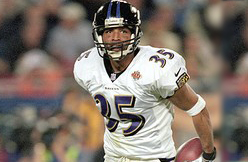

Bookmark and Share

Tracking proCanes - Billy Corben - "The U" Film

TrackingproCanes

proCanes.com is continuing our “Tracking proCanes” feature with someone who is not a former University of Miami Athlete, but nonetheless an alum of the University of Miami and is heavily involved in spreading the spirit of the University of Miami Athletic program, specifically the football program, through his new film “The U” which will air on ESPN on December 12th at 9pm after the Heisman Trophy Presentation. Billy Corben was born in Florida and graduated from the University of Miami where he majored in political science, screenwriting and theater. His feature documentary directorial debut, “Raw Deal: A Question of Consent,” premiered at the Sundance Film Festival in 2001, making him one of the youngest directors in Sundance history. Examining the alleged rape of an exotic dancer at a fraternity house at the University of Florida, the film utilized extensive clips from videotape footage of the alleged assault. Considered by critics to be “one of the most controversial films of the modern day” and “one of the most compelling pieces of non-fiction ever produced,” (Film Threat Magazine), “Raw Deal” has been seen all over the world. Following that success, Corben and producing partner Alfred Spellman founded rakontur, a Miami Beach-based content creation company, and took on another Florida true-crime story, this one closer to home. The New York Times called “Cocaine Cowboys” “a hypervent-ilating account of the blood-drenched Miami drug culture in the 1970s and 1980s.”

Corben is now putting the finishing touches on the film, “The U” which is described here: Throughout the 1980s, Miami, Florida, was at the center of a racial and cultural shift taking place throughout the country. Overwhelmed by riots and tensions, Miami was a city in flux, and the University of Miami football team served as a microcosm for this evolution. The image of the predominantly white university was forever changed when coach Howard Schnellenberger scoured some of the toughest ghettos in Florida to recruit mostly black players for his team. With a newly branded swagger, inspired and fueled by the quickly growing local Miami hip hop culture, these Hurricanes took on larger-than-life personalities and won four national titles between 1983 and 1991. Filmmaker Billy Corben, a Miami native and University of Miami alum, will tell the story of how these “Bad Boys” of football changed the attitude of the game they played, and how this serene campus was transformed into “The U.”

NFLU2009
proCanes: How did you come up with the idea for the film?
Billy Corben: Everyone in our company, Rakontur, are Miami natives basically. So one of the mandates of our company is to not only tell great stories, but tell great Miami stories. The Hurricanes of the 80’s in particular is one of those great Miami stories. It was one of those stories on our list for a long a time to tell and we had an opportunity to pitch it to ESPN and we took that opportunity. The inspiration was really growing up in Miami and seeing the dramatic impact, not only in sports, but in our community in terms of pop culture, in terms of the merging of sports and entertainment, this profound effect the Miami Hurricanes had being the team of the 80’s.

pC: What's the official name of the film?
BC: The temporary working title of the movie was “Hurricane Season,” and now it is “The U” and just “The U.” There have been some internal discussions about adding a subheading to it, but right now it is just called “The U”

pC: How did you end up partnering with ESPN?
BC: Like I said, this story of the Hurricanes of the 80’s was on our short list, of great Miami stories that we wanted to tell and ESPN Films was doing some really great work and we called them up and Connor Schell, he happened to have been from Miami and gone to high school in Miami and he knew all about this story of course, not to mention he was a big Cocaine Cowboys fan which was really exciting and fortuitous for us. We went up to New York and met with everybody at ESPN films and eventually went to the Bristol CT headquarters and met all the people we have been working very close with on this movie and they loved the idea. They loved our take on it. They loved our angle on it. To their credit, they loved that we were also alumni and graduates of the University [of Miami] working on it. They’ve also given us a lot of creative freedom and autonomy on this project to tell it in our voice. It’s definitely ESPN Films presents, there’s no doubt about that, but it is our voice, it is Rakontur’s voice telling the story just like all the 30 for 30’s. These are all personal stories. All the filmmakers have a personal relationship with these stories and it’s no different here with Rakontur, me and the Hurricanes. ESPN is producing over the course of just a couple of short years, 30 movies with 30 filmmakers. I mean movie studios these days don’t even do that. So they are working their asses off, to help all of us craft these individual unique visions, 30 of them. They’ve just been incredibly cooperative and helpful and supportive to work with. I really appreciate and I can’t imagine having made this movie with anyone else and for anyone else other than ESPN. We approached them, we pitched the story, they loved it and have been behind us ever since.

RakonturHoward
pC: You went to UM, were you always a UM fan?
BC: My grandfather had season tickets in the 40’s in the Orange Bowl and as long as I have been alive, my dad has had season tickets to first the Orange Bowl and now of course Joe Robbie, Pro Player, Dolphin, Land Shark Stadium, J-Lo Stadium whatever the hell it’s called. I think it’s Buffet Stadium, that would be fun at least or we should just call it Margaritaville. Why don’t we just call it Margaritaville and drop stadium from it? My dad has had season tickets as long as I have been alive and I grew up going to ‘Canes games. Whenever I could go, I would. I’m talking about five years old at the Orange Bowl. Some scary stuff. The Orange Bowl was quite an intimidating environment for a little kid. You could actually feel the stands move and shake as the crowd built up and roared and back in the 80’s, the crowd would often get built up and roar. I remember the feeling of that stadium. It felt like that stadium was going to come apart as everybody was stomping and cheering and screaming. I remember even being that young and realizing what an absolute sensation this team was, and these players were. I was conscious, even then, of a good show, the spectacle of a great story. You could just look down at the field, at that stage and know you were witnessing the greatest show on earth. I’ve never seen football or entertainment like that since. It’s a shame. It’s a shame that football can’t be that fun and that passionate and that exciting and that enthusiastic. Later, you know, we have the Miami rules, the excessive celebrations penalties which are just ludicrous and literally take the joy and the thrill out of a game being played by 18, 19, 20-year old kids and you would hope they would be able to enjoy it now as much as they enjoyed it then and as much as the crowd enjoyed them enjoying it.

pC: What's your favorite memory of the Hurricanes when growing up?
BC: It’s tough because I was so young going to some of these early games. In high school, when I have more distinct memories I didn’t go to as many games as I would’ve liked to, in fact I didn’t go to any of the Championship games at the Orange Bowl, unfortunately. My dad had friends to take with those tickets and he wasn’t going to let me have one of those tickets or maybe he sold them, who knows! Those were expensive tickets, even in those days, so who knows.

pC: How different was it doing a film like this as opposed to Cocaine Cowboys?
BC: Well, no joke, they’re actually very very similar. One is about Miami and cocaine and one is about Miami and college football, so see, they’re very much alike! [Laughter] In fact, Cocaine Cowboys fans will find that structurally there are a lot of similarities. Cocaine Cowboys opens with the city of Miami, as a sleepy little town. “The U” opens with the University of Miami as this institution of higher learning with a not so great football team going through six coaches in seven seasons, just really on the verge of extinction. The University of Miami had already cut basketball and football was the obvious next step for the trustees to cut and they managed to get one more lease on life, higher one more head coach, to see if they could make some thing happen and they happen to higher Howard Schnellenberger, which was of course the big shift in the fate of this program. So, the movies [Cocaine Cowboys, The U] kind of begin similarly in that regard with the old archival footage of the campus, which was a very lily-white campus in Coral Gables. We have this old classic tourism film about Coral Gables, just like at the beginning of Cocaine Cowboys we have those tourism films of Miami and Miami Beach and you’re about to see the Cocaine Cowboys come in and turn the city upside down and turn it into what it is today and the same thing happens in “The U.” In comes this remarkable football team, these groups of men, these different teams that made up the Hurricanes in that decade and they’re about to come in turn the campus upside down, college football upside down and eventually professional football on its head. So, really, they’re actually very similar films and not to mention there’s a nostalgia today for both the Cocaine Cowboys era in Miami where anything goes, it was the wild west, there was a lot of money, a lot of parties a lot of fun, even though here was murder and mayhem, you still have that nostalgia. Same thing with the Canes, there’s an even greater nostalgia for the ‘Canes of the 80’s and the exuberance and enthusiasm and style that they brought to the game despite the fact that there was some negativity some negative press some bad news from the program and that time period. There is still that very strong passion and nostalgia for the ‘Canes of the 80’s just like the Miami of the 80’s of Cocaine Cowboys.

RakonturMelvinBratton
pC: Who would you say was your favorite interviewee?
BC: Man, that’s tough. That is tough because we did something like 40 interviews of head coaches, assistant coaches, players, from quarterbacks, wide receivers to some of the greatest defensive players to ever play the game of college or professional football. This is a real tough one. Finally we just got the Michael Irvin interview so there is a certain sweet smell of success there and he was as good, as we knew he was going to be in his interview. Jimmy Johnson was sensational. Lamar Thomas was hilarious. Bernie Kosar was a sweetheart and offered a lot of great insights that we wouldn’t have otherwise gotten had we not interviewed him. Alonzo Highsmith was great. Mel Bratton was great. Jeremy Shockey, you had no idea what that guy was going to say next, he was a classic interview. That’s a real tough one. Which one was my favorite? Too hard to say, too hard to say.

pC: How long will the feature be for ESPN?
BC: We’re going to get a two-hour broadcast block so without commercials the total running time of the movie is going to be about 100 minutes, which is barely enough time to tell the story of the four national championships that we’re telling. 1983, 1987, 1989, 1991 seasons. It’s tight squeeze, it’s tight squeeze.

pC: How difficult was it to get the player interviews, were former players receptive to the idea?
BC: Good question. Very little trouble getting the interviews from the players. Except for Michael Irvin, which was a bit more of an uphill battle, but ultimately he agreed to talk to us and was terrific. Like Michael Irvin said and a lot of these guys said, the years playing for the Hurricanes were some of, if not the best years of their lives. To call someone up and say “hey will you come and talk about some of the best years of your lives” doesn’t require a lot of arm twisting. The biggest problem was the University of Miami who was not supportive in the least of the project, which was funny because I did the math, of our full-time employees at Rakontur and the independent contractors that worked on “The U” and we have combined, no less than 20 years, 20 years, at the University of Miami, that we spent as students. You do the math, that’s at least 2 million dollars in tuition, at least, for all of us and all the years and semesters we spent there. Not to mention we still get multiple emails a day asking us to donate money to the University and yet I approached the University of Miami as an alumni, as a graduate. I said “hey can we get access to your archives, your photos, your films, we’d like to interview Randy Shannon, we’d like to interview Paul Dee” and they told us to go screw ourselves. Here we are, School of Communication graduates made good, telling the definitive story of the University of Miami Hurricanes in this era for ESPN, one of the biggest, if not the biggest cable networks in the universe, basically producing a two-hour infomercial for the University of Miami. They should put Rakontur’s name on a building when this is all done. I don’t know how they measure in cash, the contribution of a two-hour primetime infomercial for the University of Miami and the extraordinary history of the football program. Nine p.m. after the Heisman Trophy ceremony on ESPN. I was really disappointed at the level of professionalism or lack thereof, and lack of support that we got from the Athletic Department and the University administration. They should really be ashamed of themselves of how they treat their alumni. It’s not like we went to them for money, we didn’t need money, ESPN was financing the thing. We went to them for support. Let us interview some people who are currently employed by you. Let us get some access to some of your archival materials and like I said, they sent us packing. Considering the quality of education that I got at the University of Miami for the money I spent, I like to say it’s a TJ Maxx education at Neiman Marcus prices. The least they could do was be professional and be courteous to alumni.

I resigned my position on the Citizens Board, a very prestigious Board of both alumni and influential people in the community who are actively involved in fundraising efforts for every program of the University. I resigned as a result of the disrespect that the University showed us. What was interesting about it, was that the University not only blocked our access the small handful of people, Randy Shannon and Paul Dee mostly, who are currently employed by them who we needed the University’s permission in order to get access to them for an interview. Not only did they block that, but they attempted be obstructionists about it. They were telling other people such as Coach [Dennis] Erickson, not to give us an interview. It’s one thing to say, no we can’t as a University endorse, though we didn’t ask for their endorsement, participate in this, it’s another thing for them to go out and try to obstruct our ability and access to people that are no longer employed by the University. So we went out to Arizona State to interview Coach Erickson and he said ‘you know, I called the University to follow-up on this request and to see about the project and they told me not to do it.’ I was like “you’re kidding?” It’s one thing for the University to say we’re not participating and do whatever you want but to tell someone not to participate?

Fortunately for us, everybody pretty much, especially the players, didn’t care what the University had to say, certainly were not going to be kept from telling their story. That’s literally what this is; this is the player’s stories. If you’ve seen any of our Rakontur documentaries Cocaine Cowboys, Cocaine Cowboys Two, Raw Deal, A Question of Consent there’s no narrator there’s no real point of view of the filmmakers forced upon the movie. It’s not a Michael Moore movie. It’s not a big expose or anything. This is their opportunity to tell their story in the first person. I always say Rakontur is first person productions. It’s not about “they and he” it’s about “I” and “we” and that’s what we got here fortunately, because the players weren’t going to listen [to the University]. The players didn’t listen to the administration back when Tad Foote was trying to implement a code of conduct and dress codes, so they’re sure not going to listen to the administration now telling them not to participate and thank goodness for them. These are men of character and men who are great characters and fortunately I think virtually everyone we approached, now that Michael Irvin gave us the interview, pretty much everyone we approached said ‘yes’ except for a very small handful of people employed by the University.

RakonturJimmy
pC: Talk about going down to Jimmy Johnson's house in the keys.
BC: Holy crap. Jimmy Johnson has life perfected, perfected. He makes Jimmy Buffet look like a stockbroker. This guy is doing retirement right. It’s amazing. He’s got this beautiful house, right on the ocean, and he very graciously invited us down there to interview him. We had a real small window of opportunity because, as he put it, he could ‘hear those fish biting out there’ and literally the background of the shot while we’re interviewing him is his fishing biddies loading up his fishing boat that’s in the background of the shot. They’re putting the bait on, the light beers, because Jimmy’s on light beers now, he’s on a diet, they’re loading up the Subway sandwiches, the fishing rods like right in the background of the shot [laughter]. They’re like ‘sorry guy we’re just running through!’ and Jimmy was like let’s do this, let’s do this. So we ran the interview and literally the last thing we did was just an intro we recorded and he said ‘alright guys, thank you, that’s it!’ He leapt down off the chair, ran into the background of the shot, jumped on his fishing boat and they just took off into the Atlantic [Ocean] to go fishing. It was awesome. There we all were, me and my crew just standing there with all of our equipment set up in Jimmy Johnson’s back yard thinking this is the coolest job ever. I got him and everybody else to sign this football. I mean everybody that we interviewed signed this football and it’s amazing. It’s like 40 signatures from the greatest players, coaches assistant coaches and one of the greatest athletic directors, Sam Jankovich, who signed this ball. It’s an amazing artifact that we have from making this movie.

pC: I assume you have a lot of footage that won't be shown on the ESPN feature, what will you do with that?
BC: That’s a great question too, because we always have a glut of extra footage. We’ll probably have some proCanes.com exclusive deleted scene that you can embed on the site at some point before or after the movie premiers. We’re definitely putting together quite a DVD package. To me actually, as a movie buff and DVD collector, my number one, top bonus feature that I look for in a DVD, if I am going to buy it or rented it or whatever, is deleted scenes. To that end, all of our DVDs, Cocaine Cowboys One especially, Raw Deal, A Question of Consent, on those two DVDs we put over 30 minutes of deleted scenes and deleted footage on there. That to me is a real serious value. That’s another 30 minutes of movie that you didn’t get and not to mention it’s a real insight into the film making process because you have to make a lot of tough decisions when you’re editing a movie especially a movie that has to be 100 minutes for television that’s got to tell the story of the Canes from the late 70’s into the early 90’s. I mean, obviously, as you said in your question, a lot of footage is going to wind up on proverbial cutting room floor. Fortunately there is no cutting room floor, it’s all digital non-linear editing, so we have all of those scenes, deleted lines, deleted scenes, deleted sequences, we have them all in a lock box in a folder in Final Cut Pro where we can go back to and access those for additional content. It’s definitely something whether it’s on proCanes.com, the ESPN website, certainly on the DVD you’re going to get a whole lot more of “The U” after the movie premiers.

pC: What phase are you in terms of the feature? Done? Editing?
BC: Man, oh man. This is an epic. ESPN is doing these 30 for 30’s which is 30 different documentaries by 30 different filmmakers about some extraordinary sports story of the last 30 years to celebrate ESPN’s 30th anniversary. They first came on in the fall of 1979, so right now they’re celebrating the 30th anniversary. When ESPN picked us up, we were not a part of the 30 for 30 series and then they announced the 30 for 30 series and told us that we were going to be one of the only two-hour 30 for 30s because the rest of them were all one hour. So, really all of the 30 for 30s are pretty much about one player or one game or in the case Barry Levinson, one band, the Baltimore Marching Band and this movie is an epic, it’s an epic. It’s one of the few, if not only, 30 for 30s that is about four national championships in under 10 years of a single team. This is an epic!

Rakontur2liveCrew
To that end, it has been an ongoing editing process not to mention that we just got a Michael Irvin on October 29th. We had locked pictures, so we thought several weeks ago, Two weeks ago we did live recording sessions that we put live on U-Stream so you could hear live a 14-piece orchestra all week long recording the music. Halloween weekend we spent editing the Michael Irvin sound bites into the movie which of course will make the movie longer which means we will have to cut other things out which means the shape and timing of the movie is going to change. We are still very much editing the movie but at the same time we are also recording the score, the original music, we are actually recording an original song, actually this is breaking news, I don’t think anybody knows about this. We are recording an original song, main title song, theme song with Luther Campbell last week which was pretty incredible. It’s an old school Miami based two live crew sounding styled song, which Luther is going to do the lead vocals on. We’re doing the graphics work, designing a beautiful lower thirds effect, I’m not going to give away the surprise but it’s a pretty bad ass concept very consistent with the spirit of the U. We’ve got some beautiful graphics work and animation that’s going on right now. So we’re really doing everything at the same time right now to try and finish this movie. ESPN said the movie is premiering December 12th at 9pm, I told them you will not have it a minute later than 8:45 pm on December 12th. At this rate that might be about when we deliver [laughter]. The movie is looking great, it’s sounding great. We’re making a lot of last minute changes. I asked ESPN at the end of the second hour of the movie if they could have a SportsCenter break, this just in ‘this just in, SportsCenter, “The U” is going into overtime” so we can make the movie a little bit longer.

pC: What's one thing you learned from making the film that you didn't already know about the program?
BC: Well I’m tempted to just say you have to watch the movie to find that out, but I’ll give you one. Jimmy Johnson’s Thursday night meetings, which I didn’t know about, but hearing about it from Coach Johnson, from the players, it took on a new life and a new depth and new meaning to what was otherwise sort of anecdotal stories about these mythical Thursday night meetings. Art Kehoe even told us, that he wished that he had gone to one, but never actually made it to one of the Thursday night meetings. Commentary from the players and coaches of things like that, that are really really compelling. Everything else that I learned, that I didn’t know about the team or the program I’m going to let you watch the movie and find out for yourselves something that maybe you didn’t know about the program.

pC: How would you say this film is different from other sports documentaries?
BC: First of all I don’t really look at it as a sports documentary. I look at it as a sports culture documentary. I look at it as a Miami story. I look at as a lot of things, but not just a sports documentary. I think it talks a lot about the atmosphere in Miami in the 1980’s, the racial tensions in the community, the fact that we had not one, not two, but three incidents where police officers murdered young black men that led to multiple race riots over the course of the decade, starting 1980 with the McDuffie murder and riots going all the way to 1989 with the Lozano shooting and subsequent civil unrest and this was the environment and the neighborhoods where a lot of the great players in South Florida were recruited by Howard Schnellenberger and Jimmy Johnson and it gave these players a perspective and a fire, a passion for the game. As Mel Bratton put it ‘football was the way out of the hood.’ They played with that passion and that fire and that swagger that nobody had ever seen anything like it before. Not on TV, anyway. Hip Hop culture and street swagger and Miami street swagger is now pretty much mainstream, but back in the 1980’s that was not what most of America knew. I think about pop culture references to black America in the 1980 and we have the Cosby Show and as far as music goes you had Run DMC, which was pretty tame Rap music. Luther Campbell was just coming on the scene, gangster rap was just coming on to the scene, it was very controversial and not ready for primetime. But here you had these players also not ready for primetime but right there in living color on your TV set every Saturday playing football and displays that you had just never seen before. That’s what the movie is about to me. Yes, it’s a great team, yes it’s certainly about four National Championships in a span of less than a decade, but it’s about these men and these personalities and the character and the characters that made up this team.

pC: Some former players I have spoken to have expressed concern over what sort of light the film will portray the “U.” What would you say the film is trying to portray?
BC: I’ll tell you this. I’ll tell you this. ‘Canes lovers who watch the movie are going to walk away from the movie still loving the team and maybe loving them even more. ‘Canes haters are going to walk away probably still hating the ‘Canes [laughter] for the same reasons they hated them before, but I think with a new level of appreciation or maybe even respect for how this team changed; first pop culture, then college football, then professional football maybe not in that order and really professional sports in general. I think this is a real opportunity for the team, the players, the coaches to tell their story from their perspective and respond, let’s say, to a lot of the criticism and the negativity that’s been around. There’s no doubt that we’re pretty objective in this film, we do present the other side of the story. But here you have first hand the Canes responding directly to that criticism and that controversy. Whether or not that makes everybody happy, whether or not that generates more controversy, we’ll have to see when the movie premiers. I don’t think anybody will throw a bottle at my head like poor Dan Le Batard [laughter]. He wrote something that pissed of a fan, I really hope I will not have enter the witness protection program after we premier this movie.

RakonturErickson
pC: You interviewed Coach Dennis Erickson, Larry Coker, Jimmy Johnson and Howard Schnellenberger. Talk about those interviews and just the difference between the 4 coaches and what they had to say.
BC: Coach Coker unfortunately is not going to be in the final cut of the movie, because we do not go all the way to 2001. Originally when we had conceived the movie we were possibly planning on going to ’01. We’re not now. This is just going to be the team of the 80’s, the Canes that were recruited primarily by Schnellenberger and Jimmy Johnson and that continued to play in the early 90’s and won in 89 and 91 with Coach Erickson. Right up to the Pell Grant scandal and the sanctions is kind of where we end our tale. In talking about Howard Schnellenberger, Jimmy Johnson, and Dennis Erickson, you could even tell today, interviewing them and watching their interviews in the movie exactly the kinds of personalities and exactly the kinds of coaches that they were and that the players and assistant coaches talk about. Their personalities are right there perfectly on display.

With Schnellenberger you get the stature of this man and the rich history of football that he brings to the table. You understand the reverence that these players had for him and you could practically still smell the cherry flavored tobacco smoke coming down the hall before he walks into a room and he’s a real presence to this day. That growl low voice that he has really contributes to the whole persona which continues to this day and you really understand why the players respected him, paid attention to him and did not want to disappoint him. They wanted to go out and win for him.

Jimmy Johnson, same thing. I mean you see Jimmy Johnson on TV every week on Fox and he’s just got that energy, and that enthusiasm, that passion, that fire that these players came along with. I think Don Bailey Junior told us in his interview, Jimmy Johnson had a chip on his shoulder from his time at Oklahoma and everything and he came in like a lot of these players did, with that chip on his shoulder. And Jimmy talked to us about how he could relate to a lot of these players because he was the first person in his family that went to college. A great line from the movie from Dan Le Batard, which I was going to tell you, but I think I am going to save it for the movie, it’s a great line about the relationship and connection Jimmy Johnson had with his players, motivating these players the right away you can see why Jimmy Johnson became, as Michael Irvin said: “A lot of the guys on the team, myself included, didn’t have fathers, grew up without fathers and Jimmy Johnson became all of our fathers.’ You can see the warmth. I mean watching the archival footage, Jimmy and the team in practice and on the sidelines in games, in the locker room, there’s always an arm around a shoulder, an embrace after a touchdown, I mean there was a bond and a level of warmth and not just respect but you know a familial bond and a love for each other and the game and that is so apparent in talking to Jimmy Johnson today.

Robert Bailey said in his interview ‘Coach Erickson was like when a substitute teacher comes into class.’ Everybody is just going mess around as much as possible and as much as they can get away with. Erickson you can see, he said in his interview ‘that the players taught him more about football, their lives, and their culture than he probably taught them.’ At the same time you can see that this is a guy knew enough to stay out of their way and to devise tactics to channel their energy off the field onto the field and into winning games on the field. You can see that he is cool and quiet but at the same time you can see he is calculating how to get these players to do what they need to do to win games. There’s no doubt that he did it, winning two national championships.

RakonturBernie
pC: Did you talk to some of the Hurricane QB greats? Talk about them and their personalities.
BC: This is not a “Quarterback U” documentary but you can’t make a documentary about the Hurricanes in the ‘80’s and not talk to some of the great quarterbacks. We talked to two in particular, both of who won National Championships. We talked to Bernie Kosar and Steve Walsh. Both were terrific and not unlike the coaches, even to this day could understand the personalities that made them leaders on the field. Bernie Kosar was about as nice and gracious a man as I have ever met. He actually did the interview less than a week before the news broke about his financial difficulties and it really broke my heart to read about that in the Miami Herald. He really could not have been a nicer guy, more gracious guy and less than a week before that news broke, did not let on at any point before, after or during the interview that he was dealing with the kind of problems he was clearly dealing with at that time and we really appreciate his time, which he gave us quite a lot that day. His insight into Howard Schnellenberger as a coach, some of his teammates and what went into being a freshman quarterback coming out of that quarterback preseason contest of the ’83 season that Schnellenberger had him and Vinny Testaverde endure to see who was going to get that starting position. It’s actually a great deleted scene from the movie that hopefully will see the light of day somewhere online or DVD about that quarterback competition and how Vinny Testaverde was clearly, to coach Schnellenberger and to Bernie Kosar, clearly the better athlete pound for pound, pass for pass and how Schnellenberger just had a feeling. They go into that season and lose that first game against the University of Florida and perhaps this looks like Schnellenberger‘s folly and Schnellenberger famously said that he went back and looked at the film from the game and determined that play by play statistically the Hurricanes beat the [Florida] Gators, just not in the final score and he was able to, I think, instill that enthusiasm and that inspiration in Bernie and in the players, that you were clearly the better team there, now we have to make that reflect on the scoreboard and that is what they did for the rest of the season with this freshman quarterback who ended up winning all of their [remaining] games and go to the Orange Bowl against Nebraska for the National Championship that year.

SinoriceMossTrackingOrangeBowl
pC: What do you think about the move to Land Shark Stadium?
BC: I was on the University of Miami Citizen’s Board, a position that I resigned from, as a result of a lack of cooperation the University gave us on this project and I was on the Board when Paul Dee came and made a presentation at a luncheon about the options that the University was facing with regard to which stadium to contract with, to have the Hurricanes games and it broke my heart to see the Orange bowl torn down, in fact it’s something, that even though this movie is not about the Orange Bowl and the destruction of the Orange Bowl plays a very important visual element in our movie at the end of it. It felt right especially because of the rich history of the stadium. At the same time the presentation that we saw, from a business standpoint, was very clear that this move was inevitable, there was nothing that was going to stop it from happening. From a strictly business perspective it was a sound decision, and as I said inevitable, a foregone conclusion that they were going to move the team. What you can’t really account for in a business decision like that, the x-factor, we’ll call it the “U-factor,” the “OB-factor.” That is that element of whether it is motivational, spiritual, psychological, or what have you, that the Orange Bowl brings to the table in terms of local excitement, community excitement about the team and about the games. It was a creaky piece of crap, that stadium, but it had not only a lot of history, it felt a lot more like a college stadium, certainly than already dated corporate coldness of what is now Land Shark Stadium. So, there’s definitely something to that.

I think the distance is not a major factor, students can still take buses and everything up there, but I think there is definitely, I mean you can see when the team is number 8, number 9 [in the polls], attendance has been pathetic this year at Land Shark, there’s no doubt about it. I think there has been more enthusiastic tailgating going on outside of the stadium that fan support in the stadium. So whether or not that’s just a testament to the dissatisfaction the fans feel with the stadium change or the fact that there’s been some beautiful weather lately so there’s a lot of competition for people’s time and attention. People get out of bed and it’s a beautiful day and they’re like ‘huh, beach or Land Shark Stadium?’ The fair-weather fans, as they call them. Ultimately, like I said, it was a sound business decisions and an inevitable one at that, but I think it’s going to take a couple of year convince the community and the fans at-large that this is something that they should drive north to the county line to experience Hurricane football.

Schnellenberger talked to us in his interview about the plans he had for an on-campus stadium at the University of Miami. But Schnellenberger has always been a major proponent of that. Look at his plans at FAU right now. He’s got a beautiful on-campus stadium and shopping mall planned that he’s been actively endorsing and getting support for and it’s a real shame we can’t have that level of on-campus enthusiasm at the University of Miami. Again, there’s not a lot of options for playing football in Miami-Dade county is the bottom line, unless you’re going to build a stadium from scratch on available land. You can’t play at the Bank United/Convocation Center, you can’t play at Mark Light Steroid Field, or whatever it’s called. There’s only so many venues to play football and when you looked at the business opportunity that the City of Miami and the Orange Bowl was afforded with and Dolphins Stadium was offering at the time, there was no hope for the Orange Bowl, for the Hurricanes to continue with the Orange Bowl. That was the final nail in the coffin for a venue that took up a lot of property, a lot of land, you can’t help but watch the footage of it being torn down and wish that they could have thought of some way to preserve that structure and the history of that structure. I mean a Marlins stadium? I mean really? Really? Is that necessary?

RouthFSUCops
pC: On your website, you use the photo of the Ibis being detained by FSU cops, why?
BC: Why not? [Laughter] Why not? It’s actually going to be a great deleted scene, John Routh, aka Sebastian the Ibis, telling us the story of how he was beat down and handcuffed at Doak Campbell Stadium by some troopers who were not happy that he was going to use a fire hydrant to put out the flaming spear [laughter]. It’s a great story and also a wonderful image that is so emblematic of the “bad boy” reputation that the Hurricanes had at the time that appeared to even extend to our mascot. I just think it’s one of those things that really deserves to be preserved as the header on our blog. Read proCanes.com’s exclusive interview and account of his run-in with the FSU cops.
pC: After all the interviews you have done, what's one word or phrase you think describes the U. BC: Well I think “The U” actually does a very effective job as a word or a phrase that describes the U. It’s “the U.” As McGahee would say ‘the U already know.’ What more do you need to say really about it? It’s become a brand. Howard Schnellenberger tells us in his interview how when he first came to the University he was giving the entire Football program an entire overhaul in terms of the facilities, box office, ticketing, the promotional materials, programs, artwork, etc, people were coming to him asking him to get rid of the U logo of the team. He said ‘why would we get rid of the U? What are we going to make it? We’re going to make it an M? There’s a lot of M’s in the world, but there’ only one U.’ He said ‘we’re going to make that logo more recognizable than the IBM logo.’ He said that in 1979. That’s exactly what has happened. One of the things we end the movie with is a montage from Monday Night Football of former Canes introducing themselves when they’re supposed to say what college they went to, they just say ‘the U.’

RakonturMichael
pC: After interviewing all these former greats, what's one thing you saw that they possessed or that made them great that the current team and future teams need to do to get back on top?
BC: I think I should leave the football coaching to the football coaches [laughter]. Well the football coaches and Sid Rosenberg and everybody on the sports talk radio who like to do a lot of Monday morning quarterbacking and Monday morning coaching. So I don’t know if it’s necessarily what the team needs to do now to get back on top, but I will tell you that the relationship that this team had with each other and with their coaches, it sounds trite, but it was a family. The former players, the way they look back at the new players and embrace them and try to mentor them and train them, I think is extraordinary. Michael Irvin told us in his interview, he had never talked with another player in the pro’s [NFL] that had the bond, relationship and talked as much about his alma mater and was as enthusiastic about the college team he played for as the former ‘Canes are. When you’re facing a tough year, sometimes teams break down into factions, sometimes there’s support for coaches, there’s people against coaches, it can become a very contentious environment when you’re not winning. It’s easy to pull together and be a family when you’re winning. It’s tougher through the tough times, through the hard times and that’s something this team really used to do. They were winning and the world was crapping on them. They would lose, at the Fiesta Bowl, the world was crapping on them. You come off the loss of the Fiesta Bowl, which Jimmy Johnson tells us in his interview, was ‘the most devastating loss of his entire career’ college or professional and a lot of the players share that sentiment, if not most of them. They came off of that loss, which was devastating, they came back to the University of Miami, back to Coral Gables and Jimmy Johnson nearly resigned with the conflict he got into with President Tad Foote. Tad Foote tried to implement the code of student conduct for the players, the dress code, etc., the players would have none of it. Here they were with the entire nation’s media crapping all over them, and here was the President of the University, and he came to symbolize everything they were up against, because they weren’t even feeling the love on campus at home from their own administration. They pulled together and came out the following year and won a national championship. Again, with a brand new quarterback, Steve Walsh, in the 1987 season.

What has to happen is that the team needs to pull together as a family; I think this movie will actually help, to tell you the truth. I think the team should watch this movie and they should understand the modern tradition, modern legacy of this team. This is not a team steeped in hundreds of years of tradition. It is a modern tradition a modern legacy, it is something current players are very much part of, especially the players from Schnellenberger ‘s fabled “State of Miami,” you know these local recruits that Randy Shannon has so passionately pursued and I hope he continues to do so. Really, that’s what they have to do. What the team needs to do is watch this movie. They should watch it on a loop. They should play it in the locker room endlessly. They should just have to watch this movie over and over again to be reminded of who the Hurricane are, where they come from and what is expected of them. What is expected of them is by their coaches, by the former players, by their teammates, by their classmates, by the campus, by the administration, by the community, by the city of Miami and ‘Canes fans all over the world, is to win. That’s all, it’s pretty simple right, just to win. Nothing more is expected of them, right?

RakonturCocaineCowboys
pC: What is your next project once you're done with ”The U?”
BC: Ha! Next project! We’re already neck deep in the next projects. We’ve got “Dawg Fight” about a ring of underground, backyard fighting in South Florida, in Perrine, specifically. Really intense story. We have a great trailer for it online. We’re working on Cocaine Cowboys 3 which is about “Los Muchachos”, the boys Louis Falcon and Sal Magluta the most successful and notorious Cuban cocaine smugglers in Miami, in the 1980’s. Cocaine Cowboys One really focused on the Columbians, now this is the Miami Cuban cocaine smuggling story. We are working on Square Grouper, which is kind of an unofficial prequel to Cocaine Cowboys which is about marijuana smuggling in Miami in the 1970’s, which is going to be amazing. It looks extraordinary. The stories are, you know, revelations. It’s more these characters like John Roberts and Mickey Munday and Griselda Blanco and Jorge “Rivi” Ayala. These people that nobody, or very few people have heard of, that are just going to knock your socks off. Interviews with people that are telling the stories, your jaws are going to be on the ground. What else are we working on? Ah yes, “Peter Gatien Project.” Now we’re working on a 90’s ecstasy movie, takes place in New York, around the nightclub scene and how the city of New York and the Feds cracked down on ecstasy and nightclubs in New York in an effort to clean up the city. They really made public enemies of the local nightclub owners of New York in an effort to get rid of ecstasy and clean up New York. Other than that nothing is going on! Of course I would love to do a sequel to “The U” about the 2001 team, we could call it “The U 2” or something like that.

We at proCanes.com would like to thank Billy Corben for being so gracious with his time to do this very insightful interview for our new feature "Tracking proCanes." Click here to check out our past interviews with Leon Searcy, Steve Walsh, Frank Costa, John Routh, Chad Wilson and more!


Bookmark and Share

Tracking proCanes - Lance Hurdle - Part II

TrackingproCanes

In Part II of our interview with Lance Hurdle he talks about who his favorite player growing up was, Jimmy Graham, the hardest away game he played in the ACC and much more! Click here to read Part I of our interview.

LanceHurdleTracking6
pC: So out of high school you weren’t really recruited by big schools?
LH: Actually I wasn’t recruited at all. I went to the Vegas Tournament going into my senior year. We played a team from Texas and I had 40 points and that’s when Santa Barbara had seen me so they were recruiting me and the Universtity of San Francsico was recruiting me and that’s the first year that Jessie Evans was there and actually he told me well I’m going to come down and take a look at you while you’re playing in high school, but that never happened. So, I was left hanging and I was real disappointed about that so at Santa Barbara it came down to me and a guy named Mike Roll that went to UCLA and he actually committed to Santa Barbara but really wanted to go to UCLA so UCLA came in with their offer and he backed out and that’s how I got put in, so basically I was second. So I really wasn’t recruited at all and when I went to Santa Barbara it really didn’t work at all and I left. Actually, when I left Santa Barbara the coach there told me ‘my concern for you is that you’ll be paying for your education come your junior year’ I said “ok” so I went to JUCO and did whatever I had to do.

pC: Was it a personal problem with him?
LH: No I think he was just a straight shooter. I guess he didn’t see it and that made me work even harder and I have a lot of friends on that team still. Actually one of my best friends is still playing for him and actually I told him and he jokes about it. After we had a big game and we beat Duke he said ‘I bet our coach is crying right now.’

pC: And you havent’ talked to him since?
LH: I haven’t talked to that coach since that day. But I do talk to the assistant coach that recruited me a couple of times but I haven’t talked to the head coach.

pC: So who’s the guy you idolized growing up? Who was your favorite player?
LH: Michael Jordan. No doubt Michael Jordan.

LanceHurdleTracking7
pC: Who do you think is the best point guard right now?
LH: It’s either Chris Paul or Deron Williams. I was watching them last night go head to head. They have some battles but I can’t pick one. If I did have to pick one it’d be Chris Paul.

pC: Are these games you’ve recorded or are you getting teams to give you film?
LH: Coach Suarez always makes tapes for me. They record NBA games. So I have a live tape of TJ Ford when he was at Texas and sometimes I watch that but sometimes I’m on the computer a lot and I just go on YouTube.

pC: So you see a move and you try to implement it in your game?
LH: The moves, the pace, the pace at which they play with how they take control of the game especially in crunch time. I just watch their demeanor on the court.

pC: What do you think about Jim Graham playing football now?
LH: I was excited to see him out there on the football field. I was excited because I always told him he could play, he was the second fastest guy on the team.

pC: He was?
LH: Yeah second to me. He almost beat me one time. He runs a 4.4 [second 40-yard dash] easy and he jumps a 40 inch vertical, so he’s an NFL prospect easy. So I said, he should be playing football. I said “you’re an NFL prospect easy because one time after practice we were throwing a pigskin around the court and Coach was like ‘stop, stop, stop.’ But Jim and I were throwing it and Jim was catching and running and I was like “you should play football” and he was like ‘ah, I don’t know.’ So I’m glad he picked up the helmet.

pC: Do you know how that happened? Did they approach him?
LH: Yeah they approached him. Actually some NFL teams were approaching him aswell so he turned down a big contract for basketball overseas to play a game that I think he can be a millionaire in.

LanceHurdleTracking8
pC: As a player when you were on the team would you gusy find yourself checking the message boards after the games and seeing what fans would say or would you guys stay away from that?
LH: Well I stay away from that. My little brother will always be on there looking and seeing what they said. And he’ll tell me and I’ll say I’m not concerned with that cuz that can mess up your game.

pC: So would you say most players don’t bother?
LH: No, most players don’t even know we have those unless they’re looking for them, but most people I know don’t care or don’t even worry about it.

pC: What would you say was your best memory from your days here?
LH: I had a few. Obviously my career high at North Carolina. We played Carolina when I was at Santa Barbara. We went to Chapel Hill the day after Thanksgiving. My grandfather who passed away when I first got here came to that game. Him and my grandmother drove up to North Carolina. We have family in Carolina but they drove up there to watch me play and I only had one point and when he passed that year before the season, he actually passed our second day of official practice, I was really hurt. I was really hurt and I told him this game is for him, so I tried to go out and be aggressive. I was upset we didn’t get the win but you know I’m not trying to be selfish or anything but that 20-point game will always stand out. I know he was looking down and smiling. But other than that, beating Duke down here, Wake Forest, beating Kentucky at Kentucky, going to Madison Square Garden, everything actually, going to the tournament getting a win. Sometimes I’m a little kid, I’m a big fan, sometimes I look at the other bench, I look at Coach K, Coach Williams, Gary Williams too and they’re legends and I just think man I can’t wait till the game is over to shake their hands. It’s crazy, probably the most memorable thing as I think of it now, is after 20 points against Carolina, Coach Williams says ‘Man you couldn’t miss any huh? Why did you have to make all the shots on us? I will always remember that.

pC: You talked about your first year the team was really close. Was it as close the second year? Who was your closest friend or best friend second year on the team?
LH: Yeah we were still close, I think we just had something. We had to get tougher mentally. As a team we were just too laid back, that’s why, but I’d have to say James Dues is like a brother to me, just like Malcolm is, and so is Julian Gamble, but James Dues we’re so much alike in a lot of ways it’s so crazy. We’re so close we talk about him being my best man at my wedding and everything and we joke around like that, but James we’re still close now. We hang out all the time. After I work out I’ll call him and stuff like that. He’s a great guy and there’s great people on this team.

LanceHurdleTracking9
pC: Who would you say was the most leader of your team that would get in your face if the game wasn’t going right?
LH: That’s easy. Malcolm. Malcolm will do that even when he’s sitting out. Yeah, he’ll call team meetings. He’ll be at home watching. We came back from NC State, you know we didn’t play well at all, and it was the third game we lost in a row. He called a meeting and he is so respected by us, because he puts in the work and he works hard. He says ‘you know I know I’m sitting out but that doesn’t mean I’m just going to sit back and watch you guys not live up to your potential.’ He was just a vocal leader so even when he was sitting out he would still be getting in people. He would tell Jack ‘hey yo man pick it up.’ Yeah he’s very intense.
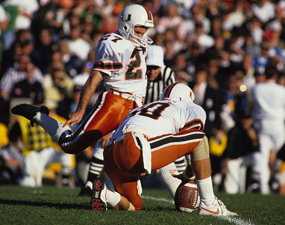
pC: He’s a transfer and he’s so young, you wouldn’t expect that.
LH: See that’s the thing about our team. We accept everything. He’s a basketball player and very passionate about the game just like we all are so he’s going to tell it like he sees it and he called all the seniors out one night and told them one day ‘you all are seniors and you are all letting your season go down because you are not being leaders’ and he said that in front of coaches in front of the whole team so I can’t wait to see what he does this year because he’s going to be special.

pC: Isn’t that the responsibility of the coaches to get the team motivated or you would say there’s only so much the coaches can do and then it’s up to the players?
LH: Yeah there’s only so much the coaches can do. We’ve had plenty of talks with the coaches and for whatever reason it just didn’t click. It clicks but not as much as when it comes from another teammate because he’s one of you, so if he sees it and he doesn’t think it’s going well it’ll click more.

pC: Do any former Hurricane players ever come to talk to you guys or hang out?
LH: They’ll come around like Rob Hite. Rob Hite will come and play pick-up with but you know what’s crazy is Ed Reed came and spoke to us one game after practice. At the end of practice he’s sitting there on the sideline and I’m like damn that guy looks familiar We’re shooting some free throws, about to bring it in, and coach says go in the locker room. We’re getting ready to leave the next day and he’s like go in the locker room Ed Reed is going to speak to you and I said ‘oh that is Ed Reed!’ So he talks to us, he’s real down to earth, very humble, he’s not about his ego at all and he gave us a lot of things to think about not just on the basketball court but off the court. He talked about how there’s a lot of guys that want to be in our spot and we’re taking it for granted. I will always remember that. He’s funny too. He’s one of my favorite football players, and to see him talk to us that was great.

pC: What do you think about twitter is it something you feel you can connect with your fans or something you use personally? Do you have a lot of fans messaging you?
LH: Yeah they [fans] do but they normally do it more on facebook. I haven’t been on facebook in a while but I had twitter earlier in the summer and I deleted it and when I got back to campus everyone was like man get twitter so I was like alright so I got it. It just keeps me up to date with everybody’s life and what they’re doing every five minutes. I think it’s fun to see what the big stars are doing when they’re like I’m watching TV or just chilling out

LanceHurdleTracking10
pC: Who’s your current favorite player?
LH: Kobe [Bryant]. Big time LA [Lakers] fan and I’m glad they won because it shut a lot of people up. You don’t realize how many Kobe haters you have until you go somewhere else and it’s ‘Kobe’s not going to win, I hope Kobe doesn’t win.’ Then Orlando is a Florida team and everybody’s like I’m going for Orlando and I’m like oh here we go, I like Orlando too but no match for Kobe.

pC: What do you think of LeBron James?
LH: He’s a beast. I don’t know whatever he was fed as a child, I mean 6’8 270 lbs, that’s ridiculous and he can jump out the gym like a guard, a fast guard. I don’t know how he can be stopped.
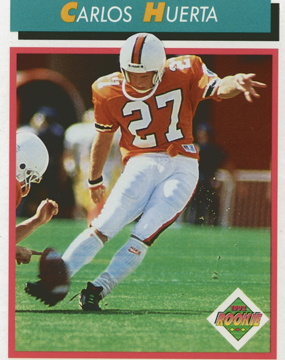
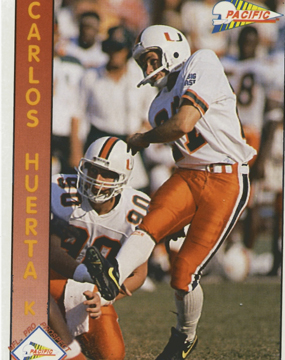
pC: What do you think from what you’ve heard is the biggest difference between college and the D -League?
LH: They really haven’t told me the game difference too much. I guess playing in the ACC is really hard every night so Raja Bell told me one thing is that there might be a lot of older guys in the D-League, more seasoned. Maybe 29 or 30-year old guys that might have gone overseas. A lot of people play in the D-League to get into the NBA so some go overseas and go to the D-League and some people are out of college for a while and then go to the D-League so for whatever reason they’re older so they’re a lot more physical. They’re going to be trying to knock you down so I’ve been in the weight room everyday trying to put on weight.
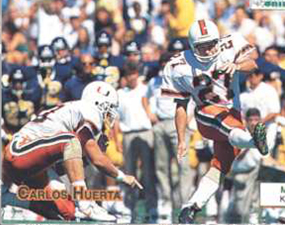
pC: Are you big follower of Canes football?
LH: Definitely.

pC: Do the basketball and football players ever hang out or cross paths? LH: Well we don’t hang out, like let’s go to the movies because our schedules are too different. They’re football schedule is different from us. So, it’s like we’re always doing something. We’re busy. But we’re all cool with each other and we support them, they come support us.

pC: A lot of football players go to basketball games?
LH: Jacory is always at the game. Jacory was on the court when we beat Wake Forest. He was jumping up and down. I’ll tell you one thing, Jacory is a real humble dude and I’m glad to see what he’s got coming to him because he deserves it. He’s not going to let none of that stuff get to his head. A lot of other guys are also very humble like Javarris [James], Graig Cooper. They’re not going to be walking around with their noses in the air.

pC: Who would you say is the biggest rival for the basketball team?
LH: Well Florida State we always took seriously because it was Florida State. But if anything, I couldn’t think of one to be honest. I couldn’t think of one. You know which one might start to become a rival, Virginia Tech because they booted us out of the ACC tournament the two years I’ve been there, so we don’t like that at all.

pC: Is it tough playing up there?
LH: Oh yea real tough and the only time we beat them is up there. But it’s real tough up there. Their fans are loud. They’re right on top of you too because of the way their arena is set up. Hopefully that’s going to turn into a rival

LanceHurdleTracking11
pC: Word Associations, give me the first thing that pops in your head when you read the following:

Frank Haith: Great coach
Sebastian the Ibis: The best mascot in the country
Jack McClinton: Best pure shooter I’ve ever been around
Florida State: I don’t like them
Chris Paul: My idol right now
Jimmy Graham: A beast
Coral Gables: A beautiful city

pC: Do you have a nickname?
LH: El boogie.

pC: El boogie? Why?
LH: Well Malcolm came up with the name. They would call me that when Malcolm got here and they put it in the media guide and everybody would see it, and during the game I would hear el boogie, the fans would say el boogie, let’s go el boogie. So it stuck and I like it because everyone’s like el boogie when they see me around.

pC: Do you have any pre game rituals?
LH: Yeah, I have to shoot around, then eat. Well I’ll shoot around for an hour then eat then I’ll come back and take a 45 minute nap and shower just to wake myself up.

pC: You go back home?
LH: I go back to the dorms or my apartment. I used to watch TJ Ford in the middle of when I’m getting dressed. Watching his pace. I watched it before the one time I woke up late and I only had like 15 minutes because we had to be there at a certain time and I was like oh, I have 15 minutes to get taped and everything so I rushed to the arena and it was the day we played Wake Forest this past year. I was like oh this is going to be a tough night so I’m sitting there trying to wake up on the way there. I get there and I throw water on my face and after we won I was like man I should do that more often!

pC: Who’s your favorite NFL team?
LH: My favorite NFL team is the Dallas Cowboys. I’ve always been a Cowboys fan but I’m a Saints fan too because I went to high school with Reggie Bush.

pC: Were you guys friends?
LH: Yeah, we were cool.

pC: He was good in high school?
LH: He was ridiculous.

LanceHurdleTracking12
pC: Did he only play football?
LH: He played basketball his first year. Freshman basketball and after a while the football coaches were like you’re a football player. He did track too. He was second to Michael Johnson in a 200.

pC: Do you keep in touch with him now?
LH: A little bit. I mean he’s busy. He’s really busy.

pC: How about favorite NBA team?
LH: Lakers

pC: Baseball? Do you follow baseball?
LH: I used to but I’d have to say the Padres or the Yankees

pC: Favorite food?
LH: Chicken and mac and cheese

pC: What’s one band or group/artist the most we could find on iPod?
LH: Jay Z or Little Wayne.

pC: What’s a movie you could watch over and over?
LH: He Got Game.

pC: A TV show you can’t miss?
LH: Martin

pC: What do you do in your spare time?
LH: Sleep or listen to music. Yeah, I like sleep

pC: Two websites you have to check daily?
LH: Twitter or my email

pC: Play video games? Madden?
LH: I love Madden. I actually play football games more than basketball games. That’s the crazy thing. I love basketball games but the football games everybody loves. I play Madden and NCAA Football.

pC: XBox or PS3?
LH: I’m a Playstation guy myself but I’ll play on anything

LanceHurdleTracking13
pC: What would you say was the toughest thing about playing at Miami?
LH: Balancing school. This year we were on the road a lot so we were missing a lot of classes and that obviously was important because it was a last semester. So, sometimes I was writing 2 or 3 papers a week and I had to take a laptop with me on the road. That was the toughest part because when I was at Santa Barbara we bussed a lot. But here we would go and stay the night and we would come back the following day so we would miss like 3 days. That was the tough part I just had to do a lot of catching up.

pC: So does Dorrell Wright come by?
LH: Yeah he does. He was at the camp. Dorrell is a great guy, he’s funny. He’s from LA so we clicked like that. When he first came out here I asked Jack to take me out to meet him. He’s really funny. If you’re around him you won’t stop laughing. He’s just real laid back you know there’s something about these NBA guys that they’re laid back. It amazed me how much alike they are to us. They’re just playing basketball. They’re just real funny and cool.

pC: So do you have to be conscious of what you eat during the offseason?
LH: No, I have a high metabolism I’m probably losing weight right now. I eat everything. I eat at late hours on purpose. For me I take that to the weight room and that turns to muscle. I have a real high metabolism. Last summer for a week I didn’t do anything, I was just resting my body, I was just eating everything, no weight lifting or nothing and I found out I lost weight because I wasn’t doing anything. So I have to do something. I try to stay away from McDonald’s and things like that, but my girlfriend she cooks me meals and I find that they put the most weight on me. So she cooks me meals and she helps a lot with that, she’s like ‘you gotta eat, you gotta eat.’ Breakfast I never used to eat, so she will wake up make me for breakfast so I wake up eat and go workout.

pC: So you lose weight during the season?
LH: A little bit but we’re always eating because we have pre-game meals, meals on the road, meals after the game and we’re always weight lifting, so I won’t lose a lot of weight but I will lose some because of how much I run.

LanceHurdleTracking14

pC: So what do you guys do on the road?
LH: Say we play on Wednesday, we leave Tuesday after class around 4 or 5 pm we’ll get there at night go straight to dinner and have our film session and scouting report and stuff like that. Then we’ll go straight to bed or we’ll go to our rooms and I had Dews who would pop in a movie and we’ll fall asleep to that and next day we wake up, breakfast, shoot around, a pre-game meal. Depending on how late we play we look at the schedule make changes and then we’ll play, go back to the hotel they’ll have food for us or whatever and the next day we’ll come back

We have charter flights for certain games so we’ll go on charter flights. For like Duke, and UNC they give us extra time to see our families out there. Last year when we went to Wake Forest and then played Duke we stayed there for a week so we had a lot of time. We went to a movie one time, we went to the mall, we got to experience what the Carolinas were like.

pC: Do the fans recognize you on the plane?
LH: Not really. Some will ask ‘who are you?’ Sometimes like when we’re going to Virginia the opposing fans will recognize us and say thing like your going lose and they just mess with us. If we won the stewardess would give us a shout out and say we have the University of Miami on board and the whole plane will be cheering. It’s just fun playing.

We at proCanes.com would like to thank Lance Hurdle for being so gracious with his time to do this very insightful interview for our new feature "Tracking proCanes." Click here to check out our past interviews with Leon Searcy, Steve Walsh, Frank Costa, John Routh, Chad Wilson and more!


Bookmark and Share

Tracking proCanes - Lance Hurdle - Part I

TrackingproCanes

proCanes.com is continuing our “Tracking proCanes” feature with former University of Miami and new Bakersfield Jam point guard Lance Hurdle. Hurdle played in 65 games as the Miami Hurricanes point guard between the ’07 and ’09 seasons. Hurdle averaged over 7.5 points a game in his two seasons as a Miami Hurricane. Before being a Hurricane Hurdle played for San Bernardino Valley CC where he was named Foothill Conference Player of the Year after averaging 16 points, four rebounds and six assists per game He also earned first-team all-state and San Diego Union Tribune All-Academic Team honors, while guiding San Bernardino to the Foothill Conference Championship. Hurdle was drafted by the Bakersfield Jam in the 5th round last Thursday in the NBA D-League Draft. Hurdles heads out to California on Wednesday to start preparations for his upcoming season.

Part I: Lance talks about getting drafted by Bakersfield, his days as a Hurricane and much more!

LanceHurdleTracking0
pC: You were drafted in the 5th round and going back to California. Have you spoken to any coaches or players from the Bakersfield Jam?
LH: I just spoke to the coaches and they just told me they couldn’t wait for me to get out there and stuff like that.

pC: So do you know any other guys on the team?
LH: I know of some other players, but I don’t know anybody personally.

pC: How many other point guards are there on the team?
LH: I’m not sure, I heard that they drafted one other point guard and I’m pretty sure they have two others. The other point guard they drafted in the 8th round from Chattanooga, I think.

pC: When did you find out you were going to Bakersfield? Did you expect to be drafted higher or was that where you thought you would go?
LH: I didn’t know where I would go, actually. It didn’t really matter to me as long as I just got drafted. I actually found out from Twitter first. I was following it on the draft board and I was trying to reload the page and as I was reloading my page a tweet came saying ‘good luck in Bakersfield.’ [Laughter]. I actually reloaded and it stopped right before the Bakersfield pick. I had talked to the Bakersfield coach the day before and they said they were interested and stuff like that, so I had a feeling I had a chance to be in Bakersfield. When the page paused right before the Bakersfield pick, I said “watch that I go to Bakersfield.”

pC: When did you actually talk to the coach?
LH: I talked to the coach the day after, on Friday. They were still busy during the draft and they knew I was on a time difference so they thought it would be too late to call. I actually talked to the secretary that night to get everything situated in terms of my flight and arrangements, just welcoming me and the next day I talked to the coach.

pC: You fly out Wednesday and when does practice start?
LH: I read somewhere practice starts Thursday, but Training Camp starts Sunday. I’m not sure when it starts, to be honest, because I have seen two different times. I just know I have to be out there Wednesday.

pC: So how does the D-League work?
LH: I signed with the NBA D-League and with the NBA D-League I sign with the league and then you’re in a pool of draftees and then they pick.

pC: So do you sign for a certain amount of years?
LH: Its’ just normally for a year because a lot of these players get called up to the NBA or they get a great contract overseas so this is a great opportunity to be seen.

pC: So you know any other people that went to the D-League and then went overseas. Do you have any friends that followed that track?
LH: Not really. I’ve heard a lot of stories about it.

LanceHurdleTracking1
pC: You said you worked out with the Miami Heat how did that go?
LH: It went well. I did the pre-draft camp like two or three times. Then they had the rookie camp but I couldn’t do that cuz I was back home in Virginia but I came back and I worked out with them for a week but they just needed an extra guy.

pC: The Heat are thin at point guard. You think that was part of the reason for them calling you in? What were their workouts like?
LH: It was like a team individual, running their plays and stuff like that. But the thing that I think hurt me was the fact that I went home and I graduated but then I had one more semester in the summer so I stayed in the University Village but my contract was up so I had no place to stay right after so I went home for a couple of weeks and they had called me and I was like, well I can come back right away and they were like it’s not that big of a deal but if it’s meant to be it will come back around so I wasn’t too worried about it.

pC: So were those workouts with all the starters?
LH: For the most the part most of the team was there but D-Wade [Dwayne Wade] wasn’t there, Jermaine O’neal, Mario [Chalmers] was there in the rookie camp, but I wasn’t there for that but he wasn’t there the week that I was there.

pC: Was James Jones there?
LH: Yeah it was voluntary for them but he showed up everyday.

pC: Did you talk to James Jones?
LH: Yeah, we actually exchanged numbers. He’s a real cool guy especially doing the pre-draft workouts so I was asking him what are they looking for and he told me ‘a point guard with a lot of confidence who can play defense and show that their aggressive on the offensive end.’

pC: So what would you say you’ve been working on the most? What part of your game?
LH: Honestly I went back to the basics. I think my biggest advantage on field is my speed. So when I work out, I just practice going full speed and doing a move at the same time. So that’s basically what I’ve been improving on, full-speed and into a jump shot, full speed and so on. Whatever I do is full speed and pacing it up and slowing it down just making my defender have to think about what am I gonna do next and whether I am going to go fast or slow

LanceHurdleTracking2
pC: Who do you workout with? Do you workout at UM?
LH: Yeah I work out with strength coach Matt Callaway, he’s a big time help and I’ve been working out with Raja Bell he’s in there too. He’s been a big time help as well just keeping me confident. He went through the CBA. I didn’t know that till he told me that and told me the D-League is more connected with the NBA so if that’s your goal you’ll be there one day if you stick with it. They’ve given me a lot of confidence and actually Boozer was up here playing pick-up. Roger Mason was with the Spurs so I’ve been around a lot of NBA guys all summer and just working out on my own

pC: Do you workout in the new gym they built?
LH: Yeah it’s nice. It’s like maybe 15 baskets in there. It’s two big main courts but on each side they have more baskets.

pC: Tell me about how you ended up at UM. Who recruited you and why UM?
LH: When I left UC santa Barbara that was a tough year for me, I didn’t play very much and I really did not have that connection with the coach that I would like to have so I decided to go to Junior College in San Bernardino and my older brother went to Cal State San Bernardino so personally it was a good fit for me because I stayed with him and I was just working out. I always wanted to come to Miami and we actually talked about just coming out here for a spring break and I said “man how cool would it be to get recruited by them and go on a full scholarship” and he said ‘don’t knock it, it might happen’ and I was like yeah they not gonna put a junior college transfer in the ACC. But one night I get a call from a 512 number, that’s Texas, and you know Coach Suarez and Coach Haith used to be at Texas and Coach Suarez still had that area code number. So I asked my brother what area code is 512 and he says Texas so I was like it might be Texas A&M because I heard they were trying to recruit me. So I listen to the voicemail and it was Coach Suarez and I was so excited. From that point on they came to see me at our college championship game and I had my best performance of the year and from there God just took over.

pC: So were any other schools recruiting you at the time?
LH: It was UM, Marshall, Southeastern Missouri State, Western Carolina, Tennessee Chattanooga. There were a lot of them

pC: So Miami was the top one?
LH: It was Miami, the day I committed to Miami I took an unofficial visit to Pepperdime and during that day when we took the unofficial with my mom I came home that night and said “you know what, I just want to go to Miami, I don’t want to do the five visit thing, Miami is special.”

LanceHurdleTracking3
pC: I didn’t know that your dream was to come to Miami so it must have been then not that difficult to transfer?
LH: It wasn’t difficult at all.

pC: You didn’t have to sit out a year so when did you sign and when did you start working with the team?
LH: I signed April 15, my birthday, and I came out here in June. I worked out in the summertime and went to class. They wanted to get me out here so I came out here second session of summer and I came out here started working out with the team, taking classes, school started and then the season was here.

pC: Who was the other point guard when you came in?
LH: The year I came was the first year [Denny] Clemente was gone. I came in with Eddie Rios, so it was Eddie and I. That’s the year they were still trying to put Jack [McClinton] as a point too, but since we had Eddie and myself they just kept Jack at the two for a little bit.

pC: Last year Jack played a lot more the point and then you lost Eddie. Talk about that and not having Eddie as a back-up. Did that hurt the team a little bit down the stretch?
LH: It did effect b/because Jack had to play the point and Jack is a good point guard but he can score and teams started to key on him when he’s at the point guard position but not having Eddie hurt us because it limited the looks Jack had and it tired him out. Jack is a good player and he found his shot but if he had Eddie it would have helped us out a little more.

pC: Talk about the previous season you guys surprised everyone and then the following season many would say you didn’t live up to expectations. Talk about that and what went wrong the second season and what went right the previous season.
LH: The first season we felt disrespected. My first year here when we went to the tournament. we felt like everybody picked us to finish 12th in the ACC. We felt we get no respect. We worked hard in practice and we even put extra time in practice. We went down to Mississippi State in a tough environment and pulled out a win there and that’s when we really came together so we just felt we put that chip on our should the first year but last year everything was given to us. We were preseason ranked, we were on TV a lot, we were in the media and I don’t think we had that edge that we had to work for it and by the time we got it, it was too late.

pC: So would you say there wasn’t a sense of urgency from the players?
LH: Yeah I think last year’s team talent on paper was obviously better. We had a year of experience with everybody we had good freshmen coming in. Julian Gamble who was supposed to play the spot Anthony King left open, was young but very skilled. You just had too many chiefs and not enough Indians, you know what I mean? We had a lot of good players. My first year we knew our role but last year it was too many people trying to find their role, but everyone is going to be good this year.

pC: You think so?
LH: They’re really going to be good and Malcolm Grant, who I work out with, that’s like a brother to me. When he first came to campus, being point guards that’s how we clicked and we’re real good friends and he didn’t go back home and we stayed out and worked out together and competed against one another so him as a point guard, his talent is going to take him to another level, but his leadership more importantly
LanceHurdleTracking5
pC: Who is going to be the scorer now?
LH: James Dews can score the ball.

pC: He showed that last year but he wasn’t consistent.
LH: I think he’s worked on his scoring ability and being able to score in a variety of ways. Dews is a good scorer Dequan [Jones] has gotten much better Dwayne Colline is going to get you and he’s going to be a beast this year. Dwayne and you’ve got the freshman guys who are really good. Julian Gamble, Reggie, you’ve got a lot of really good players.

pC: Who would you say is your mentor? Who really helped your game when you were here?
LH: Coach Suarez. That’s my go-to man. When I decided to make the decision whether to do the D League or not, that’s the first person I called. Everyone else when I talk to them about going overseas or the D League they give me negative stuff about the D League. When I talked to Coach Suarez the first thing he said to me is you’ve got to do what’s best for you. Overseas is good but there’s some negatives. The D League is good but there’s some negatives, either way wherever you go there will be some negatives and positives. I worked out with him after every practice during the season even now when he’ll come in and work out with me. He’s just a great guy.

pC: Where’s the toughest place you had to play when it was a road game? Where the fans were the worst the loudest?
LH: Well the obvious ones were Carolina, Duke, Clemson but I have to say Kentucky. They had 25,000 fans and when they started to come back they were so loud I couldn’t hear anything, literally. It was crazy.

pC: Talk about playing at bank united center? Was it tough to play somewhere that was never full?
LH: Well when we had a packed house it was easy to get pumped up for games but obviously the two years I wasn’t here they would talk about how no one was really in the stands, unless it was a big game. So it was different. The student section was always packed. I love our crowd, I love our fans here even during school they say ‘hey Lance good game or when’s the next game.’ Even when we’re out in the city. I love our fans here I wouldn’t trade them for nobody.

pC: So what do you think about what Coach Haith is doing with the program? How do you see the future?
LH: Coach Haith is a great coach and a great person. He’s a father figure to everyone. He’s definitely taken this program to a another level but I think he will stay. Last year you heard the rumors and he even said it himself, this is where I want to be and this is what I want to be doing and you even see it in his recruiting each year. It’s getting better and he’s just a great coach and a great guy.

LanceHurdleTracking4
pC: So what do you think Miami needs to do to take it one step higher?
LH: To get that ship back, I think they’ve just got to play hard because I think they were picked last again. I was looking at it with Malcolm. I think they’re picked 11th or 12th either way it’s disrespect, that’s not where they want to be. They don’t like it at all. They’re working hard, they’re running and they’ve gotten better so I think they might have a lot of growing pains because they’re young but sometimes being young can help you out because with young players there’s a lot of confidence. They really don’t know what they’re getting themselves into, so they just want to play and there is not a lot of pressure at all and the expectations are going to be like just go play and that’s the best time to play.

pC: Why the number 1? Have you always been number 1?
LH: When I was young and started playing basketball I had like number 5, number 14, random numbers and one day we got new uniforms for my AU team and my dad had number one and I said alright I like that so I’ve had that it since but when I got to high school, our high school had no single digit numbers. Our high school coach was very stern, I love him to death, so I said well let me get number 11. 1 and 1 together and then when I went to Santa Barabara I had to pick a totally different number, number 3, and that didn’t work out at all, so then I went to San Bernardino and I got “1” back. When Coach Suarez said ‘hey what number would you like?’ and I said “is “one” available” and he said ‘yeah, you’ve got it’ so I kept “one.”

pC: So at what age did you start playing? Was your dad a coach?
LH: Yeah he was a coach, he was an assistant coach to our AU team but I started playing with our AU team when I was 7 years old.

pC: You were always a point guard?
LH: I was thinking about this last night. It’s crazy that you ask me that. I was taller than everybody else when I was younger so I played “the three” but I was young so you have no true position so I was “the three” until I was about 13 [years old] and my AU coach said in the middle of the game, he says, ‘you’re a point guard not a three so you’ve got to bring the ball up,’ and I was like “what? Alright, whatever.” So it took me a while to get used to it but I got used to it and it’s been with me ever since.

pC: You could always handle the ball even at “the three” spot?
LH: Yeah but when I was 12 [years old] I wasn’t good. I would just score, score, score at the “the three” position but I learned how to be a point guard.

Click here to read Part II of our interview with Lance Hurdle and see what he has to say about who is favorite player growing up was, Jimmy Graham, the hardest away game he played in the ACC and much more!


Bookmark and Share

Tracking proCanes - Bruce Johnson

TrackingproCanes

proCanes.com is continuing our “Tracking proCanes” feature with former University of Miami and current New York Giants defensive-back Bruce Johnson. Johnson played in 42 games with 25 starts for the Hurricanes and finished his career with 69 tackles, 2 interceptions, 11 pass break-ups and 3 tackles for loss. Johnson signed as an un-drafted free-agent with the New York Giants in 2009 and has played in the Giants first two games of the season logging 5 tackles, 1 forced fumble and 1 interception returned for a touchdown in week 2 against the Dallas Cowboys. Johnson is the cousin of former Hurricane cornerback and current Seattle Seahawk cornerback Kelly Jennings.

Bruce was kind enough to take time out of his busy schedule after the Giants’ week 2 win against the Dallas Cowboys and in between signing a lease on a new apartment and preparing for the Tampa Bay Buccaneers to speak with us. Read below to see how he went from being an un-drafted free agent to returning a Tony Romo interception for a touchdown in week 2.
 
BruceJohnsonGiants
proCanes: So have you started to settle down in New York?
Bruce Johnson: Yes Sir. I just finished signing a lease yesterday for an apartment.
 
pC: Let’s start with after you graduated from the University of Miami, you were supposed to be the only Hurricane draft pick yet you ended up going un-drafted, talk about that.
BJ: It was a little nerve racking but I also knew anything could happen. I was just sitting there watching and I was a little upset but I sort of wasn’t. It just became more motivation for me when I got here [New York Giants] and when I got into Rookie Mini camp, OTAs, Mini Camp and Training Camp. I wanted to show them that I was supposed to be a draft pick and that’s been my goal ever since I got here. So far it’s been pretty good, but I still feel like I have a lot to prove.

pC: So you weren’t that surprised instead of you being the Cane sole draft pick it was Spencer Adkins?
BJ: I think that either one of us could have gotten picked up. Congratulations to Spencer, I really like how he got picked up in the draft. I’m not upset about it or anything. Stuff happens like that. I just had to take it and move on from it and that’s what I am doing now.

pC: I would assume you had a couple of teams to choose from in terms of signing a free agent contract.
BJ: I got a call from my agent and he told me that New Orleans, Tamp Bay and the Giants wanted to have me come in for a tryout. Then he called me back five minutes later and told me that the Giants wanted to sign me, so I took that and went with it and I’m here right now.
 
pC: Were you pretty confident that you were going to make the squad when you went up for Rookie Camp and OTAs?
BJ: I was pretty confident because that was my whole goal when I came up here. I had something to prove the whole time I was up here. No matter how many plays I made or what I did right I felt I had to improve even more. They don’t really give you feedback when you do a couple of things or you think you’re doing something good. That’s what has kept me going and kept me trying to do the best I can. I was trying to get a reaction, just to keep doing my best to get a reaction and see where I was. You know, you never get a reaction and I’m still trying to get a reaction [laughter]. That is what is still driving me to be the best.

pC: If you have a good day in practice they don’t tell you?
BJ: They’ll say something like ‘good job’ or you did this good, but it won’t be like they are praising you. There are certain guys who, I wouldn’t say have a certain leeway, but they may not have to worry about too much. I am trying to get to that point where they won’t have to call my name so much for certain things, and I can just go out there and play and do what I have to do. I ‘m progressing each day, I just have to take it one day at a time. Hopefully after a couple of years I can be that guy.

BruceJohnson2
pC: What has been the toughest part about from going from college to the pro’s?
BJ: In college, I started for like my last two years and I played a lot before that. Coming in and being un-drafted and being on the bottom of the totem poll [was different]. You’ve got a guy ahead of you who’s got years of experience. I am just trying to prove what I can do. They already have their money invested in someone and penciled in as the starter, so the hardest adjustment was that I have to continuously prove what I can do. It was hard for me because I knew they had the guys in there that they probably wanted in there already, but just trying to show them and keep working because you never know what is going to happen week in and week out.  During mini camp and stuff like that you never know if you’re going to be cut or they’re going to bring somebody else in. I wouldn’t say it’s the worrying but just the fact that you could be cut the next week or even the next day.

pC: What was the one part of your game you had to work on?
BJ: The one part of my game I had to work on was just taking every receiver like they’re the best. In college you play a bunch of different teams and not every team you play is up to the caliber of Florida or Oklahoma. Every practice I went in, I had to approach every receiver like he was Randy Moss or T.O. [Terrell Owens] because everyone is good. Just staying focused on the receiver that I was going against and studying more was the main thing for me.

pC: You’re playing most in the nickel formation, are you playing more in the slot or the outside?
BJ: I’m playing on the outside when they have three receivers, so that’s not too big of a change from my UM days.

BruceJohnsonTrackingGroup
pC: Talk about having former Hurricanes Sinorice Moss, Kenny Phillips and Jeff Feagles there. How have they helped you being up in NY.
BJ: When I first got signed Sinorice called me and told me he was proud of me and just told me to come in and be ready to work. When I got there they took me in and showed me the ropes and they’ve been looking out for me ever since. I work against Sinorice almost every day. He doesn’t take it easy on me and makes sure I get good work, and I make sure he gets good work. He tells me that he’s proud of me and to just keep working hard and he’s going to work me. I talk to K.P. [Kenny Phillips] and he just tells me to keep doing what I’m doing and just make plays. When I first got here I sat down with K.P. and went over some of the coverages and formations and everything. Jeff Feagles is actually my mentor on the team and that’s pretty good. So, I just came and it was like I didn’t miss a step. Coming from the University of Miami they just took me in and showed me the ropes and they have been doing that ever since.

pC: I’m sure that helped your transition.
BJ: Yeah that helped my confidence a lot. Having those guys here was a big boost for me.

pC: Did you expect to play as much as you have in the first two weeks?
BJ: To be honest with you, this is what I came in to do. I didn’t know I was going to play this much, but I told myself that if I did get the chance I would make the best of my opportunity. I’ve been having my chance so every chance I get, I just make sure that I make the best out of it to help this team and help myself out as well.

pC: Week 1, you force a fumble and week 2 you have a huge pick 6. Talk about the pick 6 and how you played it and what you saw.
BJ: Basically during that whole play we were in a cover 3 coverage and Romo saw something in our defense and checked off. When he did that Antonio Pierce, the quarterback of our defense basically, checked off into a cover 2 and switched the whole defense around. I have to give props to him because if it wasn’t for him I probably would have been somewhere else that I wasn’t supposed to be, [laughter] so I give him a lot of props for that. When Pierce checked, it put me in a totally different mindset of how I had to play my coverage and what I had to do. Once I jammed the receiver and he was going in, I passed him off to the nickel back and once I was about to go to the other receiver I just see the ball up in the air and caught it and then all I was thinking was that I just have to get to the end zone before anyone touches me. That gave me a good opportunity to show my speed. Some people kind of questioned my speed around the combine so that was a great opportunity to show my speed. I was just making sure that I didn’t get caught before I got into the end zone.

BruceJohnsonTracking
pC: Talk about your transition of going up and living in New York.
BJ: When I first came up, it was my first time coming up to New York. To be honest with you, we’re based out of New Jersey, but I have been to the city and it is a lot different from Miami. You see a lot more people walking, there’s a lot of commotion. When they say that city never sleeps, they’re right, it’s always going. I had to get adjusted to that because I’m not used to taking trains, cabs or anything like that. Having all those people close together on the sidewalk walking by you, I had to get used to that because I didn’t like that at first. I really wasn’t used to that. I was used to having my own space and riding in the car and it was kind of funny to see people in business suits getting on buses and doing a lot of walking. When I see people in Miami in business suits they’re in nice cars and everything. It was sort of like a culture shock to me, but since I’ve been here I have sort of gotten used to it and I’ve been just trying to make the transition.

pC: Do you go to the city often?
BJ: I’ve been there a couple of times, but I don’t go too much.

pC: What’s your schedule like during a game week if you play on Sunday?
BJ: What it is, is we’ll play Sunday and then we’ll come in on Monday we might lift and basically we’ll watch some film of the game and we’ll be done by around 1 o’clock and then we have Tuesday off as well and then we’ll come back on Wednesday and that’s pay day, so we get paid on Wednesday. Then we’ll do some preparation from Wednesday until Saturday. Saturday we’ll go to our team hotel if it’s a home game or we leave on a plane to go to an away game. If it’s a late night game like this past Sunday, we’ll eat and have little meetings on Sunday if it’s an early Sunday game then we’ll do all that the night before.

pC: Who has helped you most in your adjustment to the Giants.
BJ: Pretty much all the DBs from the safeties to the veteran corners. Corey Webster, Aaron Ross, Terrell Thomas, Kevin Dockery all of them have helped me out a lot. There are no secrets everybody is trying to help everybody. I ask all those guys questions about certain plays so I can’t pinpoint one person and the coaches are very helpful as well.

pC: You’ve gotten a lot of playing time in the first two weeks because of injuries do you know what’s going to happen when people get healthy?
BJ: I’m just going with the flow right now, only time will tell. Until then, I’m just going to keep doing what I’m doing.

pC: Let’s Talk about the Canes right now, what do you think of their start so far?
BJ: Yeah man, they’re looking real good. I hate that they had to start when I left [laughter] but at least they started it. I’m glad to see those guys doing good because there are a lot of guys that I played with [on the team] so it’s good to see them playing well and being ranked in the top 10 right now. I hope that they can just keep it going just for themselves so they can have a better outcome when draft day comes.

pC: What do you think is the key to this week’s game against Virginia Tech?
BJ: As long the offense keeps clicking like they are and the defense keeps attacking, bringing that pressure and everybody keeps hitting I think we’ll be fine.

BruceJohnson
pC: What is the difference between last year’s defense, which you played on, and this year’s defense?
BJ: I feel like they have a lot of stability now. I think they have everything set and everything how they want it. With the coaches being set and being there for a while, that’s the big thing that they need and the players getting used to them and buying into the system and knowing what to do. Plus those guys have a lot of talent and putting the coaching and the talent together is a big improvement. Guys are also hungrier this year.

pC: Did you think Bill young was going to be there for a while?
BJ: As a matter of fact I did, but things happen and you just have to keep moving.

pC: You played in both the Orange Bowl and Land Shark Stadium. What’s the difference, did you miss the OB?
BJ: There will never be anything like the OB [Orange Bowl]. It’s tradition and it’s been with the Hurricanes for the longest. Whoever’s decision it was, we had to move and playing at Land Shark wasn’t bad, but you did miss the OB sometimes because you just had that feeling, the Orange Bowl voodoo. I did miss the OB but having a big screen too, was pretty nice. They both had their pro’s and con’s.

pC: You played under both Randy and Larry, how did things change?
BJ: Both coaches demanded greatness out of their players. I didn’t really see much of a difference. I don’t want to say they had different coaching styles but they both demanded greatness and perfection out of their players. They both wanted to win and I couldn’t really tell much of a difference between them.

pC: This week you’re going up against Kellen Winslow Jr. Any thoughts?
BJ: If I have to guard then I have to guard, just like anybody else.

We at proCanes.com would like to thank Bruce Johnson for being so gracious with his time to do this very insightful interview for our new feature "Tracking proCanes." Click here to check out our past interviews with Leon Searcy, Steve Walsh, Frank Costa, John Routh, Chad Wilson, Sinorice Moss, Twan Russell and more!


Bookmark and Share

Tracking proCanes - Twan Russell - Part II

TrackingproCanes

In Part II of our interview with Twan Russell, Twan talks about his recruiting experience, the Washington game, the NFL Draft, Randy SHannon, the current state of the program, his love for cartoons and much more! Click here to read Part I of our interview with Twan.

On Friday September 19th, The Russell Life Skills and Reading Foundation will be holding it’s White Tie for Literacy Gala at the Seminole Hard Rock Hotel & Casino to raise even more money for the community. To register for the Gala click here.

pC: Do you remember anything from your recruiting visit?
TR: Yeah, they dropped me off at the wrong hotel. [Laughter] Darrin took me out one night and Mike took me out the next night. Mike got confused on the hotel because there were a couple of different Marriots so he dropped me off at the wrong hotel. I didn't notice, I didn't know Miami. I'm from Fort Lauderdale. I get out of the taxi and get to the counter and I'm thinking this doesn't look right. I ran back outside, I don't know Mike's number and I had to take cab and I didn't even have any money! [Laughter] I'm bartering with the driver and telling him I'll get my mom on the phone and she can pay you. So yeah, Mike took me to the wrong hotel. We still laugh about today.

pC: You still talk to them?
TR: Yea, I talked to Mike the other day and I was with Darrin a couple of nights ago. Our families are friends.

TwanRussellTracking6
pC: What would you say was one of your top memories from UM? You never won a Championship.
TR: I won one bowl game. I came in '92 and we played for the National Championship. I was on the active roster, so I would travel because at one point we lost a couple of linebackers, Rohan [Marley] was out and so was Corwin Francis so what they did was they told me they wouldn't play me because that would burn my redshirt but they would take me just in case.

pC: That’s great for you, you got to travel.
TR: It was great! I was there for the San Diego game. [Laughter]

pC; So you got to witness all the brawls, or did you get involved too?
TR: So..... [Laughter] I got to travel that whole year. We played for a Championship and lost, the debacle in New Orleans. The next three years we were in the national championship hunt. My fourth year we couldn't go to a Bowl Game and then my last year we finally won a bowl game, the CarQuest bowl, we beat Virginia. It was a great game, but for me it was bittersweet. It was a great game because we won, but I hurt my knee on the last play of the game. So, I'm going into the draft, though at the time I didn't know I was going into the draft, and I'm preparing for the NFL. I had a knee sprain on the last play of the game. I don't know what happened, some guy fell on my leg and it was a disaster from there. It was awesome because we won though.

pC: You were part of another tough game, the Washington game.
TR: I started that game.

pC: Wow, I'll never forget that game.
TR: Shucks, you? I remember Napoleon Kaufman, He caught the screen pass and I was actually out there for that play. I read it perfectly but it was three against one, and the rule is, if you're outnumbered like that you kind of throw your body into it and take everybody out. I don't like that because you can create three different holes for a guy and he has three different ways to go. My rule is I try and split it so at least I can make him cut back inside or outside. So I decide to split it and made him cut outside thinking I have all my boys coming and they just weren't there. [Laughter] I can still see him running. I mean he's down there in the Keys by now! That killed me. That was probably one of the hardest games because it wasn't about the team, it was about the dynasty. When you carry that kind of weight on your shoulders you feel like you let all the guys who built the place, the guys that didn't win down. We forget about those guys, from when the program was cancelled and then we brought the program back, people forget how we built this program on their backs and they never got to see on the field the rewards but it's because of them we were able to come.

pC: I am sure they lived it through you guys.
TR: I hope they did. I really hope they did. When we go back to some of these alumni weekends. It's great to hear their stories. Maybe they can't talk about National Championships but they're talking about guys who went to the NFL and the bitter rivalries, the Gator Flop. I STILL hate Florida. Nat Moore is a close friend of mine and outside of him going to Florida he's a really good dude.

pC: You're having a hard time finding a good memory.
TR: By University of Miami standards a great memory is a National Championship. I have three bowl rings that I have never worn. I have never even shown my kids, I just realized that as we were talking. They're sitting underneath my bathroom cabinet. I don't display them and at the end of the day, I don't want to be rewarded for losing. I had great moments. There were a lot of great games, some of the Florida State games. The West Virginia game with Tremain Mack coming off the corner and blocking the punt was awesome. We had some great moments, for me I kind of would define happiness when you win. I just think that's one thing I never accomplished. I have never won a team sport my entire life. At St. Thomas we were runner-ups, we lost to Fort Walton Beach, Danny Wuerffel. Every time I see Danny I slap him on his head. I won one championship in track in hurdles but you celebrate that by yourself so I have never won a team championship. I wish I had. That's why I think all the good memories I have are not great, they are just good memories. Winning is good, but Championships are great.

pC: Where was the toughest place to play an away game?
TR: There are a couple of places. West Virginia was always tough. Virginia Tech was always tough only because they would grow the grass three inches high and then they would wet it. I wouldn't say Florida State was a tough place to play, it was more of a great place to play. I don't think that place ever defined whether we won or lost the game. Outside the chants it wasn't that bad. At West Virginia your life was in danger. They hit Randy Shannon upside the head with a trashcan. They would spit on you. We would wear our helmets all the way onto the field. They would pour drinks all over us. That was a violent place. I used to get scared. Am I going to look up in the stands and see someone with no teeth?

pC: Or throwing his teeth at you.
TR: Exactly, he probably would have. [Laughter]

pC: Did you have a nickname either in Miami or as a pro?
TR: That I am willing to share? [Laughter] In college I didn't really have a nickname, T Russ, nothing crazy. In the NFL they would call me “Angry Christian.”

pC: Why is that?
TR: It was kind of a play on words because most people say Christians are nice and sweet but I was a special teams player and I had to run down the field and knock someone out and there is a switch that would turn on. People would tell me to calm down and I wasn't going to calm down, I'm playing football. I would get in a little fight or something and they would say 'Christians don't fight' and I would say "go read the bible!" You read some of the most gory wars in the bible, it's the Christians fighting, so I got the name "Angry Christian" after practice one time. I got in a fight with one of the offensive lineman. He just hit one too many times and it was enough and I lost it. I remember [Dave] Wannstedt was the coach at the time and he says 'Is that Twan?" Yeah, "A C," angry Christian.

TwanRussellTrackingRedskins
pC: So you didn't expect to get drafted?
TR: No, honestly the first time I heard my name in the NFL was when there was scout with the Raiders in the middle of the season at the facility watching film.  I didn't know who he was and I was going in to watch film and he says 'you need the room?' I asked him if he was a new coach or something and he said 'no, I'm with the Raiders, what's your name?' I told him and he said 'Oh yeah, I was just watching you, you might be OK when you get to the NFL.' I said "NFL?" [Laughter] He said 'hey, I see you being able to play a long time on special teams and if you really work hard you could become a starter.’ I was like wow. Maybe in the back of mind I knew I wanted to go, but you never know. I was taking internships at Channel 10 and with the Urban League. I was thinking when this thing finishes, I'm going back to mama's house. I was more focused on graduating from college and making sure that [I could make a future for myself]. Yes, I was training and staying shape, but this was during football season, I was just concerned with the next game. After that conversation, it was in the back of my mind.

After the season Randy spoke to me and was kind of giving me some instruction on what I should be doing as far as my training and the blueprint of what the NFL was looking for and what they're expectations were. He told me to make sure I was healthy and when it was time to run, to run my best. He told me I needed to go to the Senior Bowl, but I ended up not going to any of them, but I went to the combine banged up. I ran, but didn't run well, I ran a 4.7 [seconds 40-yard dash], but I was still hurt, so a 4.7 hurt wasn't too bad. I ended up being drafted by the Redskins.

TwanRussellTracking2
pC: Did you sit there on Day Two and knew you were going to get drafted.
TR: It was kind of mixed. There were some teams interested, where they were saying depending on what happens they might be interested in you in the third round. Like on day one I'm sitting there with my mom and brother, just hanging out. It was kind of stressful, my agent had told me you're probably going to go in the 4th or 5th round but depending on the team you might go in the 3rd round. So on Day 1 I get a phone call and it's the Detroit Lions. They asked if I was ready and told me they were thinking about taking me on the next call, they asked if I thought I could play linebacker and I told them I was ready. So, they had made mistake. They meant to call Matt Russell. [Laughter] So the guy calls back and apologizes and tells me the intern gave him the wrong number and name. That was tough. I was done after that call. I didn't want anyone around me. Day two we were just sitting around watching and my little baby niece walks up to me and says 'Uncle Twan, did they call your name?' and I said "No they didn't call my name! Stop asking me." [Laughter] Everybody had their marching order to leave Twan alone. The Redskins called me, but it was kind of weird because I never talked to them, they never showed any interest at least not to me. A couple of days before I guess they called my agent and told him they liked me for their 5th round pick.

pC: So you were with the Redskins, Dolphins, and Falcons, what was your favorite stop?
TR: The Dolphins, without a doubt. I started a few games, but I was a backup. I played all three positions depending on what year it was and who was hurt and what the situation was. My first year I had a big nickel role but at the end of the day I was a special teams player and I was proud of it but don't get me wrong. I didn't like the fact I wasn't starting. I will never forget what Randy told me. He told me 'Twan everybody in the NFL has a niche. Focus on special teams and you'll have an opportunity to play linebacker at some point.' I took that and never forgot it and if everyone has a niche, what's my niche?

Early on, I wasn't a big guy, I wasn't as big as I needed to be for linebacker but I was fast. So my rookie year I went to Pete Garcia who was the special teams coach and I told him "I'm going to be your best special teams player, I just need you to point me in the right direction" and he just starts laughing. He's an old school guy. I came out there young and glassy eyed. He just turns and tells me 'show me on the football field.' I thought the guy hated me. He cussed all the rookies out, he acted like he didn't like us, but when it came down to it, he did that because he wanted to see if we could handle it. One of the defining moments was on opening day when I walk away with a few tackles and he taps me on the butt and says 'hey you did a pretty good' and then he cussed me out again. That was the first positive thing I heard the guy say for the four months I'm associated with the team. [Laughter] It's memories like that, that made it all worth it. Football is a fun game and it has afforded me to do a lot of things, have a great family, taught me how to deal with different people.

pC: What ended it for you?
TR: My third year with the Dolphins, third game of the year, I chipped the bone in the back of my knee. Initially we thought it was a minor deal and I could come back and I tried to come back without having surgery. I ended up having surgery, came back a couple of weeks after that and it just wasn't well. It was a grinding and burning sensation in my knee. I've been hurt but I had never had an injury that I couldn't play with. I stayed hurt, I was always small but I played. From the time you started the year everything is hurting so for me pain was just my friend. This was the first time I couldn't turn the pain off or I couldn't find something to cover the pain. It was tough. That year I was on a cane and crutches and I ended up getting picked up by Atlanta. They kind of took a chance on me and they needed a special teams guy to come in and help. I played the year but it was painful, it was the worst experience I ever had. I have no idea how I played on Sundays. I had an OK year, I was second the team in tackles but I was a skeleton of who I used to be. It just wasn't a good fit. I knew at the end of the year, unless I had a significant increase in comfort, I wouldn't play again. I came back home and I was at my mom's house because she had gotten sick. I was crossing the street and I misjudged the car and normally you just run out of the way. It didn't go that well. I limped and kind of had to jump and I remember sitting there, like, I'm done. I had to get back on crutches and a cane again for a year. I wasn't close to getting hit but it was just so much effort to cross the street. It was rough so I ended up retiring. 

pC: Was it tough to retire?
TR: No, because for me I wasn't retiring because nobody wanted me , but because I couldn’t do it. I think there is a difference. When a guy is healthy he is thinking he can still go out and play, that's tough. But when you can't physically, I think it's an easier pill to swallow. 

TwanRussellTrackingRandy
pC: Who was the most influential person from a football standpoint?
TR: I'm kind of like a hodge podge of a bunch of different coaches. Probably the coach I spent the most time with and had the most opportunity to learn from was Randy. He was my position coach in college and my position coach with the Dolphins. I spent six years of my upper football life with him. 

pC: Why do you think the program slipped the way it did in recent years?
TR: Whether it's a company or a marriage, a city or country you have your "lows." It's not if they come but it's when they come. You have to manage the lows to make sure you are preparing yourself to go back to the "highs." People change, lifestyles change, players change, the dynamics of the school changes, everything affects football. You change the acceptance rate by one percentage point, well that's two players. A lot of things kind of fell into that. I don't blame one individual. A lot of people try and pass it off on Larry Coker, or a lot of people try and pass it off on Miami's academics or the Orange Bowl. It's everything. For whatever reason it happened. We were down then, and we're on our way up. You can see it. If you look at every college institution there are highs and lows. That's just the way it is. No one really knows why but if you change the offensive coordinator or your quarterback gets hurt it can change the entire year. There are a lot of variables that go into it.

A few years ago we were down, I mean we were as low as you can go. You have people wanting to jump off a bridge and drag the team with them. That stuff hurts, but what's the plan going forward? Who is the person we are going to put in there to make sure that five years from now we will be on our way up. Look at Nebraska. Dynasty. Michigan. Dynasty. Look at Ohio State. People forget. These dynasties go down a little bit. The difference between the University of Miami and them is that we're more than a dynasty and people have higher expectations for us, but we're not invincible. I'll tell you I think we have somebody in place who is building it the right way for longevity.

pC: So you think Randy Shannon is the man?
TR: Absolutely I think Randy Shannon is the man. People say it should be faster. You ever do something bad to your wife? Have you ever said something stupid? How long did it take you to fix it? It's years! It doesn't happen overnight. One bad thing can destroy a dynasty and it may never come back. We have a guy who is building it the right way. Unfortunately he had to get rid of some things, redo some things and retool. He had to bring in a different type of culture. The culture that worked 20 years ago doesn't necessarily work today. If a CEO or manager can't change with the times they're going to fail.  The University of Miami is changing its culture. The things that we did 20 or 30 years ago don't work today. The mentality is a little bit different, so now we have a guy in there that's willing to change it a little bit and he's doing it the way he knows works. These guys need someone who is strong but loving. He's his own man. I don't care what you say about Randy Shannon, he's his own man and I respect that. At the end of the day they're going to judge him. I trust him. I know what he did for me. I know the man I am, a lot of it has to do with my relationship with him and the people at the University of Miami. They're going to be back. You can see the building blocks. We're impatient! When we were going down, other people were going up. I know some people say it's a four-year term, but it's really longer than that. We didn't get into this hole in one year, we got into this hole in multiple years and when we were going down these other teams were building. I mean you could say in essence that it's a six to seven year turn that we're trying to catch up with. Do I think it will take six to seven years? No.  I think Randy has a real good blueprint. I don't like making predictions especially when it comes to a team I have an affinity for. I know this season is very difficult and people are talking about these first four games. 

pC: You may be a little biased because you work for the Dolphins, but what do you think about the move to Land Shark Stadium?
TR: [Laughter] I'll be honest my initial thought when they first talking about moving from the Orange Bowl to Land Shark Stadium. I thought, I don't know about that, I'm thinking about tradition, I'm not thinking about amenities. Land Shark Stadium is one of the better stadiums in the world. When we classify Land Shark Stadium we measure it by world standards. Someone asked me one day 'if that's the case and the Orange Bowl is so great, you must take the family there all the time and never miss a game.' I was like "it's tough for me to take the kids there because there are no bathrooms, there is no cover for them, if it gets to hot I have no where to take them." And the guy is like 'if that's the case then why do you care about the change?' I paused and thought that it makes a lot of sense. Then I thought about it some more and concluded it's a great transition. You talk about the amenities alone outside of the football game.  I think at the end of the day people go to watch the game because of the game, not because of where it is. But people now are like 'hey if it gets too hot, I can go in the suite or I can get myself a nicer meal or go to the bathroom and be comfortable for a couple of minutes. 

SinoriceMossTrackingOrangeBowl
pC: The atmosphere though isn't the same.
TR: I am biased now, I am biased. This year will be a little different; we'll have a couple games that we pack them out. We're going to really see a hump because Land Shark Stadium is a special place when you get a big crowd in there. Now you can't say it doesn't look like the University of Miami's home. They transform it very well especially when they decided to put the "U" in the middle. When you win, none of that matters.   

pC: Word Associations, Give me the first thing that pops in your head when you read the following:

Randy Shannon: Greatness
Larry Coker: Wow, [laughter] Great Dresser
Orange Bowl: Special
Land Shark Stadium: Ultimate
The Ibis: Gritty
Fiesta Bowl: Hate it
Ohio State: Hate them, second to Florida
Butch Davis: Transition
Art Kehoe: The man

pC: Do you follow any teams other than the Dolphins?
TR: I watch as much football as I can since I work Sundays. 

pC: Favorite NBA Team?
TR: I'm a Heat fan.

pC: Do you follow baseball?
TR: No. I actually hate baseball. When I was in Middle School, I went to Lauderdale Lakes Middle School. My sixth grade year, I had never played the game before and they had some flyers up for tryouts. I walk up to the coach and say "hey coach, I can run, I can catch, if you can teach me how to bat, I think I could be a real good player." He tells me 'I don't have time to teach you how to bat, I've got all these kids over here that play city ball and already know how do it right now. You're too much effort.' I was like screw you and I hated baseball from then. 

pC: What's your favorite food?
TR: Collared Greens

pC: What sort of music will I find in your iPod?
TR: I love gospel, rap, hip-hop.

TwanRussellTracking5
pC: What movie could you watch over and over?
TR: I pride myself on never watching the same movie twice. [Laughter] 

pC: Ok how about a movie you could watch twice?
TR: Those little kid movies. “Cars.” I have seen the movie one hundred times. My son loves it. 

pC: What's one TV show you can't miss?
TR: You want me to be honest? I'm a cartoon freak. I don't miss any of them. I TiVo them all. 

pC: When you say cartoons do you mean the old cartoons or Simpsons Family Guy?
TR: No, I hate the Simpsons and Family Guy. I watch Yu-Gi-Oh, Fantastic Four, I mean you name it, I watch it. My son and I watch it all. I'm a cartoon nut. I TiVo about 20 cartoons. I don't watch them all, but I pick and choose. My favorite is probably Wolverine X-Men.  

pC: What do you do in your spare time?
TR: Work on the foundation and hang out with family.

pC: Two websites you have to check daily?
TR: The Dolphins website and sun-sentinel.com

We at proCanes.com would like to thank Twan Russell for being so gracious with his time to do this very insightful interview for our new feature "Tracking proCanes." Click here to check out our past interviews with Leon Searcy, Steve Walsh, Frank Costa, John Routh, Chad Wilson and more!


Bookmark and Share

Tracking proCanes - Twan Russell - Part I

TrackingproCanes

proCanes.com is continuing our “Tracking proCanes” feature with former University of Miami Hurricane, Washington Redskin, Atlanta Falcon and Miami Dolphin Twan Russell. While attending St. Thomas Aquinas High School in Ft. Lauderdale, Florida, Twan achieved academic success and received athletic accolades.   Despite having to face numerous challenges, he was named to the academic honor roll countless times.  One of his proudest moments in high school was winning the State Track and Field Championship in the 300-meter hurdles.   Although track and field was his first love, Twan received a scholarship to play football at the University of Miami.

TwanRussellTrackingLiteracy
Some highlights of his college football success include: leading the University of Miami Hurricanes in tackles (115), posting 20 tackles against East Carolina University, earning Second Team Big East All American honors and being named Special Teams Captain. After earning degrees in Broadcast Communications and Criminology at the University of Miami, the Washington Redskins selected Twan in the 1997 NFL Draft.  During his NFL career, Twan played the linebacker position with the Redskins, the Miami Dolphins and the Atlanta Falcons.

Twan remains active in the community, making it a point to speak at functions and support causes that benefit those who are less fortunate. Through his foundation, The Russell Life Skills and Reading Foundation, Twan provides young people with the fundamental tools essential to success. His foundation does this by emphasizing the importance of reading as a purely educational tool and as a means through which young people could experience the world beyond their immediate communities.

On Friday September 19th, The Russell Life Skills and Reading Foundation will be holding it’s White Tie for Literacy Gala at the Seminole Hard Rock Hotel & Casino to raise even more money for the community. To register for the Gala click here.

Part I: Twan talks about his Foundation, the first four games on Miami’s schedule, Coach Erickson, Ray Lewis, Warren Sapp and much more!

proCanes: What are you doing with the Miami Dolphins now and when did you start working with them?
Twan Russell: I started with them [Miami Dolphins] about a year after I was done playing, around August 2005. I am the director of the youth and community programs. I oversee all youth initiatives from a Dolphins’ standpoint in schools. We have in-school programs, we have community center programs, we have youth football programs with the primary focus of teaching football and educating kids. We have a big initiative called “Dolphit” where we say kids have to be fit in the classroom, they have to be fit physically and they have to be fit socially. The three main things are education, physical fitness and positive choices. You have to do those three things to be “Dolphit.”

pC: How many schools are you involved with?
TR: All of them. All of the schools in South Florida and right now we’re trying to expand to all eight counties which is a huge initiative. We’re doing a skeleton right now. It [the initiative] is coming from our owner, it’s coming from our CEO. They don’t just want to be the Dade, Broward and Palm Beach Dolphins they want to be the South Florida Dolphins. It is kind of cool because it expands what I do and expands our message, which is what it’s all about anyway.

TwanRussellTrackingFoundation
pC: How did you get into this? Did you get into this through your foundation? Is there overlap between the two?
TR: There is a lot of overlap because a lot of the things that I implement now I learned while building my foundation. But I guess the way I got involved, probably about a year after I was finished playing I got a phone call and was asked if I would be interested in working for the Dolphins from Bryan Wiedmeier, at the time he was the COO of the Dolphins. He asked me if I would be interested in working there, so I went in and it was a cool meeting because he asked me ‘what would you like to do?’ and I said I want to do this, this and that and he said ‘OK great, if you can those and also do this, we would love to have you.’ It was a cool interview because it was more about this is what we kind of want to accomplish and we’re looking for somebody to go out and accomplish that for us. It was fun because it kind of fit who I am and what I want to do.

pC: Let’s talk a little about your foundation. When did you start it and talk a little about the mission.
TR: I could talk about the foundation for days, but we actually started in 1998 but we didn’t incorporate until 1999. My mom and I were sitting in the house one day and I told my mom “I would really like to do something in the community, I would really like to start a foundation and I want to do it around educating kids.” She says: ‘That’s exactly what I want to do, you’re taking the words out of my mouth.’ So we sat down and put a plan together and originally we were just a homework program. Let’s just help kids with their homework. Within that first year we learned very quickly that the reason children aren’t doing well in their class work or homework had nothing to do with desire, it had to do with ability. So we said let’s focus on the problem. We took a different focus and said let’s focus on literacy. Let’s teach our children how to read and write and from there they can teach themselves and learn anything they want to.

People say ‘you only focus on literacy, what about math and science and the rest of the subjects?’ Well, if you can’t read you can’t do the rest of the subjects. We see a significant increase in our children once they catch up in their proficiency in reading. Now where they struggle is the word problems and FCAT questions because they mix up the sentence a little bit because the kids may get confused as to what the question is asking. The children in our program score higher in the FCAT and we don’t teach the test. The reason for that is because we take the fundamentals in reading and writing where it’s 60% phonetics and 40% whole language. We take those to philosophies and we say what does phonetics do well? Phonetics is great for understanding the origination of the word you can sound out any word you have never seen and maybe use it in everyday language either written or oral. You can sound that word out and decipher it. Then the second part of that is whole language. Whole language is if you put up an apple and the word under it is “apple,” it’s memorization. It’s great for reading ability and comprehension. They both have good qualities so let’s combine the two. Our kids read faster, comprehend better and they can read any word that’s out there, because they have the tools.

There was a study that came out a couple of years ago that you can predict with a 90% accuracy rate whether a child will be successful in high school by the time they are in third grade. Our kids go all the way up to high school but we understand that if we can get those children on par by the time they are in third grade they will have a better chance to achieve later on in life. Probably 60% of our population is that younger group, pre-k to third grade. Don’t get me wrong we have quite a few 4th and 5th graders and middle school students; we even have a teen center in Miramar. Our teachers understand that those are the critical years and we put a lot of effort in those years.

TwanRussellTracking1
pC: Let's talk about the first four games on the Miami Hurricanes’ schedule.
TR: We have Florida State, we match up well against FSU. We have for years. Anyone can win that game and obviously you know who I'm piquing. Then we have Georgia Tech and of the first four games, I think that is the toughest one. We haven't beaten them in four years. We don't match up well with them. I remember when I played against the option. It was assignment football, you had the fullback and then you had maybe three people that had two players. The strong safety, linebacker and the end had the quarterback and the pitchman. Between the fullback, quarterback and pitchman, you slow played the quarterback to the pitch. It's hard to explain that to a young guy because a young guy trusts his ability not necessarily his mind. Now you have guys that have been in the system a couple of years and get it. The defense hasn't changed. The offense with Whipple has changed, but from a defensive standpoint we'll be OK. Of the four that's the one that makes me a little nervous. Oklahoma, I think we match up well against them. Virginia Tech is kind of like Florida State. Anybody can walk out of that game victorious. All of them can turn out that way. People say, 'oh they CAN'T win that game,' that's a bunch of crap. The University of Miami can match up against any of those guys. They play good football and have talent coming up and have some young guys that are hungry.

pC: So let’s start from the beginning. What age did you start playing , did you play any other sports?
TR: I probably started playing football at five years old and you were supposed to start when you were six. So I was not quite on the team initially, because I didn't qualify from an age standpoint. Back then the ages were different. If you were six at any point during the year, when you turned six you could play. For the most part of the year I was 5 but then I turned 6 by the middle of the year. I used to be the practice squad guy that everyone used to run over. By the end of the year I started to play a little better. I had an older brother on the team and I kind of wanted to be like him and he beat me up all the time. I think most of it was to just find ways to hit him on the field because he was a running back and by wanting to do that, I wanted to be a better player. 

I played football most of my life, but my passion was track. When I was in middle school, I ran the hurdles, triple jump and long jump. When I went to high school I thought I was going to be a decathlete or Olympic hurdler. Believe it or not, when I was looking at colleges I looked at colleges that were going to let me run track. It was a good plan initially, [laughter], when you're a linebacker and weigh 180 lbs coming to college and you're still running track. I would get up to 195 pounds but then during track season I would get down to 180 lbs. It was Spring of my freshman year and I was missing spring practice because it was during the Big East [Track] Championships where I placed fourth. I come back and I'm like man, I placed fourth, I didn't even practice that much! I was all excited and I was thinking maybe I can do both. So Coach [Dennis] Erickson catches me in the hallway and he says: 'Hey Twan, come here. I heard you did really good.'  He was totally setting me up. I told him “thank you coach” and he says: 'Yea you did 4th, huh?' I said “yeah I am really excited about that” and he says: 'Yea but next year you won't be running track if you want to stay on the football team.' That was the last conversation I had about track. [laughter] He was cool about it, I mean he said it jokingly but he was serious. I'm kind of glad it happened that way because then I could focus more on football and my class work. It allowed me to broaden my horizons as far as what I wanted to do. It gave me the ability during the offseason to do more internships and it kind of broadened my horizons as far as where I'm going to be working. So actually it was a blessing in disguise. He did it just for football reasons, but it actually turned out being good.

TwanRussellTracking4
pC: You were planning for life after football?
TR: I had no idea I was going to the NFL. It's funny because when I was in High school I had no idea I was going to college. I started and I knew I was an OK football player. I went to St. Thomas Aquinas. There were a bunch of us who were playing and I never really got the media attention in football. I got a little in track.  I think it was maybe the beginning of my Senior year and I walk up to Coach Smith and say: "Coach, you know I need to start thinking about college, I don't think my mom can afford it" and he starts laughing and tells me 'go look in that box.' So I go look in a box with my name on it and in the box there are a million letters with my name on them. He says: 'why don't you reply back to those people and maybe one of them will give you a scholarship!' You know, I'll tell you, that was one of the best things that ever happened to me because, I didn't know. You know what I mean? Now a-days kids are being recruited as sophomores. I played because I loved to play the game. I probably played better because I wasn't worried about stats. I played because I loved the coach, I loved my teammates. I just loved the game. After that, I was like OK! I started getting phone calls and Randy Shannon was one of them.

pC: Randy Shannon actually recruited you?
TR: Well he wasn't the first, Erickson's offensive coordinator recruited me initially but then Randy did. At first, I wasn't sure if I wanted to go to the University of Miami. For me, I didn't just want to pick a school because I wanted to play there. My mom was pushing me to go to Notre Dame.

pC: Who was it down to in the end?
TR: It came down to Notre Dame and the University of Miami. Florida State was in there for a little while, until I went on my visit. [Laughter] It just wasn't for me. I narrowed my schools down by thinking number one, of all the schools which ones could I play for? Actually early on Michigan was number one on my list until they told me they wanted to move me to strong safety. Then I narrowed it down to Notre Dame, FSU and the University of Miami. Those were my top three. They all had good communications programs because I thought I wanted to be a broadcaster. Syracuse was high on my list because they had the best broadcasting program, but from a football standpoint I couldn't see myself playing there. Between Notre Dame and Miami, Miami won out from a weather standpoint and everything about the University of Miami, fun in the sun, on top of the fact that I knew I was going to get a great education. I was going be close to home and I had a great rapport with the coaching staff. I love Coach Erickson. I knew them from when my dad worked there.

pC: I was going to say you had a connection to the program.
TR: When I was in 8th grade and Coach Erickson had never seen me play football he told me 'one of these days , you're going to be looking for a college and I hope it's the University of Miami.' It was kind of a joke, but when it started coming down to it, and I don't know if he remembered making those comments, but it meant something to me that he knew my name. Whether he asked somebody or whatever, when he walked in a said 'hey Twan, how you doing?' I felt a sense of pride that the head football coach of Miami knows my name. Who sealed the deal was probably Randy [Shannon]. We developed a relationship and he truly cared about me as a person. He didn't just give me the crap talk. He was real with me. He said 'you're going to come in and sit on the bench and play special teams for a few years. I've got Darrin Smith, Michael Barrow.' So he was real, and I appreciate that. He didn't give me any crap. At the time the defensive coordinator was Sonny Lubick. I liked them all. I liked Sonny and Randy and I knew when I went there I was going to be among the family. I knew they were going to show me tough love and I needed it. I knew they were going to help me when I needed it. Actually that was the best decision I ever made because that's what it was. There were times when I needed to get slapped in the head and they did it, not literally. Maybe I was out running five o’clock in the morning. There were times when I needed a pat on the shoulder and they did it. There were times when I needed to be pushed and they did it.  That is all you can ask from a program and I think that is one of the reasons why they were so good at what they did. They understood the person. It was more than just football.

pC: What do you think was toughest part about playing at UM?
TR: Probably the whole thing with my father before I got there. That was tough

pC: Did you get a lot crap from players or looked upon weirdly.
TR: Probably most of it came from me because I knew it was there. That was probably the biggest single reason of why I didn't want to go to the University of Miami. I didn't want to deal with it. I remember having that conversation with Randy and he said: 'Twan, we're not recruiting because you're anybody's son, we're recruiting you because you're a man that we want here and we think you can help us.' That went a long way because a lot of people were saying 'why would you want to go there after what happened?' But, that was the best decision I ever made. The things that I dealt with because of that. My first year, I don't know if I wasn't at the University of Miami if I could have handled it if I didn't have the support. I'm not talking about someone holding my hand, I'm just talking about people who cared about me and protected me and said 'hey Twan, today you need to address this and leave it alone.' It made me tougher physically and mentally to be able to deal with those situations. Even now as an adult, you deal with all sorts of crap, but if I can deal with that, I can deal with anything.

TwanRussellTracking5
Probably the worst time I ever had was probably my redshirt sophomore year and we were at Temple I think or West Virginia. They start chanting 'Pell Grant' and other things and I'm in the middle of the game. I'm a special teams player so I have a lot of time to be on the sidelines. [Laughter] I'm a 19-year-old kid, and this one guy is just killing me. My teammates kept telling me not to worry about it and then they started to make it personal and said my dad's name and I lost it. I don’t remember who tackled me because I am trying to hop the fence and get the person, because I just lost it. I look at it now and think, wow that was crazy but I didn't even realize what I was doing at the time and my teammates pulled me back and told me not to worry about it. It's things like that, if I was somewhere else, I don't know if the coaching staff or the players on the team would care enough to help me through that and they wouldn't have understood. It's because of those things I am who I am right now.

pC: How would you say Erickson was as a coach?
TR: I loved the guy. I loved him. I loved him. I thought he was a great coach. He was one of the main reasons I went to Miami. He cared about his players and he probably did it to his fault but he cared about the guys. A guy cannot say coach Erickson did not care about him or did not try and take care of him. He did it to a level that most people wouldn't understand. I love him. There is a critical moment in every athlete’s life, where you rise to excellence or stay mediocre. What he did through everything, he made sure he gave you every possibility to rise to excellence. I remember those locker room talks and those one-on-one's he had. Before he left, I was a young guy. I wasn't contributing to the level of the Michael Barrows or Darrin Smiths, but he still had time for me. He would pull me to the side ,ask how everything was going. He would say: 'hey, you know Spring is coming up and I will be watching you to see what you can do.' He talked to guys on that level. Since I have been in the NFL and other places, I never had a coach that did that outside of my position coach. I never had a coach pull the guys to the side and you're the obsolete guy and say: 'hey I'm looking at you now and waiting for you to do something because I see it in you.' That doesn't happen. For me, I thought he was great. I loved him.

pC: You were there after he left. Did you notice a huge difference between Coach Erickson and Coach Butch Davis.
TR: Yeah, it was a different coaching staff. Completely different coaching styles. Erickson was a little looser, but Butch came to town when he had to crack the whip a little bit. That doesn't make him any better than Erickson, we needed a different type of coach and a different type of person for that time. We were going through all of the probation stuff, but you know he was the perfect coach for that time and I bet if we had a different coach at that time we wouldn't have come out of it that successful. He came in seeing that he had some players on his team that he needed to take care of but he still had to build for the future, knowing he didn't have all the resources to do it. Some people didn't understand what he was trying to accomplish but when you look at the long-term picture there were some things he needed to change whether you like it or not. If you watched him later on, it worked out. You can't get mad at a man for his plan. He was a good coach and we had a good friendship. He even brought me up to Cleveland and I flipped a coin. I was close to going but for me it was important to stay home and be with my family.

pC: It was between the Dolphins and Browns?
TR: Well I was with the Dolphins and I was a free-agent and the Browns brought me up and he was serious. From the moment I stepped off he was very serious about his offer, but for me it was more than just that. I really thought down here, I could make a mark in South Florida not just on the football field, but off it, and that always played into my decision and it turned out to be a good decision.

TwanRussellTrackingRay
pC: How was it playing next to Ray Lewis?
TR: It was fun. We just played the game. We just had fun. Football is so much less complicated than people make it. We knew what the coverages were, we only called three or four defenses back then. Sometimes we would put stuff in and then so often I would hear Randy say, 'screw that, we're going to do what we do' and he would throw it all out the window. [Laughter] Coach Tubberville would say 'screw what we learned all week, Cover A Cover 2 and we're going to line up and kick their butt.' That's the way we played. We would make jokes on the field. It was fun and we were intense, but we wouldn't take life too seriously.

pC: Was he the leader of that defense at the time?
TR: We had Warren Sapp, we had a lot of guys on that team. We had CJ Richardson, we had a lot of leaders on that team. At that time I wouldn't say he was the leader of that defense. He left with Warren and Warren was a big personality back then.

How was it playing with Warren?
Warren is crazy. It's a good crazy though. A great teammate, fun to be around. You talk about somebody who would keep you on the edge, the things that he would say you wouldn't even think. He knew football, he knew the game, he was brilliant. When it came to X's and O's I always thought he was very smart. 

pC: Who was the best player you played with at UM, or the toughest to go up against in practice.
TR: It's not just one! It's hard! I came in my freshman year, I remember it was during Spring and the young guys do practice squad and all that stuff. It was a four-wide set and they have Kevin Williams in the slot and I'm the linebacker so I have to bump out Kevin. I remember covering him and the quarterback didn't throw the ball to him and I remember telling him "I D'd you up Kevin" and he says 'you didn't D me up, the quarterback just didn't see that I was open.' [Laughter] I was sitting there thinking that these are the guys that I would watch on television. You know, Darrin Smith, Michael Barrow, Jessie Armstead. To be in the meeting room with them and see how they break down film, see how they communicate on the sideline and even off the field and see how they help the young guys be successful. All that for me was a big deal. It's hard to say who was the best. You had Ryan McNeil and then you start talking receivers with Lamar Thomas, Horace Copeland, running back, it just never stopped.

So who was the best player? Maybe me? [Laughter] That's the joke at the University of Miami, everyone asks who the best player is, and everyone looks in the mirror! [Laughter] I don't know. Even Ray [Lewis] he was a good College Football player but he is a GREAT NFL player. Ray in college was good, everything he did was good, but what he is doing in the NFL is CRAZY. Very few guys can raise their level by 100% when they go to the next level. Most guys can go up 20 to 30 percent, but he increased it 100%. You can't compare the college guy to the NFL guy. They are two different people. To answer your question, I don't know. Do you throw Gino there? You have Kevin Patrick, it just doesn't stop. I can do it by position!

TwanRussellTracking3
pC: Give me the best receiver at the time and bets linebacker.
TR: Receiver is tough, it was “Fast Track Football” back then. It becomes a coin toss between Kevin Williams, Horace Copeland, Lamar Thomas. Probably of the three, the most exciting because he talked a lot was probably Lamar. Horace always had the huge catches and flips in the end zone and Kevin Williams was a great kick returner but he was great in the slot. It's hard to find those slot guys. Think about how many games he scored on a punt return, running the ball catching the ball.

Linebacker is easier for me. See my all-time favorite linebacker is probably Darrin Smith. That doesn't take anything away from Mike and Jessie, but you know Darrin was a head guy. He wasn't the biggest guy in the world, but he was smart, savvy and tough when he needed to be.

pC: Didn't you take his number when he left?
TR: Well, he took my number before I got there. [Laughter] Well I was 45 in High School and when I got there I had to get 54 so I was waiting to kick him out. He was one of the reasons why I went. On my visit I spent a lot of time with Darrin and Michael Barrow. Those two guys are two of the reasons why I went. Hey, if they can do it and they're from the same area and kind of my build out of high school, I can do this as well.

Click here to read Part II of our interview with Twan and see what he has to say about his recruiting experience, the Washington game, the NFL draft and more!


Bookmark and Share

Tracking proCanes - Sinorice Moss - Part II

TrackingproCanes

In Part II of our interview with Sinorice Moss he talks about fellow ‘Canes on the Giants, being a NY Giant, Eli Manning and much more!  Click here to read Part I.

SinoriceMossTrackingEli
pC: Would you say this season is more important because it’s a contract year for you or that doesn’t really play?
SM: Honestly I’m not even worried about the whole contract thing. I’m worried about myself going out there and being the best that I can be for myself. I’m not doing this for the coaches, I’m not doing it for the newspaper articles, I’m not doing it for the magazine covers, I’m doing it for myself. I’m very, very hard on myself so I’m doing it for myself completely because I want the best for me. I want to go out there and I want to perform at my very best, because I know what I’m capable of doing and capable of bringing to this team. So I’m not doing it so people can say oh yeah, I’ve seen Sinorice Moss do this. I’m not doing it for the newspapers; I’m not doing it for the coaches; I’m doing it for myself.

pC: How is it having Eli Manning as your quarterback? I mean first of all his pedigree and him being the number 1 overall pick and just the pressure of him playing in New York. How is it having such a big name as your quarter back?
SM: Eli is a great man. Seeing what Eli has to go through to finally get recognized, I still feel like he’s still not really recognized like he should be. It adds fuel to my fire because Eli has a brother that’s in the NFL, I have a brother that’s in the NFL. Peyton Manning is very successful, Santana Moss is very successful, in the NFL and in their careers. And when Eli first came in the league, he had his struggles. He had his problems; everybody does. Everybody has problems. You don’t just come into the NFL and become this big, big star. You’re going have to work and fight through different things in order to become who you want to be. Eli fought through that adversity and all the negative opinions people had about him and he went out and performed every week. He stayed quiet and he performed. He never got too uptight. He never said anything outlandish in the papers. He stayed quiet. He worked on his craft. And he became the MVP of the Super Bowl and we won the Super Bowl. And now every body is hollering and raving about Eli Manning. Eli Manning is this. He’s that. He’s better than Peyton, but then you still have the people that are saying ‘Aw, Eli’s nothing. He’s this. He’s not that.’ But he stays calm, he wants to become better. He works hard. He talks to the players. He’s talking to me. Plenty of times, telling me about this or that route. Saying I’m going to put the ball here, I’m going to put the ball there. He’s not an arrogant guy. He’s not an arrogant guy at all. He wants to perform. He wants to do right. He wants to carry this team and lead this team back to the Super Bowl. So having him as my quarter back. I mean, I won’t have it any better.

pC: You can tell he’s pretty down to earth.
SM: Yeah he is. He plays pranks. He loves to joke. He plays pranks all the time but people never know that because all they say is Eli has no emotions. But trust me, he does. He laughs, he cracks jokes, he pranks everybody. It’s very, very great for myself to have him as my quarterback. I’m honored to have him as my quarterback and be on the same field as him.

SinoriceMossKennyPhillipsTracking
pC: How is it having Kenny Phillips on your team with you guys?
SM: It’s awesome.

pC: How is Bruce Johnson doing?
SM: Bruce did very very good for himself this spring.

pC: So it’s three of you and Jeff Feagles?
SM: Yes I saw Jeff today. It’s love once you’re a part of the University of Miami family. We always talk and we always sit down and chat. Kenny still lives in my neighborhood. He lives right down the street from me. I can walk to Kenny’s house. Kenny walks to my house and borrows movies. It’s family. Me and Kenny grew up together in Miami. We went to the same high school. We went to the same college and now we’re playing on the same NFL team. It’s family.

pC: Shockey was there when you were there. And William Joseph also?
SM: Yeah and William Joseph. Thomas Carroll was here. He came in for a little while.

pC: And Jerome McDougle.
SM: Yeah Dougle was here last year.

SinoriceMossCaneTrackingPartII
pC: So any reason that you chose 83 in college? Was it because that was Sanatana’s number when he was with the Jets?
SM: I definitely didn’t choose that number. That’s a good catch. When I got to the University of Miami, the number that I wanted when I first got there was number 2. I wore number 2 in high school. I wore number 83 for like a year in high school because I was born in the year 83. And my brother also wore 83. So that was like a number for me. When I got to the University of Miami, and we were doing the whole thing I asked to see what number I would have, so I went upstairs and asked and they were like ‘Oh, you’ve got 83’ and I was like oh, that’s cool, that’s perfect. I didn’t even have to ask for it. And it’s stuck with me ever since and when I got to the NY Giants, when I first got here they gave me number 89. I was walking back after the first practice of rookie mini camp and the GM at the time, Ernie Acorsie, he said I’m putting you back in 83, you belong in 83. He called the equipment guy over and said, he belongs in 83, put him back in 83.

pC: And nobody had 83 at the time?
SM: I believe somebody did. We had a tight end at the time and he wore the number 83 and they put me back in 83.

pC: I’ve heard stories that you have to pay to be put back in a number but you didn’t have to do that?
SM: No, I didn’t have to do that because Acorsi said he wanted me back in 83. He felt like I was going to make the 83 known as a Giant.

pC: Going back to your UM days, tell me one crazy story or something that us fans may not have heard of or something that really stands out from your time at UM.
SM: Crazy stories, man. I remember one time, one late night, I think it was going into my Junior season, we had a late practice and I went home and went to study hall and everything and I think that day in practice there was something that I got upset about that I didn’t do right in practice. I went home after study hall and practice and all and it was real late. I’m laying down in my apartment or whatever and I got mad. I jumped up, I grabbed my cleats and I drove to the field and one gate was open and I ran through the gate and I’m on the Greentree Field and it was pitch black. I sat there with my shoes, I stretched. Then I started acting like I was in the huddle. I broke the huddle, lined up and I ran every route until I felt like I did it the right way. Every route! I ran every route until I felt like I did it the right way, on both sides of the field. I lined up like I was in the huddle, I called the play out. I lined up and then it was so funny because, Pritch, Pritch was the guy who locked all the gates and walked around the field and made sure everything was fine before he left. And it was late and I didn’t realize it was this late and he walked back there and he says: ‘Noris, are you alright?’ I said, “I’m fine, I’m just working on some things I need to work on.” He said, ‘Oh, because I was worried and I was in the back and I was watching you and I wasn’t sure who it was so I had to come out here and check on you.’ And I said: “Pritch it I’ll be alright.” And then by the time I finished, all the gates were locked, because Pritch locked them all and left. So I had to jump the fence to get to my car and this was like 11 or 12 o’clock and I didn’t even know. I had to be right back up at 6am to go and work out.

pC: Were there any special nick names that guys call you now or when you were a Cane?
SM: Everybody calls me “Nory”. Some people call me C-No. Some guys call me Moss man. Some guys, I mean they have so many nicknames for me out here with the Giants. They have so many crazy nicknames for me I can’t think of them off the top of my head.

SinoriceMossTrackingPartII
pC: Do you have any game day superstitions or rituals you have to do?
SM: I’m a neat freak. I’m real big on making sure everything is nice and clean. So, before the games, I grab my socks, my shoes, I grab my eye patches I put under my eyes and I lay them down. I have them in order. And I keep them on the left side of my locker and I have them in order before every game and I put my IPod on shuffle and let it flow so whatever plays it’s going to play.

pC: Anybody ever mess with the order of your things?
SM: Oh yeah. Amani Toomer. He did it every time because he knew how neat I was. So Amani used to come sometimes and mess up my stuff and his locker was on the other side and he used to mess it up and walk away so when I came back to my locker I was like, man who touched my stuff, but I already know who did already and I’d just laugh and walk over to the side where he was and he’d just look at me and laugh like yeah, I did it. It’s funny because he knew how much, more than anything, I needed my things in order and he’d just mess it up.

pC: Who are you closest with on the Giants?
SM: Our whole team is just so close. We have so many nights where we go out. We have Applebee’s Fridays or we go to the city and we do so many different things as a team it’s just ridiculous. But a lot of guys that I’m really, really cool with, of course Kenny, Erin Ross, Corey Webster, Dominique Hixon, Steve Smith, all those guys, we’re real close. We have nights where we go out and just hang with each other. This team is such a close-knit team and a lot of people really don’t realize that and the NY Giants is a great organization and everybody on the team wants to do well. And everyone is rooting for the other person to do well.

pC: Is that strange for an NFL team. Or are a lot of teams like that?
SM: I’m not sure if a lot of NFL teams are like that. It’s kind of strange I would say for an NFL team because everybody has families now. People are married. Guys have kids and do so many different things and you see how close everyone is because they’re inviting you to their houses. You’re meeting their families, you’re meeting their kids. Their kids know who you are. They want to be around us. They bring their kids out to the field. We’re close-knit so you could be out at Wal-Mart and you see them and you say Hey, and the kids say ‘hi.’ It’s very very different because I know a lot of guys from other teams that say when practice is over, everybody leaves, or they do their own thing. And it’s not really like that. You have guys going back to meetings and watching things and it’s like six to eight guys watching film and that’s what it’s going to take for us to be great.

pC: It almost sounds like college?
SM: Yeah, it definitely does because we definitely did that at the University of Miami. We stayed and watched film together and did all those things to become better and that’s what we’re doing out here.

SinoriceMossTrackingOrangeBowl
pC: I read in a recent online chat how much you loved playing at the Orange Bowl, so what do you think of the move to Dolphins Stadium?
SM: I really don’t like it at all. I heard about the move to the Dolphins Stadium whenever it was, and I was like I hope they don’t do that. And one time I flew home, so it had to be my second year in the league after the Super Bowl, I flew home and I drove by the OB. Every time I drove by the Orange Bowl, I crossed my chest and kissed and pointed to the OB. I did that all the time. Every time I passed by the OB, I crossed my chest. Made a cross and sent a kiss and pointed at the OB and I passed by and I was like “hold on they tore down the OB already?” I called my youngest brother and I asked him and he said ‘yeah.’ I actually got up and drove by. I was hurt. Not only the University of Miami played there, you had Super Bowls, some of the best Super Bowls that you could think of were played at that stadium, so to me that was a historic stadium, not only for us, not only for the University of Miami, but so many guys that played in the NFL that retired, that are in the Hall of fame. Maybe some of the guys had their best game on that field or at that stadium and they can’t ever bring back their kids or grandkids to look at it.

pC: Have you been to a game at Dolphin Stadium?
SM: I haven’t.

pC: Where would you say was the toughest away game for you at the U?
SM: Virginia Tech. Hands down. They made that noise in that stadium it was definitely a problem. They made that gobble noise, it was definitely like something was wrong. You better button up your helmet. Button up your chin strap and get ready to fight because they were definitely coming out with it. They were definitely going to make you feel it.

pC: Who would you say had the nastiest fans?
SM: West Virginia. My freshman year we played at West Virginia. It was horrible. Everything. They were throwing stuff, cussing, and this and that. West Virginia was pretty bad.

Word Associations, Give me the first thing that pops in your head when you read the following:
Randy Shannon: Motivator
Larry Coker: Inspirational
Orange Bowl: Historic
Fiesta Bowl: Depression
Ohio State: I hate ‘em
Sebastian the Ibis: [Laughter] Sebastian! Cool guy man

pC: You played with Kyle Wright and Brock and Kirby Freeman. Talk about Kyle. He was the big time recruit and he never panned out for whatever reason, talk about those guys as QB’s. What was the issue? Changing offensive coordinators every week?
SM: That could have been a problem. I’m not sure. I know I was real close with Kyle when he was thr QB. I was very close with Kirby. When Brock was there we would go and have lunch and eat and sing songs together. I had a good relationship with all three of those guys and it’s always good to have a good relationship with your QB. But outside of them just being my quarterback, we were really good friends because they was good people.

Honestly I really don’t understand what happened with Kyle or with Kirby. After I left school, there were a lot of different changes. A lot of coaches left. Larry Coker was gone. So being a young guy that’s coming into a school and you’re set in your ways you say okay, these are the coaches that are going to be here and all of the sudden they’re gone, it just throws you for a loop. So maybe Kirby and Kyle really couldn’t handle that as being young QB’s. Brock Berlin was a fighter. That’s why still to this day when anyone says something about him I get upset. Because I know how much he put in to be the best he could be for the University of Miami. He put in so much. He put his heart in each week into performing and doing his very best.

pC: Did people give him a lot of crap for being a transfer from Florida?
SM: They joked around. Everybody jokes around in the locker room. If they know anything about you they’ll crack on you but he knew it was all in good spirits. It was never a problem because Brock was a fighter and he busted his tail every week to be the best QB he could be for the UM. There was never anything I could say bad about Brock because I saw what he did. I saw how many hours he stayed. I saw the blood, sweat and tears from being knocked around and called different names and booed. They booed him one time at the stadium. You know how much that hurts. They booed him.

pC: Yeah they booed him at the beginning of the 2nd half against Florida.
SM: He fought through that. And won games for us. Big games. He’s a fighter.

SinoriceMossBrockTracking
pC: Do you still keep in touch with Brock?
SM: Last time I saw him was last year. He’s with the Rams. We played against the Rams and we ran across the field like we were in a movie. Like when you see someone you haven’t seen in a long time. We ran across the field. Hugged each other. We were just so excited to see each other because we were great friends. We’re real good friends.

pC: If you’re not pulling for the Giants, what NFL team are you pulling for or you can’t root for anybody else?
SM: I root for the guys that I went to school with and the guys that I know. I specifically want the guys that I know and the guys I went to school with to do their very best each week. I mean I go on the computer and look up everybody and make sure they had a good game, what did they do, how many balls did they catch, how many yards did they run. I check up on Frank [Gore], Roscoe [Parrish}, Reggie, my brother, everybody, Antrel, Kelly [Jennings], Kellen [Winslow]. I check up on everyone because I want them to do well and I know they’re working hard to do that.

pC: What do you think about Hester, do you think he can do pretty well as a number one receiver?
SM: That’s funny you ask because I just talked to him two days ago. He’s doing good. He’s got a lot to prove and a lot of naysayers and doubters but that’s just going to be fine. Hester shocked the world his first two years in the NFL and he’s going to continue to keep doing it.

pC: Do you follow the NBA? Do you have a favorite team?
SM: I don’t have a favorite team. I’m a big Lebron [James] fan, big Dwayne Wade fan. If those guys are on TV, I’m watching and if I get the opportunity to go to the game, I’m going go see it.

pC: How about baseball?
SM: A-Rod! I’ve root for A-Rod since I was in college. There were times when A-Rod was at the facilities during the summers working out and when I had the opportunity to run with him so, yeah A-Rod all-day.

pC: Favorite food?
SM: I like pastas man. I’m a spaghetti guy.

pC: What sauce do you prefer?
SM: I like Chicken Alfredo. I’m a big Alfredo guy. My mom’s homemade spaghetti takes me over the top.

pC: What favorite band/group is your favorite or I’d find most on your ipod?
SM: That’s tough. I listen to all types. Gospel, R&B, Hip Hop, Alternative, Country, everything. That’s a tough one. Can’t say a favorite.

pC: One that pumps you up before a game?
SM: The Phil Collins song [In the Air Tonight], gets me every time. I still play it in my IPod. Still get’s to me every time.

pC: What’s a movie you could watch over and over?
SM: I’m a big movie fan. A movie I could watch over and over? The Program.

pC: What about a TV show?
SM: Kings and Queens. They still show a little up here. I’m a big fan of that show. No lie. I love it a lot.

pC: What do you do in your spare time?
SM: I’m in my house watching movies or playing Nintendo Wii. I love the Wii! Snowboard, Mario Kart or Golf.

pC: No Madden?
SM: No Madden, I don’t play madden. I play all the fun games. All the Super Mario’s and stuff like that. I let everybody else play Madden and call me and tell me how they did.

pC: Two websites you check daily?
SM: NFL.com, I check that all the time. Always on twitter it seems. [Laughter]

SinoriceMossTrackingPartII.1
pC: Have you found Twitter to be a good way to connect with your fans?
SM: Of course. It’s a very good way to connect with my fans. To see me as a person not as the football player. They can see my likes, dislikes, things that I’m a fan of. To see how I am as a person and what I do throughout my day. Stuff like that. I feel like that’s a great, great, source that they’ve built and it’s really taken off and a lot of people use it.

pC: Are you going to be doing it from the side lines?
SM: Definitely not. That’s one of the stupidest things I’ve ever heard. On game day I’m not even worried about my phone till after the game.

We at proCanes.com would like to thank Sinorice Moss for being so gracious with his time to do this very insightful interview for our new feature "Tracking proCanes." Click here to check out our past interviews with Leon Searcy, Steve Walsh, Frank Costa, John Routh, Chad Wilson and more!


Bookmark and Share

Tracking proCanes - Sinorice Moss - Part I

TrackingproCanes

proCanes.com is continuing our “Tracking proCanes” feature with former University of Miami and current New York Giants wide-receiver Sinorice Moss. Moss played in 46 games with 12 starts for the Hurricanes and finished his career with 63 receptions for 1,046 yards (16.6 yard avg.) and 8 touchdowns. As a senior, played in 10 games with 8 starts at flanker and led the team with a career-high 32 receptions for 554 yards (17.3-yard avg.) and 5 touchdowns. He also thrived in Track. Moss was selected with the 44th overall pick in the second round of the 2006 NFL Draft by the New York Giants. Moss is the younger brother of Washington Redskins wide receiver Santana Moss, who was also a standout wide receiver for the University of Miami prior to entering the NFL. He has one son, Sinorice Moss Jr.

Part I: Sinorice talks about growing up in Miami, his days as a Hurricane wide-receiver, his transition to the NFL, the U Family and much more!  

SinoriceMossGiantsTracking
proCanes: How is the off season going? It had been reported that you pulled a hamstring?
Sinorice Moss: [Laughter] It’s fine now. It’s going real good.

pC: What are you doing differently this off season compared to last year or prior years?
SM: I’m doing the same thing. Working out hard and making sure I’m staying on top of things.

pC: Why did you stay up in New York this offseason? Why not come down to Miami and train?
SM: I’ve been doing it for the past couple of years but I just felt like I wanted to stay up here instead of going home this time. I wanted to be around the facility and show these coaches what else I can do.

pC: Is Jessie Armstead a coach?
SM: You can say that. He’s kind of like a coach. He works closely with the defense.

pC: Well you guys have that bond. Do you talk about the U often or not so much?
SM: All the time!

pC: If we can start from the beginning, when did you first start playing?
SM: I started playing at the age of about 7 or 8. I started playing at Miami Scott Lake Optimist Club in Miami, Florida.

pC: And what position were you playing?
SM: I was a running back one year, then I switched to offensive line [laughter] and then I stayed at running back throughout my little league. After I left Scott Lake Park I went to Miami Lakes Park, maybe when I was like in 6th or 7th grade and that’s when I first started playing wide receiver.

pC: Who was your favorite player growing up?
SM: Oh man, my favorite player growing up was definitely Barry Sanders. Yeah, I was mainly a running back so I was a big, big fan of Barry Sanders.

pC: Why did you end up switching to wide receiver? Did you want that or was it something that the coaches wanted?
SM: No I definitely wanted to do it. When I got up in age I started thinking, I probably am not big enough to play running back so I made the transition over to wide receiver and I always had pretty good hands. I can catch pretty well. So just learning to use my speed and learning how to run routes wasn’t too bad because I had an older brother who was doing it all the time.

SinoriceMossSantanaTracking
pC: Did Santana help you a lot in terms of developing your game when you were younger?
SM: Of course. I mean we were always throwing the ball around or I would watch him run routes outside or go see him practice so it helped me out a lot growing up.

pC: Would you say you guys were competitive or more of the older brother helping out the younger brother?
SM: It was more of the older brother helping out the younger brother. Sometimes he got real competitive though. It was funny the times we used to be in the house playing throw up tackle. It was real nice.

pC: So were you always a Hurricane fan growing up?
SM: No. To be honest with you we were big Florida State and University of Florida fans growing up. Yeah, very very big on Florida State and very ery big on the University of Florida. Personally I liked the University of Florida because they threw the ball all the time. Me and Santana were in love because they threw the football all the time. We had female cousins that went to Florida State and were there when it was Warrick Dunn and Charlie Ward and she was good friends with them so we grew up watching those guys play and we also grew up watching the Hurricanes. I can’t say I was a big, big Hurricane fan growing up but now you can’t stop me from talking about the Hurricanes.

pC: So were you just not recruited by Florida or Florida State?
SM: I was recruited by Florida, LSU, Colorado, a lot of teams, but I just chose to stay home.

pC: What Coach recruited you from Miami?
SM: Curtis Johnson.

pC: And do you stay in touch with him?
SM: Yes. I recently talked to him a couple of weeks ago.

pC: Was it ever a close decision that you may not go to UM?
SM: At first I really wasn’t sure but when it came down to it, there was no other place I would rather be than at the University of Miami and be around my family and have my close friends be able to come to the games.

pC: So what was the toughest thing about playing at the “U?”
SM: I wouldn’t say it was tough at all. Not to me. Playing at the University of Miami was more of an honor and a privilege for myself to have the opportunity to be a part of a great organization.

pC: Was it hard at all following in your brother’s footsteps?
SM: Well, of course it was. You know you have people that doubt you. You have people that say so many different things about you. They want you to do this. They want you to do that. I could never be Santana and Santana could never be me. So growing up, I followed in my brother’s footsteps. I went to the same high school, went to the same college, there were a lot of expectations that okay you have to do this because Santana did it. I’m not Santana, I’m Sinorice. So when the opportunity was given. I stepped up and I made plays. So I can only be myself. I can’t be Santana. So that’s where the pressure was, people wanting me to do what Santana did and I’m not Santana.

pC: What would you say your favorite or best memories of the “U” were?
SM: Just being around the guys, working out, going to classes with my teammates. We were like brothers. So just being around those group of guys. Working hard. Sweating and just getting ready for the games. That’s what I really miss the most.

SinoriceMossFSUTrackinf
pC: Is there maybe one game that definitely stands out? One memory that I have of you is obviously that Florida State game and the screen that you took for a touchdown. What game would you say stands out in your mind?
SM: Oh that’s definitely the all-time favorite because it was against Florida State. Big game. Big rivalry. We were down and having the opportunity to catch a pass at such a clutch moment and do something with it and score a touchdown was very big for myself, very big for my career. And we were home. We were at the Orange Bowl. A place that I loved playing at. It’s no longer here anymore, and I’m very disappointed about that, but it’s a place that I will remember forever. I have so many memories in that stadium from myself and watching my brother Santana.

pC: What former teammate that you went up against would you say was the toughest guy in practice that you had to face on a daily basis at UM?
SM: I’d probably say Antrel Rolle. Antrel and I had a lot of battles when we were in school. We had so many guys that would dominate the field when I was in school. You can go back looking on the roster of my teammates, guys that I play with here in the NFL. Everyday was a battle. No matter who you face you were up against someone that you were going to have to work very, very hard against. Kelly Jennings, Marcus Maxey, and so many different guys I could name or go down the line of corner backs Sean Taylor, Mo Sikes, my cousin Glenn Sharpe, when he was there. There were so many guys that were there that you had to face every day.

pC: Who do you think was the overall best player on the team when you were there?
SM: Overall I don’t know. We were surrounded by greatness. There were so many people on that team. It wouldn’t be fair for me to say that somebody was the best player when we were surrounded by so many dominant players and we made each other better. You walked into practice and you saw so many guys making plays, running fast, doing so many different things. It made you want to become better. It made you want to work hard and take those extra steps and stay those extra days and watch film, and go on the field, and stay on the field later and do those extra things to become better and I think that’s why I love the University of Miami so much, because I was around guys. We made each other better and still to this day you go back home and you see those guys that you played with young that are now in the NFL and you see what they’re doing now and it makes you want to become better. Like my brother, Reggie, and all those guys have been in the league for like 9 years now. And for a young guy like myself being in the NFL, I want to have the opportunity to do those great things that they’ve done in the NFL.

pC: And when you were there were a lot of NFL receivers coming back and did they help you develop your game?
SM: I mean I had my brother, one of the best of the best. It’s not necessarily that I needed for someone to come back and talk to me because I had my brother there but Reggie Wayne was always around. Him and my brother are very close and he always came back and talked to us. So having those two guys there, it doesn’t get any better than that.

pC: Who would you say you were closest to on the team?
SM: I was either with Glenn Sharpe, that’s family, with Ryan More, Aikeem Jola, Brandon Meriweather. I still talk to those guys all the time. They’re family. Once you’re part of the University of Miami, you’re family.

pC: Talk about that. Talk about how UM has that sort of thing about family. Talk about what its like and the feeling you get and the bond you create even with players you’ve never played with.
SM: It’s so special. I really don’t know what it is. It’s a special feeling of guys that went to the University of Miami that worked hard and fought through adversity. They had some good seasons at UM, they had some bad seasons. But at the end of the day they came out on top and to be a part of something like that [is special]. We’re different guys. Even if we weren’t in school with those guys we knew what they went through to get to the NFL. So it’s like a brotherhood. We woke up every morning and went to weight training. And we woke up every morning and went on the field even when we didn’t want to sometimes and we fought and we practiced and practiced hard and we went out to the Orange Bowl and we competed and we won games. It’s such a tightness, still to this day, all of us at the NFL have so many crazy schedules and doing different things, we’re still close whether we went to school together or not. We’re still close because we’re part of that UM family. Guys have tattoos on them because it’s a brotherhood. We bleed orange and green. I get so upset sometimes when I hear guys in the NFL say stuff about the University of Miami. I get ticked off. I get pissed off because they really don’t know what we went through. Not to take anything from them and their school but it’s just the feeling that we had, when you were a part of the University of Miami family, you’re brothers and nothing is going to break that bond. I think it will be like that for years and years to come. Even the young guys that are down there now, when they make it to the NFL, it will be that they are a part of the University of Miami. We’re family. I support you, I’ve got your back no matter what.

pC: Have you been getting a lot of crap in the locker room since we’ve been down the last couple of years?
SM: Of course. Of course. You have guys that went to different schools that I faced when I was in college and now they’re beating the University of Miami. Miami’s this, they’re sorry. They’re this, they’re that. I get pissed off, I say some other things that I can’t say to you right now. I tell them just wait. It was a group of young guys last year. A team pretty much full of freshmen and sophomores. I talked to Coach Swasey. Coach Shannon down there is doing his best.

pC: So you go to UM to win a National Championship, unfortunately you didn’t, you played in one but lost, and then your last game some would say was the beginning of the downturn, against LSU? Talk about that. Did you get the sense after LSU that Miami would struggle in the following years?
SM: I really didn’t think that to be honest with you. We went out there and played in the game but didn’t play our best and we got defeated. The world had seen it, that LSU got the best of us. And that was my last game, my last ever Bowl Game in college. So I was pretty upset about that. But I just really didn’t look at it that way, like this is going to be the game and next year they’re not going to do this. It never crossed my mind at all.

SInoriceMossLarryCokerTracking
pC: How was it playing for Coker?
SM: I honestly really did enjoy playing for Larry Coker. He was a great coach to me and someone that wanted the team to do well. He stayed on top of guys. He spoke to us. He was always available if we needed him. Always a coach that I could go knock on his door if I needed him and he would sit down and talk to me about anything: if I had a problem with school, if I had a problem with something that was going on in practice, he was always there. He was a team Coach. He was one of those coaches that was always there. He had his times that if we weren’t doing things right he was going get up on us. I mean he wasn’t going to just let us slack off. Coach Coker was going to get on you. If you were doing bad he was going to get on you. It’s sad because a lot of people have their different opinions about so many different things and there’s no way in hell that they could ever be a Head Coach of a college football team or even play football, but everybody has their opinion. So there were times when I heard things about Coach Coker when I left school and you can’t blame it all on the coach! The coach is not out there on the field. It’s up to the players. All the coaches can do is coach us throughout the week. Teach us technique. Teach us the knowledge of the game. Teach us the things we need to know and call the plays and us as players we owe that to the coaches and to the fans to go out there and execute the plays and win football games. So a lot of times it was truly unfair for the team to say the things that they said about Coach Coker because it wasn’t all his fault. You know when things go wrong they start at the top.

pC: What do you think are the factors that led to things sliding?
SM: I really don’t know. I don’t know what it was. It wasn’t lack of talent at all. If you go back to the years that I haven’t been there, you see the talent, you see the guys flying around, you see the guys making those spectacular catches, you see the guys doing all those things that you’ve normally seen at the University of Miami. So it was never a lack of talent and it will never be a lack of talent at the University of Miami because you have so many guys that are coming there from Miami and coming from Texas and all over that are very, very talented. So you can’t blame it on talent at all, or lack of talent at all. Whatever it was and whatever it is, hopefully it’s done now and hopefully they understand now. The group that’s entering, they understand, what it takes and what it means to be a part of the University of Miami. It’s not a joke. It’s not something you just come and you’ll be able to just float through. You’ll have to work hard for it. To have that love, to have that fight to go out there every Saturday and win some football games.

SinoriceMossCanesTracking
pC: Talk about your transition to the NFL. What was the most difficult part in terms of going from college to the NFL?
SM: For myself, I can’t say the speed of the game. The speed of the game is pretty much the same as when I was in school. It is faster because you have line backers that are running at the same speed as receivers and running backs but I can’t say it was the speed of the game for myself.

It was just me being able to realize that it’s a business now. That the NFL is a business and they are bringing you in here to do something. You need to come in here and do it and not BS around and not have excuses but come out here and show these coaches you want to be here and that it means a lot to you. So coming to the NFL, my maturity level went up so much because I had so many older veterans around me when I first got into the New York Giants. I had the Tiki Barbers, the Michael Strahans, Amani Toomer, Plaxico Buress, I had Lavaar Arrington, Carlos Edmonds, so I could just name guys that were savvy vets that played in the league for years and made plays that were very, very known. So I had the opportunity of speaking to those guys and also seeing what my brother went through so it kind of made me mature and say okay, this is a business. I need to get on my job, I need to work out, I need to do this, I need to do that. I need to make sure I have everything down pact. I need to make sure I know my schedule. It’s a business. If you miss a meeting, they’ll fine you. If you miss two meetings they’ll let you go. It’s what it is. If you’re not producing they’ll let you go. So they just wake up one day and feel like they don’t need you, they’ll let you go. It’s a business. It’s not college where you have four years to be here. No, if they feel like they don’t need you, they’ll let you go. And I realized that quickly. There were days that I can become friends with one guy and the next day he was gone and I’d be like where’s such and such. They were like oh they let him go and I really didn’t understand that because I really didn’t know how it worked. I learned that my rookie year in the league real fast.

pC: So what do you think, what has been the biggest adjustment or what’s one thing you’ve worked on this past season or this off-season in terms of your game. Is it the deep ball? Is it getting off the line of scrimmage?
SM: Just staying consistent. Just going out there day in and day out. Running my routes, running precise routes. Catching the ball. Running past guys using my technique. Doing all the right things to stay consistent and doing it on a consistent basis. That’s something that I’ve been doing since I’ve been here. Just every day going out there and proving something. Everyday. Just proving something to the coaches. Never being complacent. Never being satisfied with just being on an NFL team or just being on the NFL Roster. I’m not satisfied with it. I would never be satisfied with just being in the NFL. That’s what a lot of guys need to understand. Okay, I made it to the NFL, okay so now I want to keep working, to work on things I need to work on to better myself so I can become a great player. Not just be happy with the fact that I’m on a team, or I’m on a roster. That doesn’t satisfy me and would never satisfy me so I just try to stay consistent. Each day I step on the field I try to make a play, I try to do things, so coaches can say okay this guy is working and we can do this with him and we can do that with him.


SinoriceMossGiants2Tracking
pC: What position have you been practicing most in the off-season and going into mini camp? The slot? The outside?
SM: It’s still up in the air who’s still going to be starting for our receiving crew. So this past spring in the OTA and mini camp, they had me in the slot sometimes, they had me outside, so just being able to work either inside or outside will be good for me. It’s being on the field period and having an opportunity to catch some balls and help this team is a big plus for me so it really doesn’t matter where they put me at, I just want to be out there and help the team the best way I can.

pC: Are you going to be playing at all any special teams?
SM: Yes. I’ve been doing punt returns and kick-off returns since I’ve been here so I’m just waiting for the green light. That’s all I’ve been doing, basically, waiting for the green light.

pC: Last year you had some limited playing time and that one game where you had two touchdowns. You’ve made the most of your opportunity. Do you feel because the receiving crew is now kind of young with losing Plaxico and Amani Toomer, now’s your opportunity, now’s when you can really make a difference?
SM: I feel like now I have a bigger opportunity to show people the player that I can become. The past 3 years when I was in the league, when they called my number and put me in the game, I made the play. When they threw the ball my way, I made the play. And even though it was very, very limited, there’s nothing I can do about that. I can sit here and complain and fuss but I’m not going do that. I’m going to keep working and keep showing the coaches why they need to put me in the game and when my number is called, be ready. So when I get the opportunity, I’ll be ready.

Click here to read Part II of our interview with Sinorice Moss and see what he has to say about Coach Coker, being a Giant, Eli Manning and much more!  


Bookmark and Share

Tracking proCanes - Chad Wilson - Part II

TrackingproCanes

Part II: Chad talks about Dennis Erickson as a coach, the “U” Family, former teammate CJ Richardson and Carlos Jones and much more!  Click here to read Part I of our interview with Chad.

pC: How was Erickson as a coach?
CW: I read Kevin Brinkworth’s statements about him and he pretty much hit it on the head.

ChadWilsonINT
pC: Did he run a loose ship? Were the players really running the place? Or is that kind of blown out of proportion?
CW: I don’t know how things are now. But the players were accountable for themselves and we got on each other and if you were just an outsider coming in it might look like we ran the show but we just didn’t necessarily wait for a coach to tell us to do something. Even down to when it would rain. When the lightning struck, we didn’t turn to the coaches. We started taking it in. They had to deal with the fact that 85 players are running off the field now and you’re not going to have a practice now because we said that’s it. And that works to our advantage when we’re on the field. It’s just a different thing about us. So to say we were on a loose ship? I don’t know. Was he a disciplinarian? Certainly not. Did he sweep some things under the rug? Yea he did. Did it hurt us in the end? Yeah, it probably did, so I don’t know.

pC: Did you guys know he was leaving after the bowl game?
CW: No. There was speculation but, no.

pC: Did he say anything in that locker room after the loss? He didn’t ever address it?
CW: Nope. It wasn’t anything like that. I knew when Lubick was leaving. He told us he was taking the job at Colorado State and it was a whole emotional goodbye to his defensive backs. If you knew Lubick, to see him get emotional you were like wow, but never with Erickson.

pC: Talk a little bit about Miami and that tight bond with old players going back and helping the young guys. Do you go back often?
CW: Early on I’d make it to all the games and I’d come around campus but life gets in the way. I’ve got three kids. I don’t miss any of their things. I coach their teams and as they got older the games would get later in the day on Saturday so I couldn’t make it to the games unless it was a night game. Randy has a passion for bringing teams down and making them play in the noon heat so it kind of cuts me out from going to the games. The alumni event I couldn’t go to because I had something to do for my kids, so I guess life gets in the way a little bit. But I’ve made it down here. I brought my youth football team down last year and Mike Barrow gave them a tour. I’ve been coming down to the campus more now since I started the website and talking with the coaches so it’s good that it’s allowed me to do that and it’s in the course of my living so hopefully I can make it to more games this year.

But the whole thing about the “U” family, that’s the uniqueness of this place and that’s what I try to get across to recruits. I say listen, don’t get hung up in the fact that Oregon has an underwater treadmill. In the grand scheme of things that really doesn’t mean anything. You’re not there to be in the locker room. It’s what’s going to happen on the field and your future and so on and so forth. You have the opportunity to come to this place (UM) if they’re recruiting you and if you’re interested and have pros come back and teach you the game and teach you how things are there. I remember being out on the field one summer and Michael Irvin came out and ran routes with us. That doesn’t really happen much at the other places like it does here. And once you’re a ‘Cane it’s like a fraternity, it’s like a brotherhood. I can see a ‘Cane that I didn’t play with, like Jeff Popovich, but it’s like we have the same mom almost. That’s the uniqueness of this place.

pC: You played with Dexter Seigler and Ryan McNeil. How was it playing with two greatest defensive backs in UM’s history? Did they mentor you?
CW: Well Ryan mentored me because he was older. Dexter saw me come in as a threat. He didn’t say it but he would ask certain questions and Paul White too. There was nothing better than being at our meetings because I think the funniest guys on the team were the defensive backs. Dexter didn’t really mentor me, he saw me more as competition whereas Ryan was an established All-American and he knows I’m not here for his spot, so he would mentor in that sense. That whole ‘92 class, those guys I really looked up to. All three of those linebackers (Michel Barrow, Darrin Smith, Jesse Armstead), even outside of football, just how they’ve handled their lives outside of football. What they did with their finances, how they carried themselves, top notch. And it’s something, now that I’m not playing, that I reflect on. Man this is how these guys did these things and they set a pretty good example which is great because I’m not playing football anymore so I don’t really need to reflect on how they covered a guy coming out of the backfield. I need to think about how they did things off the field.

pC: Did you have a nickname?
CW: Nothing that stuck. They did remind me a lot when I first got here that I wasn’t at Long Beach State anymore. Anytime something went wrong or I did something wrong or I got beat, “you’re not at Long Beach State!” Even Tubberville jumped in on that. I think he may have been the one that started it.

pC: So where would you say was the toughest place to play an away game? The Carrier Dome because it was so loud?
CW: No. You know I wrote for the school newspaper too. I wrote a column while I was here and I would always get on the West Virginia fans because they were the worst. They’d yell all kinds of stuff. I remember the phone ringing one time. We had the phone on the sideline and Lamar Thomas and someone else were coming over and the phone was ringing and someone yelled ‘Hey Lamar, get the phone, it’s your probation officer!’ and they’d yell all kinds of stuff. Some of it would be racial but whatever you couldn’t let them get under your skin. One year they threw a trash can and hit Randy on the head and hurt his neck. They were just crazy. We went there in ‘93 and it had to be 10 to 15 degrees outside and the guys are bareback painted up and they ran onto the field after the game (they beat us 10-7) so they were probably the roughest crowd. I’d heard from guys before that LSU was crazy. They’d throw batteries and you weren’t supposed to come out of the locker room without you’re helmet on and all that. But for me when I was there, the worst was West Virginia.

ChadWilsonWashigton
pC: What do you think about the program now? It has suffered the last few years, why do you think it did?
CW: I think the program suffered the last few years for the same reason why we started to fall down in the 90’s, the recruiting. Some coaches get recruiting and understand it, and others don’t. Erickson’s group, I don’t know that they ever really did. I don’t know, I might get some flack for this, but for those two championships he won, I don’t want to take anything away from him as a coach, but the majority of the playmakers out there were guys Jimmy recruited. I felt like once he left the cupboard was bare. And in Coker’s years, he did the same thing, he had early success with players recruited by Butch. Butch was an awesome recruiter. So I think that’s the deal, it’s just the recruiting thing. I think Randy’s gotten it back on track.

pC: So you think Randy is the man for the job?
CW: Yeah I do. I really do. We’re in a world now where we’ve got to see results now or the fans want the coaches fired. Fans say that Randy has this year and if he doesn’t get it done this year [he’s done] and I’m like holy crap! The guy is in his third season, a brand new head coach, he’s doing good things, we’re not on the police block, he’s trying to deal with cupboard that was bare. It’s a very difficult job and you’ve got to allow the guy time to do it. Yeah, give him 5 years; give him to the point that his kids are seniors, 5th year seniors. If it’s still not happening then, if it’s still mediocre then, then maybe you have an argument. But to say in his third year “he must win” it’s ridiculous. I hate to see that.

pC: What would you say is the most common misconception about UM players is?
CW: Every guy that you talk to is going to say the same thing: that we’re thugs because we enjoyed ourselves on the field and okay we might have had some run-ins with the law, but you know I had this conversation with a guy yesterday, who is a Florida Gator. I said you see what’s going on now? Take it from someone who’s been at two division football programs. It’s no different at Florida then it is at Miami then it is at Texas then it is anywhere, unless maybe BYU or something like that. They’re all doing the same crap, it’s just that when you start winning championships there are more eyeballs on you. There are more people there waiting to tear you down and find the bad. We’ve already seen the good, that’s great you’re up here. There’s no where else to go but down here. So they’re around your campus more they’re following you around more. You’re more visible. So now the things that you were doing that no one cared about, now they care about them. That’s what’s going on with the Gators and that’s what happened with Miami. That’s all it is. We weren’t thugs, we were just 19 and 20 year-old kids, going out and doing crap that 19 and 20 year-old kids did. We’re not thugs and like what Brinkworth said, look at what this class has done. You’ve got a movie star, you’ve got a guy that’s in the WWE, you’ve got it all over the place. So multi-talented.

pC: Brinkworth said he couldn’t really tell me a crazy story and then he ended up telling me a crazy story, you’ve got to give me some sort of good crazy story.
CW: Well without naming names I’ll give you a good crazy story. We were all in building 36. We all lived there. If you can imagine a bunch of football players being in one building. It probably wasn’t a good idea and that’s why they broke it up anyway. So, four guys in one room started playing pranks on four guys in another room and they are going back and forth and back and forth. So having to one up each other the end of the pranks was one of the guys in one of the apartments took a crap on a plate and somehow got into the apartment of the other side and put it up in the air vent and got out of there! Every time there AC kicked on, the most horrible smell would fill up the room and they were like what the hell is that? It’s hot in South Florida so you’ve got to have you’re AC on, so that crap would kick on and oh man! I thought it was the greatest prank ever. So it ended up that someone had the grand idea, hey let’s see what’s in the vent, and they found the plate and they were like oh my god! But to give you one story it’s very difficult.

Word Associations, Give me the first thing that pops in your head when you read the following: 
Erickson: oh man, uh, tough one. You hit me with that one early. Uh, wow. Come back to that one
Randy: A Cane. When I think of a Cane that’s a Cane.
Larry Coker: Over his head.
Orange Bowl: Mystique.
Dolphin Stadium: Um, temporary. Temporary, I hope.
The Ibis: The symbol.
The Fiesta Bowl: Heartache.
Ohio State: I’m in the recruiting business now, um, robbery.

pC: Can you think of one for Erickson?
CW: Normally when I do this, stuff jumps to mind.

pC: Is it more because of your Seattle experience or your UM days? I get the sense that he’s not on your good side. If you saw Frank Costa, I think he said no comment.
CW: Really? I’m not bitter with him about my days in Seattle or cutting me. I guess in the end it felt like it wasn’t really his decision. I felt like the general manager was pulling the plug on that. Could he have kept me if he wanted to? Sure, you know, he kind of told me a story about how there’s a chance we’ll bring you on the practice squad. But when I’m holding a ticket in my hand that you paid $1200 to send me from Seattle back to Miami, I know you’re full of ****. So I kind of would have preferred if he would have looked me in the eyes and said ‘listen they cut you.’ At least give me that. I don’t know, I guess that would symbolize some of the stuff that went on. The word that would come to mind would be, I don’t know.

pC: Talk about your senior year. You were an All-Big East player. Did you start your whole senior year?
CW: Actually my second season here I started the first game. And I’ll give you the truth on this. Paul White and I were in a battle in the spring after my first year here and I felt like I beat Paul out straight up and I don’t know if there was an allegiance to Paul because he had been here two years before me, but they came up with the idea that you guys are going to rotate starts. Chad you start the first game and Paul you start the second and rotate and I was a guy left with one year to make enough of an impression to NFL scouts and I felt like man am I going to be able to do that and what games am I starting? I had to pull the schedule out and see Boston College, looks like I’ll start the Florida State game and the Colorado game. Okay, it looks like I had the better of the starts. The week leading up to the second game I got hurt. I hyper-extended my knee. I thought I had torn ligaments but they did an MRI and I didn’t, but I wasn’t able to play the second game which was Virginia Tech. So, I wasn’t supposed to start that game, Paul started like he was supposed to and I was good enough to come back and play the third game which was the game I was supposed to start. But now when I’m ready to come back the defensive coordinator, McMackin says to me, ‘Oh well no, Paul is starting this week.’ I said “well he started last week and you told me we were going to alternate starts and I’m ready to come back.” He goes ‘no, Paul will start and if you’ve got a problem with that…’He came at me that way! I said “alright I don’t have a problem with it, that’s fine if that’s what you want to do.”

So I went to the practice and said you know what, I don’t think my knee is right, I don’t think I could play. I wasn’t going to sacrifice my senior year. I felt like I blew the previous year, they could have and should have red-shirted me because I didn’t really play a significant amount of time, I was behind Ryan McNeil. If Ryan were to get hurt or anything I wasn’t going to go in. It was going to be Paul. So you guys should have red-shirted me. So I lost that year, so I didn’t want to come my next year, my senior year and you [the coaches] blow it for me too. I didn’t want that and I remember this conversation with Hurley Brown and he said to me: ‘listen take it from me because I did the whole alternate starts thing with Charles Pharms and you don’t want anything to do with that.’ So I kind of took that to heart and said the right thing is maybe I’m not 100%. Could I have come back and played? Yeah. Would I have been alright by the end of the year? Yeah. But I said sometimes you’ve just got to look out for yourself. My senior year is not going to be spent starting against Temple starting against this one and that one and he gets all the choice starts and at the end of the year I’m left holding the bag. So I said “I don’t think I’m ready to play.” The next week I said “I don’t think I’m right yet.” Then I finally said “hey you guys need to probably red-shirt me.”

pC: So they red-shirted you?
CW: Yeah they red-shirted me. So I took the red-shirt year and in the end it was great. Paul was able to start all of the games, finish his senior year out strong and not have to rotate and alternate with me and I just came out the next year and started all 13 or however many games we played.

pC: Who did you start opposite from?
CW: Carlos Jones.

ChadWilson5thYearSenior
pC: Why did he fall off? Did he just get in the dog house?
CW: I think he relaxed. Carlos had kind of like a lazy way about him. It could kind of be misunderstood but he’s a New Orleans kid and the way he comes across, it could look like he’s just not playing hard and that’s why I think it’s important for coaches, and Jimmy was really good at this, at understanding a kid and treating everyone differently. I think he fell into the dog house and of course the new staff came in they didn’t really understand him in ‘95.

pC: He played his freshman year and made a couple of great plays against Florida State.
CW: His next year he played along me and had 5 interceptions and think he was tied for the team lead and man after I left, that was a disappointment for me because I felt like the kid was on his way and he ended going to Seattle as a free-agent. He ended going up with Erickson and they cut him. So I was disappointed in that because I felt like he was going to be a superstar.

pC: Can you talk about CJ Richardson a little, only because he is one of my all-time favorite players. I never understood why he didn’t make it to the NFL.
CW: He didn’t fit the cookie cutter. He wasn’t a tall safety he wasn’t really big and he wasn’t really fast.

I loved that guy. I loved playing with him. My senior year it was Malcolm Pearson and CJ and I. CJ and I worked better together and I think it was just the kind of player I was. When Malcolm was on my side of the field I was a little nervous because Malcolm would come and jump routes and I’m doing the same thing, and I knew with CJ, I could give him the signal that I’m going jump this and if it’s not what I think it is, he would be over the top of me. With Malcolm I’d jump the route and I’d run into Malcolm and we’re both jumping the same thing and the guy goes behind and it’s done. But that defensive backfield didn’t give up a touchdown until the Pitt game which was late in the season and I remember we weren’t really aware of it and that week I think someone made us aware that we hadn’t given up a touchdown and Pitt scored one. I remember the look when the guy caught the pass and Malcolm was on the other side of the guy and I remember him looking at me and me looking at him and we had the look like, “Oh my god what the hell just happened” look.

pC: The defensive backs that year were no-names, no one was an All-American.
CW: We were all very hungry guys. Carlos was hungry he was trying to finally get into the starting line up. I was, because I thought I should have been starting the year before. CJ and Malcolm had been head hunters on the special teams for all those years and made a ton of plays and just wanted their time to shine. So you had four hungry guys back there. I think we worked hard. CJ was a hard hitter. He’d knock you’re head off. He’s a good guy. I know he hung around here a little bit after we were done and someone told me he was coaching High School football.

pC: Talk about for a second the move to Dolphin Stadium what do you think about that? Did you go to a game there yet?
CW: I have not been to a game at Dolphin Stadium and again it’s because I coach the football team. I don’t think I can give a fair opinion about a game in Dolphin Stadium because I haven’t been there. It just seems to me, when I see it on TV that there isn’t any atmosphere there and obviously it’s not the Orange Bowl. And that’s the problem, you’re comparing it to the Orange Bowl. It just doesn’t seem like there’s an atmosphere there.

The Orange Bowl for being rickety and run down, as a player, there’s nothing better than running out to into that stadium and feeling the energy. I guess some of it has to do with the kind of fans that were in there. Like the heart and soul fan that can afford to get in there and yell and cheer and really get out of their seat because that’s why they are there. It’s not like you said, a corporate place, where the guy’s back might be turned for a 90-yard kickoff return because he’s talking business. So I’m imagining that’s probably what’s going on there [Dolphins Stadium]. That’s the way of football now, corporate dealings. Unless you’re in one of these small towns, where there’s football and nothing else, I don’t know that you’d get that atmosphere. I don’t know if the Orange Bowl will ever be duplicated. You’d have to sacrifice too much money to create a place like that

pC: Talk about who’d you say was the most influential person in helping you develop your game?
CW: I don’t know. Don’t get me wrong I had great coaches. I learned something from Willie Brown, although I had two defensive back coaches when I was at Long Beach State and even though he was the Hall of Famer he was not the better of the two. The coach I had the second year was a guy by the name of Jimmy Warren and he was a great NFL defensive back, but unfortunately his claim to fame was, and you’ll look for this now the next time you see the play, he was the last guy that had a chance at Franco Harris in the immaculate reception. He was a great great coach. And he probably stands out to me out of the five defensive coaches I had in five years. He was the most instrumental in developing my game and developing the mental toughness I would need. I didn’t like him at first. No I didn’t like him, I thought the dude was a jerk, he was pretty much in our face, but I learned to love the guy afterward. When I left and came to Miami I kept in touch with him for several years. Actually when we went to the Sugar Bowl he came down to the hotel and met me at the hotel and we talked, he earned my respect.

pC: Your favorite NFL team?
CW: I don’t root for NFL teams anymore and there’s a story behind that. I grew up a big LA Rams fan. Don’t ask me how growing up in New York. I guess I liked the colors. They had Eric Dickerson. I loved Erick Dickerson. Loved him. And when they decided to let that guy go to the Colts over a million dollars I said okay I’m done rooting for teams. You know I like Eric Dickerson so I’m going to root for Eric Dickerson wherever he goes. I’m done with the Rams and I’m not rooting for any NFL teams. I root for players and I’d say last year the team I probably followed the most was the Ravens. I really love what they do.

pC: Do you follow baseball at all? Do you have a team in baseball?
CW: Yeah, I’m a huge, huge Yankee fan.

pC: Favorite Food?
CW: I don’t really have any. I like Italian.

pC: Band or Group we would find on your iPod?
CW: I like a lot of Busta Rhymes stuff.

pC: A movie you could watch over and over?
CW: Every football player you talk to likes Scarface but I like Training Day. I like Denzel Washington and I thought that was a great performance by him.

pC: A TV show you can’t miss?
CW: That changes over time. The whole family has gotten in love with Operation Repo Man. We watch that a lot.

pC: What do you do on your spare time?
CW: Spare time is not something I have a whole lot of. I like to read. I’m reading right now a book by Malcolm Gladwell it’s called Blink. And it’s about the power of thinking without thinking. It kind of talks about how you’re subconscious mind allows you to make snap decisions about when you meet people or when you’re in a situation. How that takes over without you even knowing. It’s very interesting.

pC: Two websites you have to check daily?
CW: GridIronStuds.com of course and I go on Scout a lot and ESPN.

We at proCanes.com would like to thank Chad Wilson for being so gracious with his time to do this very insightful interview for our new feature "Tracking proCanes." We would also like to thank JC Ridley for his help in tracking down photos of Chad Wilson. You can see more of JC’s photos at www.caneshooter.com and follow his blog at jcridley.blogspot.com. Click here to check out our past interviews with Leon Searcy, Steve Walsh, Frank Costa, John Routh and more!


Bookmark and Share

Tracking proCanes - Chad Wilson - Part I

TrackingproCanes

proCanes.com is continuing our “Tracking proCanes” feature with former University of Miami defensive back Chad Wilson. Chad Wilson played for the University of Miami and Long Beach State University.  He played two seasons for the now defunct Long Beach State 49ers football team.  Wilson was the only freshman to start in the 1990 season and was the first freshman to see playing time in a game for the 49ers since 1985.  Following Wilson's sophomore season with Long Beach State,  the University decided to terminate the football program. Wilson was recruited by every top college football program in the nation including the University of Miami and current head coach Randy Shannon.  Wilson spent three seasons with the Hurricanes playing from 1992-1994.  Wilson started 13 games for the Hurricanes,  played in three major bowl games (Sugar, Fiesta and Orange) and was named All Big East his senior season.  At the conclusion of his senior season Wilson signed with the Seattle Seahawks as a rookie free agent. 

Part I: Chad talks about the website he is currently running, his early days of playing football, what it was like to transfer to the “U,” the QB controversy at the time, the toughest WR at the time to cover and much more!  

ChadWilsonGridIronStuds
proCanes: So talk about what you’re up to now? I went to your website GridIronStuds.com and it looks great!
Chad Wilson: I stumbled upon that really by accident. Like everything I’ve done since I left UM this was by accident. I went for journalism at UM. I started off as a broadcast journalism major and after a while I realized for what I was thinking of doing, I didn’t really need to major in broadcast journalism. I was going to be on air personality so I said let me switch to business and they didn’t like that too much because when I transferred from Long Beach (State University) I lost thirty credits, virtually a whole year, so I was already behind and then by changing my major some of the courses didn’t convert or whatever so I ended up being behind. It ended up being this whole big thing and it turns out they were right because as it is, I am still 19 credits short. So the advisor was right, but me being the young know it all, I went against her advice. Had I followed it [her advice] I probably would have been done.

I was coaching football at place called Archbishop McCarthy High School in Ft. Lauderdale and a couple of seniors that were there I thought were pretty good players and they deserved some kind of exposure so I took their highlight videos and put them on YouTube. What you would normally have to do is mail a DVD out to all these different scouts and the individual colleges. So rather than having to do that, which could be a tedious process because of the amount of time it takes and all would have been lost by then, I put them on YouTube and emailed the coaches with the link and it seemed like a real easy thing to do. I went patrolling around and I thought I can help a whole lot more than just these kids here. So I started going around talking to kids, asking if they were going to school and they would give me their video tapes and I would put it on YouTube. I said I bet if I made a website and put as many kids as I could on it and start soliciting kids to send me their highlights and putting them on there, I could help a lot of kids and then low and behold the site was born.

pC: How is the site going?
CW: It’s going great. People love the site. It’s a lot better than I thought. I knew it was a good thing and people are really taking a liking and I’ve also included a youth football section and the dads go out and add the highlight videos. I have two boys that play and both of their last seasons I’ve had highlight videos made for them and I put them on the site. So as it stands now there’s like 350 to 400 videos and I started in January. And there’s a lot more out there to be submitted

pC: And you’ve told universities about it?
CW: Well like the number one linebacker recruit in the country, his brother, put the video on my site and it must have been at 2 am and I go to see my new submissions and this kid is just killing people, you know? Blowing everyone up and I was tempted to pick up the phone and call the kid at 2 in the morning! So I waited and in the morning I sent an email and it turns out it was the brother and I asked who’s recruiting this kid and he says ‘a couple of people’ and I say “a couple of people? This kid should be recruited by everyone!” So I started telling everyone and I told the coaching staff here [University of Miami] that I’d work with them and next thing I knew this kid blew up. He goes to Treasure Coast High School in Port St. Lucie. They have had a football program for about four or five years so he kind of is hiding and man it was exciting for me to see this kid go from not really known to USC offering this kid a scholarship. It’s just great to see stuff like that happen.

pC: Are you still coaching as well?
CW: Yes I’ve since moved from McCarthy to University School. That’s on the campus at Nova Southeastern right over there by the Dolphins’ complex, so I’m coaching receivers there and we have a number of prospects that Miami is going after, one of them being a defensive end that came from Jamaica last year who never played football but the kid is 6’7” 240 and can run. I came and told the staff [University of Miami staff] I think we have a kid down there you might want to take a look back and the running back coach, Tommy Robinson, went to take a look at this kid. When he was there he saw all these other kids walking around and said ‘hey you know what, I think we’ll spend some time around here and see what’s going on.’ All those kids’ videos are on my site and I get a kick out of helping these kids because I know what it’s like to be a high school junior or senior and you want to play college football and you feel like you’re good but you’re not getting exposure. I aim to help those kinds of kids and in the process I’ve gotten better recognized kids to put their videos on the site. Even a kid who has an offer from pretty much everyone he wants one from, still sees the value in putting the video on there. It’s to the point now that high school kids have fans so fans want to see the videos. It’s quite different from what I had. I never had a highlight video and there weren’t fans. You might have kids at the school that were friendlier but now you have grown men who want to know hey where are you taking a trip to this year and all that stuff.

pC: What position do you coach or are you head coach?
CW: No I’m not the head coach. I coach receivers at University School. I played defensive back here so I’m coaching receivers on how to beat guys like me. This will be my second season there.

pC: What age did you start playing football?
CW: I began playing when I was about 11 years of age. I moved to Florida when I was 10 from New York. In Brooklyn there’s no optimist clubs at every corner like there is here so the most I did was play on the street. My mother is from Trinidad. So the sport in Trinidad is soccer, so when I came down here I lived with mother and my grandmother and my step grandfather and my step grandfather pushed me to play soccer so that’s the first thing I played. I started playing football and in middle school the football players would wear their jerseys on Fridays and they seemed to have all the girls around them so I was like “I could play some football!” I went out there and it wasn’t ANYTHING like what I saw on TV. You’ve got your helmet on and people are trying to knock your head off and I was like “man, I didn’t know it was going to be like this” but I stuck it out and it worked out for me.

pC: So when did you go to California?
CW: I started my first two years of High School at Cooper City High. My mom was a flight attendant and it was just me and her living together and she’d go away for several days at a time and I’m 15 years old and I’m deciding whether or not I want to go to school and what time to come home. I never got in any big trouble; I just wasn’t making the greatest of choices. So my dad lived in California and I’d go out there in the summertime and at about 15 I just decided I needed to straighten up, I needed to decide what I wanted to do with my future, so I figured I would go live with dad. So I moved out there and finished my junior and senior year at Canyon Spring High School in Marino Valley and from there I ended up going to Long Beach State University. It wasn’t my first choice of where I wanted to go but my dad in his own way made me realize that’s probably where you need to go, so I ended up going there and after two seasons they cut the football program there. My second season we played Miami. And Miami beat the hell out of us 55 to nothing but for me it was a homecoming.

pC: I remember that game!
CW: Oh really, yeah they beat us sideways. But I had a great game because I was coming home and I wasn’t going to look bad. So when they cut the football program I called Ryan Collins. Ryan and I grew up playing football together. We played in Optimist in Pasadena together so I called him up and said “they cut football so why don’t you ask the coaches if they’d bring me on” and he went and talked to Randy and Randy was a graduate assistant at the time so they pulled the film out from that season and they looked at it and said they’re going to offer you a scholarship so I jumped all over that. Now a number of schools, all kind of schools came to Long Beach State after they cut the program trying to recruit guys. I played with Terrell Davis and we were the only two guys that played as freshman so as a school coming in it’s valuable that we had the division one experience so I set up trips to all these places like Hawaii because I had never been. I wasn’t going go to Hawaii but I wanted to take a trip out there. LSU, Houston, Colorado, and I had all these great trips set up and I wanted to take them but Randy said ‘Hey you need to come now’ and I said “oh well, that’s the end of those trips”so I came right away.

ChadWilsonUM92
pC: So you came basically in January, spring?
CW: Yeah, he told me I had to come now because school was going to start and I needed to enroll, so I came in January of ‘92 and played spring ball and my first season was ‘92.

pC: So Randy was technically the one that recruited you?
CW: Yeah he’s the one responsible for bringing me in. They threw it in the graduate assistant’s hands and I’m forever grateful to him for doing that.

pC: So were you a Hurricane fan growing up?
CW: Actually no. I liked the Hurricanes but I was playing defensive back and you know what I’m saying, back then Deion Sanders was the guy. I wouldn’t say I was a big Florida State fan. I was a fan of Deion so obviously I watched their games but shoot I loved Miami but Deion was the guy for me. When I was out at California I actually wanted to go to UCLA. It was a school I liked so when I was done with high school I wanted to go to UCLA but unfortunately they didn’t recruit me.

pC: So you are a Cane but you almost went to? Was it close between UM and anyone else?
CW: When they decided they wanted me, no. I wanted to come back home. But before they cut the football program at Long Beach, I realized that program wasn’t it. I wanted to come back home, I called Florida State. Not necessarily because I was a big fan, because yes, I liked Florida State but the tuition was something I would be able to afford. I figured I was going to have to walk-on, they weren’t going to just give me a scholarship So I figured I would call Florida State, it’s a place I see myself going. I’m not going to go to Florida so I figured I could afford the tuition somehow to go to Florida State and go there. I was in talks with Mickey Andrews and they weren’t offering me a scholarship. I’d even asked for a release from Long Beach during the season which they didn’t take a liking too.

To give you a funny story, the head coach was Hall of Famer Willie Brown. I told him I wanted my release and he told me well which school do you want to go to? First of all he didn’t want to give me the release, he wanted to stall me. So I said Florida State and he said okay I’ll get back to you. So that day at practice I got there and I’m lined up at corner back and they sent the best receiver a guy named Mark Seay who ended up playing for the Chargers. They sent him deep nine straight times. He caught the first one and the next eight he didn’t catch one. But when he caught the first one, I guess he told the whole team behind my back, and the whole team started going ‘OOOOOOOOOOO.’ I guess the plan was to try and break me down and make me feel like I wasn’t good enough to go to Florida State. But it had the opposite effect because you just sent you’re best guy nine times down the field and I covered him. I don’t belong here, I’m better than this. It had the opposite effect. But I’ll never forget the whole team doing that and it was pretty much at that point that I said “I’m outta here.” So I called Florida State and they never offered a scholarship, so when Miami offered a scholarship I thought what could be better, I’m from down here so I didn’t hesitate.

pC: Mark Seay sounds very familiar.
CW: Mark Seay he played the Super Bowl in ‘94 for the chargers. He was a very popular guy there because there was a story that he was at a party and there was a gang that did a drive by and he saved a baby cousin or something and saved her life from being hit. He got hit with the bullet and lost a kidney so he continued playing without one of his kidneys. So apart from being a very good receiver that was his claim to fame, he was playing without a kidney and he saved his niece’s life.

pC: What would you say was the toughest part about playing from Miami after coming from Long Beach?
CW: I wouldn’t even say it was the change in competition. Maybe that at first was a bit of an adjustment for me but I just took it as I was learning to be a ‘Cane. Obviously Miami worked a lot harder than Long Beach State did, and not that I was a stranger to hard work but really understanding what it took to be a ‘Cane. I think it took me the first whole year to really understand that. I’m putting in the hard work but there was something else. It’s like a fraternity, it’s like an initiation that goes on. They cut my head bald like they did to freshmen and I’m thinking “man I’m a 20 year old guy, have some respect here” and they were like ‘no, you’re new.’ So it was just learning to be a Cane and I imagine it was like that for everyone.

pC: So what would you say was your favorite memory because you went through 3 tough bowl games.
CW: I came here in time to just miss a championship ring and then lose 3 bowl games. My biggest memory? The first Florida State game I played in. It was a noon game. Hot as all hell and the guys had to get IVs and just the whole atmosphere

ChadWilsonCarrierDome
pC: So that’s probably the one that really stands out?
CW: Yeah, but there are many. Being in the Carrier Dome for the first time and being in a stadium that small, but that place makes so much noise. That place seats about 38,000 or it did at that time, and I remember it was a close game in ‘92. There was a last minute play, so obviously the fans were in it and I remember at one point they were so cranked up, I was trying to talk to someone next to me and I couldn’t even hear myself talking. I was like man this little place cranking it up! Then there’s the Sugar Bowl. Not a great memory but memorable nonetheless. I was like “wow, everyone is against us here.”

pC: Who would you say was the toughest receiver or teammate you went against?
CW: You know for all of the great athleticism of UM athletes and UM wide receivers you hear about, I mean, you have Kevin Williams who runs a 4.2-40, you have Horace Copeland who ran a 4.3-40 but you couldn’t run with him after 40 yards, he just was so damn long-legged. My first practice there they would call us together after the stretch and they would call someone out to the middle and they called Horace Copeland out and I watched this guy go out there and with out bending his knees do a back flip! I was like “holy crap I’m at Miami now I’ve got to cover this guy today?” I remember thinking, boy I’ve got my work cut out for me, but with all that Lamar Thomas was the hardest guy to cover,

pC: Why?
CW: He was the least athletic of that trio but he ran great routes. He was a student of the game and I think part of it was him knowing he wasn’t blessed like the other two so he made up for it by being a very good route runner and totally knowing the position and how to turn you around and swing you around. He was tough.

pC: I never knew that. For him not being the most athletically gifted guy he talked a lot too.
CW: He’d back it up. He was talking to me before we even started practicing. I came here in January, spring practice wasn’t until April. He was in my ear by February. He’d see me on the way to practice and give me an earful like you’re the new guy. But he’d back it up with his play.

pC: Who do you think then overall was the best player on the team?
CW: I tell people this and it’s hard for them to believe me. For all the great guys and great athletes that were there when I was there, I tell them the best athlete that I played with was Warren Sapp. I watched the guy run sprints with the running backs. I watched him dunk a basketball at I don’t know, 280-290 lbs. Go up and dunk a damn basketball! He was a tremendous athlete. The best player is tough. With a gun to my head, I’d say him, but I’d also say Ray [Lewis]. But I’d have to say Sapp because when Ray was there with me he was a sophomore so I would say Sapp was the best player I played with.

pC: Who would you say you were the closest to?
CW: Probably Ryan Collins since we grew up together.

pC: Talk about the whole quarterback controversy. From what I have heard it divided the locker-room quite a bit.
CW: It divided it in the sense that maybe guys had different opinions. But to the common person when you hear, divided the locker-room, it would give the impression that there were arguments and fights about it and that was never the case. I never witnessed anything like that. You and I could have been in the locker-room and maybe you thought Frank should be the QB and I thought Ryan should be it but it never spilled over to a heated argument. We went out there and played and if you’re on defense we’re going to do whatever and we know, we’re going to punch the other team in the mouth. It would be great if you guys [the offense] scored in the process.

pC: Was the whole controversy tough on him? I could tell it was tough on Frank
CW: It was tough on him and obviously I’m going to be biased because I felt like Ryan should have started. I felt like he gave us a better chance to win and it was tough because we went through that period of time where we weren’t accomplishing our goals and your goal is to win the championship and the ‘93 season could be categorized as a disaster, it ended with the Fiesta Bowl blow out. It’s a game I knew we were going to lose. And if you talk to most of the players there and they’re going to be totally candid, they’ll tell you that’s the game they knew we were going to lose.

pC: How did you know?
CW: It’s just you go through the week and realize that we didn’t really care to be there and it’s not where we thought we were going to be and I don’t know that we had a great deal of respect for Arizona and that was part of the thinking of the team that year. We were coming off of ‘91 and ‘92 and we felt like we’re just better than you. We’ll show up, we’ll put our helmets on with the “U” on it and you’ll bow down. And we weren’t talented enough to think that way so we got beat by teams we shouldn’t have. We shouldn’t have lost to West Virginia.

pC: Do you think the controversy was racial?
CW: No but some people tried to make it that. And that’s an obvious thing; Frank’s white, Ryan’s black and around that time there weren’t a whole lot of black quarterbacks making headlines. I always told Ryan “you know what man, you’re five years too soon, because if you’re coming out now you would have had plenty of opportunities,” but of course people try to make it that. Frank didn’t play very well at Florida State, so I think that might have been the game where they replaced him.

pC: Yeah he got benched and that was it.
CW: Right, and we did our thing with Ryan and we lost to West Virginia and to be honest with you, we probably would have lost both of those games anyway just because the team as a whole was thinking like I told you, like we’re just going to put our helmets on and win.

pC: So you think it was just like lack of motivation from the coaches? They didn’t motivate you the right way to be ready for those things.
CW: I just think you’re not going to win a championship every year. You’re hungry, you’re building toward that goal and then you reach that goal with a group of guys that were hungry and you get this other group that comes in and they don’t necessarily know the road so they think: I’m at UM now, what we do is win championships so I don’t need to stay late in the weight room and maybe the guys that are at the top now aren’t staying late in the weight room so you start going back down and I think maybe that’s what’s happening at USC. They’re not in a sharp decline but not winning the championships anymore and you see them losing to Oregon State and that’s nothing but they think they can just line up and go on the field and the other team will see that they’re the Trojans and when the ball snaps they’ll just fall down to the ground and they’ll run to the end-zone. Then they’re shocked when that doesn’t happen. It’s like how dare they score! I think that’s what went on in ‘93 and then we were pretty hungry in ’94, as a result of ’93 season.

pC: Were the defenses and offenses close in the locker room or would you say they were more separate?
CW: Locker-room wise we’re all friends. When we got out there on the field it was offense versus defense. And that’s just the nature of UM. That’s the whole competition but on game day we were one unit.

pC: Do you keep in touch with a lot of former teammates?
CW: I wouldn’t say a lot. I keep in touch with a few. Ray got me tickets to the playoff game they played down here. So I text him and talk to him a lot. I’m on Facebook so I’ve got a lot of guys on there. Kevin Patrick is a defensive line coach at USF so I came and saw him. He’s coming to recruit some of our kids so we talk. I have the website going on now so I have him going on there and checking out kids. So I guess I do keep in touch with them in one way, shape, or form. I’ve sent [Jeff] Popovich to the website. He’s at FIU. I get to keep in touch with them that way. And Ryan and I are still good friends. We live in the same area.

pC: What does Ryan Collins do?
CW: He sells insurance and financial planning and he coaches youth football like I do. I’ve been a head coach the last couple of years for youth football and he’s a coach at Pasadena where we used to play and I’m a coach at another park.

pC: What about coaches? Do you still talk to your old defensive coordinators or any of them?
CW: No because they’re all pretty much gone. My first year it was Sonny Lubick, the next year it was [Tommy] Tubberville and my last year it was [Greg] McMackin who is the Hawaii head coach now. Obviously I see Randy and talk occasionally with him. After I played at UM, I went to the Seahawks and [Dennis] Erickson was the coach and he had the unfortunate task of cutting me.

pC: So you finished and you signed on as a free agent with the Seahawks. Did that connection with Erickson help you get the gig?
CW: It did because they called soon after the draft and said they wanted me up there. I had a couple of other places I could have gone to and in hindsight; I probably should have gone to some of the other teams.

ChadWilsonBostonCollege
pC: What other teams?
CW: The Steelers, the Chiefs, and like I said, in hindsight I probably should have done that. I think I relaxed too much in Seattle thinking these guys would hold on to me, would take care of me, and in the end it’s a business which is what I learned when I went to the NFL. It’s very much a business, they balance their books, they make some decisions based not necessarily on what’s happening on the field but what’s the best financial move and it’s something I didn’t fathom because you play the sport all your years growing up and that’s pretty much how the decisions were made. If you were better than this guy you played. It didn’t necessarily work like that in the NFL. Not every organization. Some organizations play it to win and some are playing for profit.

pC: After that did you try any other teams or that was it?
CW: I tell this heartbreaking story and this is what pretty much ended it for me. I got released from Seattle in ‘95 and the following year they had a pro-timing day at UM and I went down there and I participated in the pro-timing day and had a great workout. I ran a 4.4-40, it was great and I was in good shape. It was in February and I didn’t hear anything from any team for the rest of February, nothing in March, nothing thru April, the draft came, I watched the entire draft. No one called me. So the draft was over and I got on the phone with my agent and on the other phone in my house I was using the internet because back then it was dial-up. There was no other way. So I’m on the phone with him and we’re looking at each team and who they picked and what would be the best place for me to try and go to and that conversation must have gone on till midnight close to 1 o’clock in the morning. I got off the phone went to bed. Next day I went to work and from the office I called at about 1pm to check my messages and the Dolphins had called me three times the night before. I picked up the phone, I called the defensive-back coach and I said “hey, I just got your messages and I’m ready to go.” He said ‘well listen we were calling you last night, we wanted you to come down and sign a contract but when we didn’t hear from you, we got a little worried and so we got someone else and we filled our 85 man roster.’ He says: ‘if anyone gets hurt in camp you’ll be the first one we call.’ And I said man, when stuff like that starts happening it’s not meant to be.

pC: Wow…
CW: It’s tough, but I didn’t want to be 30 years old and still trying to play football.

pC: You got over it really fast? A lot of people have a hard time letting go?
CW: I let go but I didn’t get over it because in ‘98 the Broncos went to the Super Bowl and I’m watching Terrell Davis and me and this guy, we were the guys. He went to Georgia and I went to UM. I should be playing. I had to go through that two years in a row and every time the Super Bowl would come around I’d get these feelings but after a while I just accepted it. I stuck to what I thought; it wasn’t meant to be. There was something else I was supposed to be doing in life.

Come back tomorrow and read Part II of our interview with Chad Wilson and see what he has to say about Coach Dennis Erickson as a coach, the “U” Family, former teammate CJ Richardson and much more!  


Bookmark and Share

Tracking proCanes - John Routh - Part IV

TrackingproCanes

Part IV: John’s talks about the Ibis’ pipe, being hit by a bullet in New Orleans, Randy Shannon and the current state of the program and much more! Click here to read Parts I, II and III.

RouthPipeIbis
pC: You were there when the Ibis had the pipe, what is you’re feeling on that change?
JR: I got blamed for it and I didn’t do it! It was late the ‘80s or early ‘90s with all the political crap and stuff going on and I was approached, because the costume didn’t have that. The one before me did, the ones in the 70’s with the papier-mâché head. So someone from the bookstore came to me and said we’ve been approached by the cancer society or somebody and would there be a way to get rid of the pipe and I said well I don’t carry a pipe on the field so whatever ya’ll want to do. So it wasn’t my decision but once they made a decision the New Times wrote an article and interviewed someone at the bookstore that said well John Routh said…and I didn’t do it! I just said do whatever y’all want to do. And I just got blamed for it. I still have a friend that blames me saying you got rid of my pipe and my bandage.

Well I put the bandage back on it in my last game at the Sugar Bowl against Alabama because I got shot the night before in New Orleans.

pC: You got shot?
JR: Oh yeah, walking around on Bourbon Street. It was out of costume. We had done the Hurricane Club New Years Eve party so I was walking with some cheerleaders and Sunsations and we were going to go to Jackson Square because they do the fireworks at midnight. So walking down the first block of Bourbon Street, BAM! I felt this sting and what they realized was about a mile from the Quarter in the Ninth Ward that everybody learned about after Katrina, at some housing projects, somebody had gotten up on the roof and shot some AK 47s’ towards the Quarter. And we were walking in the street doing the fight song and I had one of those little New Year’s Eve things and I was at the back of the group. I had my head to the side and it came in right here (pointing to the side of his head above his eye) and exited here (pointing to side of his head a little lower) and grazed my shirt and I had a red stripe.! I never went down. One of the Sunsations turned around and started screaming so a couple of others
RouthCheerleaders
stopped and there were some police there on the first block of Bourbon Street where there was a Woolworth’s and they had a mirror. So the cop goes ‘sit over on the car’ and he has a towel and he says ‘well we got our first one’ and I’m like first what? It’s twenty minutes to 12, and he’s like ‘we’ve got our first gun shot victim’ and says look insert wound, exit wound and that’s when I noticed I had the mark and found the ak47 slug. By the time I got to the hospital there were two or three other Miami fans that had gotten shot. One was sitting at a table and it went through the table and another one apparently it hit off of her chair and went into her spleen and she was in pretty bad condition. I never heard of the tradition of shooting bullets at New Year ’s Eve and I come back to Miami and find that I have a bullet in my pool from South Miami. The next night was the Championship Game and I put a bandage on the outside of the costume. Before the game I’m walking around on the field with a bandage on my face and Bob Graham, the AP reporter says you’re not working the game tonight are you? And I got the quote of the week in Sports Illustrated, I said: “it’s gonna take a hell of a lot more than a bullet hole in the head to keep me out of this game!” And unfortunately we lost the game, but Sports Illustrated made a comment about how I got shot the night before. That was my last game, we had a 29 game winning streak going into it.

pC: What do you think about the move to Land Shark Stadium?
JR: Certainly I would have loved for us to stay in the Orange Bowl but not in the condition that it was in. That’s one thing that I think that the city and the county really screwed up because it was such a great place but on the other hand in this day in age where comfort seems to be a key I now don’t have to worry about my car getting blocked, although sometimes it can take between 30 to 45 minutes to get out of there but I like Land Shark Stadium. Having worked there for 10 years, I know it well. It’s kind of like being on a cruise ship at the club level. I hope over the years that we will draw fans from up north and I hope it becomes as dominating a place as the Orange Bowl. I used to sit at the end zone particularly when the other team was coming down in the west end zone and when they were coming in I could literally feel the ground shaking as fans stomped there feet. There is no other place like the Orange Bowl, but unfortunately as years went on and because the city and county didn’t put the money in it to fix it up they had to move. We could talk about this issue for hours, but I hope Land Shark Stadium will prove to be a good home. The key is getting the talent and Randy [Shannon] is doing a great job.

Routh1985reunion
pC: What do you think about the current state of the team?
JR: I think things are really looking up. He’s got a ton of talent coming in and we have a ton of talent there. Even the year before last when we went 5 and 7, 5 of the games we lost by a touchdown or less. The game against Virginia was an aberration. I think we’re close and certainly next year’s schedule will be a tough start if we could start 2 and 2 or 3 and 1, then you never know.

pC: What do you think about the job Randy is doing?
JR: I think he’s doing a great job recruiting wise and the one thing that others say is that the image is cleaned up. And I always thought the image thing was a joke. It never has been as bad as people make it out to be. But Randy has done a good job of getting good quality kids in the program as well as good talent. I think we could be one season away from the title. If we start 3 and 1 we could be back in hunt.

We’re close. Miami fans are used to competing for the championship every year. We’re spoiled. From ‘83 to ‘95, Dennis’ last game we played for the National Championship against Nebraska. We won 4 titles but we had a chance to win 5 or 6 others and that’s just unheard of. Even Notre Dame in its greatest years, Army in its greatest years, Oklahoma in their greatest years, never did what we did over a twelve year span plus winning 58 home games [in a row]. All the numbers were there. And we really did get spoiled, particularly when you think about it coming a heartbeat away from having the program disbanded in the 70’s. In looking at the facilities, I came from South Carolina which was a state school that has tons of money. Even back in the 80’s their facilities are comparable to what Miami has now. And that’s the miracle of Miami, how we did it with so little to back up with what happened on the field.

pC: Leon Searcy described the weight room back then being smaller than an Applebee’s.
JR: We had the baseball players come in at 6 and track at 7. It was so small. And even though we were spoiled because of the 80’s you’ve got to realize what a miracle it was. If we had had state dollars like Florida or Florida State, imagine what we could have done!

pC: Word Associations, Give me the first thing that pops in your head when you read the following: 
Randy Shannon: Class.
Larry Coker: Very nice guy
Orang Bowl: Greatest stadium ever.
Land Shark Stadium: Getting there.
Dennis Erickson: Good friend.
Coral Gables: Great city.
Fiesta Bowl: Uh, do I have to go there?
Ohio State: Hate them.
Jimmy Johnson: Silence…… I’m trying to think of a word…. I want to say class…but
Sebastian the Ibis: A lot of fun times.
Maniac: A lot more fun times.
Ron Fraser: Greatest guy in the world.
Tad Foote: Nice man
Shalala: A go getter.
Bobby Bowden: Good ole Boy.

I want to go back to Jimmy Johnson. He was innovative, because of some of the things he did. He changed college football by taking an offensive back and beefing him up and making him a linebacker. Jimmy changed college football by doing that. That’s why we beat Nebraska all the time because they had those big fat guys on the line and we had guys like Greg Mark and Russell Maryland and Cortez Kennedy who was fast for a 290 pounder.

RouthTomArnold
pC: What was the worst away stadium experience? Toughest place to be the Ibis? FSU?
JR: Actually no, FSU wasn’t bad at all because we beat them all the time and they knew we were gonna beat them. Florida Field was tough only because they were just obnoxious as hell. I only went to it once and it was in ‘86 and they threw ice and the fans were just obnoxious as hell. That’s the thing. We went to so many places and just kicked so much butt back then! That was one of the things, talking about how the locker room was quiet, we went in knowing we were going to win. Like LSU, we went there I think we were 1 or 2 and they were 3 or 4, everyone was talking about Death Valley and how tough that was and we got off the bus and some 80 year old woman yelling ‘we’re gonna kick your f****** ass!’ And I was like oh boy, and we just went out and kicked their ass. And we knew we were going to win, we just had this attitude that we were going to win. Even when we went to tough places it didn’t seem that tough.

pC: Nortre Dame?
JR: No because my first year doing football in ‘84, we went up there and beat them 35 to 13, I think it was. Alonso Highsmith ran I think for 4 touchdowns and maybe it was a tad of arrogance but we just knew we were so good that we could just go anywhere.

We played at Michigan in ‘87, which was the game with the crazy comeback. Funny story about that. I was changing in the room where Jimmy was going to be interviewed after the game and Rich our SID (Sports Information Director) came out with about 8 to 10 min left and I had my little radio there and was listening to the local broadcast and they had just punted to us with 7 min and 9 seconds left and Rich goes ‘John you might as well pack your stuff up because we’re gonna use this room for Jimmy’s interview.’ I said, “Rich this game ain’t over” and he says, ‘John come on’ and I said, “Nah it ain’t over.” As I’m walking down the tunnel, Father Leo is standing at the end of the tunnel and he goes ‘John why don’t you just call it a day, this one is over.’ And I said “Leo you’re the first person I’m gonna hug when we win the game.” I just had that attitude. Even though there were seven minutes to go and we were down 16 points, when Carlos Huerta kicked the field goal, I was under the goal post to signal it and I went charging across the field and Leo came out and he gave me a hug at the edge of the field. We just had that attitude that we couldn’t get beat so I really don’t remember fearing going in anywhere.

RouthStateChamps
pC: Who did you feel then was our biggest rival?
JR: FSU, because, even though, like Bobby Bowden says there gonna put on my tombstone, “but at least he played Miami” those were the games. I was under the goal post for Wide Right I and a lot of friends of mine that were at Hooligans couldn’t tell but as soon as they saw me waving my arms, they knew. I was standing there, the ref always stands right under the goal post and the look on his face as he looks at the other guy like I can’t believe he missed it. He had this look of how did he miss that chip shot? So, I went charging out to the front.

pC: So FSU?
JR: Yeah because of the high intensity, because if you won that game you had a chance at the National Championship. That’s why I made a “State Champs” sign and as everybody said you’ve got to win the State of Florida to win the National Championship. That’s really the way it turned out. And the Gators really weren’t in the picture then. It was Miami and FSU.

Click here to read Parts I, II and III.

We at proCanes.com would like to thank John Routh for being so gracious with his time to do this very insightful interview for our new feature "Tracking proCanes." We would also like to thank JC Ridley for his help in tracking down photos of John as the Ibis. You can see more of JC’s photos at www.caneshooter.com and follow his blog at jcridley.blogspot.com.

Click here to check out our past interviews with Leon Searcy, Steve Walsh, Frank Costa and more!


Bookmark and Share

Tracking proCanes - John Routh - Part III

TrackingproCanes

Part III: John Routh talks about his most memorable experiences, what it feels like to put on the Ibis costume and much more! Click here to read Parts I & II.

RouthRings
pC: Name one of your most memorable experiences as the Ibis or Maniac.
JR: Well, probably it’s the Ibis, the Championship game against Oklahoma when we won was amazing.  There’s so many of them so it’s hard picking one.  The Oklahoma game was my first football championship. The ’85 baseball championship was my first real national championship even though in ‘82 I hung out with the team after South Carolina was eliminated but I wasn’t really part of the team.  So the ‘85 championship for baseball I was jumping on top of the pile.  I was supposed to be technically the Maniac not the Miami Maniac but everybody knew I was the Miami Maniac because I was wearing orange and green.  I went to Jerry Miles, the NCAA director, in the pre-tournament meeting and I didn’t do it the year before but for some reason I just felt like we were going win and I said “Jerry I know I’m supposed to be impartial but when Miami wins is it okay if I jump on the pile?”  And he said, “Yeah, oh yeah, well sure.”  Because we were like the 6th or 7th seed so he said “yeah if Miami wins, sure why not.”  When we got two strikes I looked over at him and gave him a thumbs up and he was like yeah go ahead.  So in the videos I’m jumping on top of the pile so it’s things like that that I remember.  There was a time, many times, they’d pass me up the stands and the Ibis would get passed up the student section.  They would start chanting “we want the bird, we want the bird.”  You know and I’d egg them on a little bit.  I’d charge like I was going in and then I’d stop.  And a few times we actually did it. 
 
I just remember one time when they passed me up and it was a blast because I’d go up and the crowd would be cheering, going nuts. It was slow going up because everyone would have to like lift and push but going down it was fast and I came down one time and it was like one whole fraternity decided to go and get something to drink and I’m flying down and literally slammed right into the seats.  They had moved!  There was a gap and I had bruises all on my back although it wasn’t a pleasant memory but being passed up really was a lot of fun and that was a way to connect with the students because it was there moment to shine.  Usually we were up by 30 points at that point so it was like alright let’s have some fun and do something other than watching football.
 
pC: Did you keep your identity?  Did people know John Routh was the Ibis?
JR: Well my name got out because I was here for so long but I don’t think there was ever a photo of me or anything.  And I’d try to sneak in and sneak out.  I’d look like the equipment manager when I was walking in.  Even in baseball, Mark Light is not that big of a ball park so I’d get in early enough to put my stuff away and then I’d kind of just walk around and that was the fun thing too because sometimes I would walk around get a soda and I’d hear someone say did you hear what the Maniac did last night, so the anonymity of it was kind of fun.
 
pC: The costume…I’ve seen those old papier-mâché heads were you in one?
JR: They had a big big head in ‘83.  I wore it one time at the spring game, that was when we were talking about me doing it [the Ibis] for the next year, and I said this thing [the head] is not workable.  I mean the head was so big, the hands were big, the feet were big.  The guy that did it was pretty athletic and did a good job during the ‘82 and ‘83 seasons but I wanted to do more of a comedy thing and be able to just go crazy so the company that did the Maniac redesigned the Ibis to what it is today and I helped in the design. I took some of the things about the Cocky costumes that I liked and some of the things about the Maniac that I liked and combined these two and that’s how we went from having a mouth like this (motioning hands real big) to having a beak so that’s when we redesigned it for the ‘84 season.  But that costume was a monster to work in.  The head was so big and hands were monstrous and the Ibis is a small bird so we brought it down to size.
 
RouthManiacWedding
pC: Talk about the feeling of putting on the costume.
JR: Usually before the games I’d be kind of nervous and that was one thing I always said that if I wasn’t nervous it might be time to give it up.  Even though I’d done it hundreds of times it’s kind of like an actor getting on stage, there is somebody there who’s never seen you perform before so you want to do your best.  A quote I heard from Joe DiMaggio was once he dove for a ball late in the season when they weren’t going to make the playoffs and they were winning 10 to 1 and they asked him why did you do that? He said: “well there may be one kid in the stands that’s never seen me perform so I wanted to give him my best.”  So I’d get kind of nervous before games by sitting in the football locker room, baseball is more laidback.  And the Maniac was kind of a loser you know, go play with the girls and the girl would always leave with another guy and I’d do the routines to where the Maniac would be the fall guy whereas the Ibis was tough and like a football team always had to win and the costume fit differently.  The Ibis has a chest patch so once you put that on it really started to get you pumped up a little bit and I was in the locker room where before the game it was deathly quiet.  The guys are just sitting there concentrating and so I’d get pumped up too.  It really was a neat thing. 
 
I wish I could remember more stories of what really happened in the locker room.  I was doing my thing and there were guys, like you see in the movies, hitting each other in the chest.  It was really the quietness that got you pumped up.  And I’ve always said over the years, the games that we played the worst were the games where the guys were walking into the locker room yelling “hey were gonna kick some butt”  the games that we really dominated, particularly games against Oklahoma, Notre Dame, Nebraska, Florida State, were the games where they were so intense that it was quiet before the game.  They had the intensity of, this is the game and we have to do it.  When you put on the Ibis costume, and you’re standing in front of these guys, you know it’s like going to war, I mean granted we know nobody is going get killed out there but there’s a feeling of these are my guys and I’m behind them and they’re behind me and even on the sidelines sometimes guys would come over when they would score a touchdown and I’d be in the end zone they’d hug me and high five me just as much as they would the other players which was kind of neat because they really accepted me as one of their own.
 
pC: Talk a little about he costume itself.
JR: The whole costume weighs 15 pounds it’s mostly the feet.   It’s really not that heavy.  It would be hot in any costume.  Billy the Marlin was a hard head and absolutely no air came in unless I was turned into a 30 mile an hour wind, then maybe.  But the Ibis was a relatively airy costume through the eyes and the mouth and some heat would go out through the top.  You know on a Saturday afternoon if it’s 85 degrees outside, you could assume it would be 110 degrees in the costume.
 
pC: You had to be relatively fit to stand that, right?
JR: Yeah I was back then.  Not now! [Laughter] 
 
RouthGatorHanging
pC: Did you train?        
JR: No, I did so many appearances, just running around in the costume was enough. The last time we played the Gators in a regular season in ‘87 it was September 6 about 92 degrees here, a 12 o’clock game.  I did some stuff before the game and normally I eat before but it was a big game and I was out on the field and worked the game and by the end of the third quarter I actually stopped sweating. It was the beginning of a heatstroke and they actually called the paramedics and hooked me up to an IV and then I went out and finished the game.  That was actually the game that I had and inflatable alligator and I strung it up on the goal post in the open end zone and by the end of the game the police came with their guard dogs and I actually threw the gator on the goal post and it was swinging and I was really close to getting the flag but there were like 30 seconds left and the play was at the other end so they didn’t see it but one of the police dogs actually got away and jumped at the gator! I was turned toward the student section and I hear this POP and I look back and the dog had the gator in his mouth! So, I went home and actually spent three days in bed with 104 degree fever.  I actually had a heat stroke.  I weighed myself and I had actually lost 17 lbs. So I started the game at like 160 and when I got home I was at 143.  I’d lose anywhere from 5 to 10 lbs per game but it was water weight.  Within a few days I’d gain it back.  I’d start the season at 155 lbs.  During football I’d lose about 10 lbs but during baseball I could lose up to 20 lbs in a season just because there were more games.
 
Back then we had five or six baseball games a week.  Back then, Tuesday, Wednesday and occasionally a Thursday we had a game and then Friday, Saturday and Sunday.  The first year I was down here we played 65 home games.  We’d go from January 28th and play just about every day.  I’d lose 20 lbs easily during the season.
 
pC: Do you talk to the current Ibis?  Do you help pick them?
JR: I’ve spoken to a couple of the guys. I really don’t help in the selection or anything.  They do that all through campus but over the years I’ve spoken to some.  They’ve got it down pretty good.  These guys have seen other mascots performing over the years and know there’s a lot more you can do instead of just being a Disney mascot.  And these guys do a good job.  I’m very proud of both the Ibis and the Maniac and how they get out and entertain.  And it’s not easy.  I’d have friends who’d say you have the easiest job in the world and I would tell them fine why don’t you come over and put up the costume and they’d do my skit for about 3 minutes and then would ask “alright now what do I do?”  And I would say “Hah!”  It’s not that easy now is it? I’d really try to get into the character.  I’d truly think I’m Sebastian the Ibis and that’s one of the things that these kids seem to do.  You’ve got to be the character because it’s with the character you can get away with a lot more.  And one good thing is that they’ve kept the traditions.  The Ibis has always done funny things he’s always been entertaining.
 
RouthIbisEntrance
pC: You mentioned the beak, I’ve always wondered why you twist the beak?
JR: That was more for TV.  I always saw every other mascot say were #1 even though they were number four or seven so I was just trying to think of something different.  Occasionally I would just put the beak over the camera and it was just one of those things that you use the costume in any way you can.  It’s something that you always know; that’s the Ibis when you see that, so it was more that I was just using the costume however I could.  It was just like I’d do a little a #1 spin around wave to the camera and then pull the beak kind of like saying alright I’m outta here.
 
pC: Did you ever just randomly go out to the Grove at night in the costume?
JR: Actually in the late 80s I had a Go ‘Canes van.  Oakland Toyota had donated it, it had go ‘Canes along the side and it had the U.  It was a great Toyota van.  So everyone knew where I was!  And people would go up and ask if that was Vinny Testaverde and I’d be like no, no it’s just me, but occasionally I’d just pop the head on and drive down US-1, but if I was going to do a birthday party I’d just pull in with the costume on.  It was more just driving around campus doing stuff.   On some days I’d put on the costume and just go over and hang out by the pool and hang out with the girls at the pool.  If I had a little extra time I’d do that.  And you know it was more about trying to promote the character.  You only saw the character at the games so this was a way of making the character more popular because if it’s something you see all the time [then the awareness rises]. That’s something I like about Donna Shalala, whenever she makes appearances she wants the Ibis there.  And that’s one thing I’m very pleased with about South Carolina that’s something they’ve done with Cocky.  When you see those mascots you know they are from South Carolina and the Ibis is from Miami.  That’s their identity and they identify it with the school. 
 
Part IV: John’s talks about the Ibis’ pipe, being hit by a bullet in New Orleans, Randy Shannon and the current state of the program and much more! Click here to read Parts I & II.


Bookmark and Share

Tracking proCanes - John Routh - Part II

TrackingproCanes

Part II: John talks about what it was like to be Billy the Marlin, how the C-A-N-E-S CANES chant started, the differences between Coach Johnson and Coach Erickson and much more! Click here to read Part I

pC: How was it being Billy?
JR: It was more of a job. Being the Ibis and being the Maniac , it was fun! I had a little scooter, after I moved off campus. I moved off to Miller Drive and a lot of times I just put the costume on and took a ride out to campus and drove around in the scooter, I mean it was really fun, it really was great. I can’t even call it a job. And that was my attitude when I was in costume: if I was having fun, I figured everyone around me was having fun. So if I were in costume now, I’d probably be sitting here banging my head on this pole because I know people would laugh saying “Look he’s banging his head on the pole!” You know, so just doing crazy stuff, and like I said there were no rules. So now the ACC has rules for mascots and UM has certain things they want him to do and things he can’t do. But there were really no rules so I made up my own rules. I mean it was really a blast.

RouthBillytheMarlin
pC: So how long did Billy the Marlin last?
JR: I did 10 years with them ending in 2002.

pC: You didn’t do Burnie or anything else?
JR: No, I did do Freddy the Flamingo at the Hialeah race track. That was a little side job.

pC: So Billy wasn’t as fun? I guess the crowds there aren’t as big?
JR: Well the first year, until the strike of ‘94 we averaged about 40,000fans. When you look back on it, people blame Huizenga for dismantling the team in ‘97 but it was really the strike of ‘94, it really hurt baseball here because when they came back in ‘95-‘96 we were averaging 10,000 fans going from the 40,00 [fans] before. And even during the ‘97 season and even when Wayne [Huizenga] spent all this money to buy the team we were averaging 17-18k and we were in the wild card hunt and fighting Atlanta for the lead for most of the year. Then in September, here we have Alex Fernandez, a hometown boy, pitched on Friday night and Livan Hernandez, the Cuban defect, pitched on Saturday night. We had 17k on Friday night and 18k on Saturday night, and this was in early September in the middle of playoffs. I really think the strike hurt things more than Huizenga’s dismantling but he gets the blame for it. Being Billy was more of a job because we had the corporate sponsors, Major League Baseball had established the rules that mascots could only be on the field once per game so I’d do pre-game stuff, take the first inning off, because I’d been out for a half hour, do the corporate suites or whatever I had to do 2nd and 3rd innings, do my routine in the 5th inning, hit the stands in the 6th, take me out to the ball game in the 7th, hit another suite, it was very structured. And when the team was out of town, it was appearances at banks and other places. And I wasn’t able to travel and do the summer jobs like I wanted or I had done. It definitely became more of a corporate thing. I’d do 300 appearances outside of the games. Some were paid appearances, birthday parties and a few things, but the majority of it was corporate things which were part of the job. It was still fun to be in costume but it wasn’t as fun as doing the college games.

pC: There were stories in the papers about it how your time as Billy ended. It didn’t end in a good way?
JR: When John Henry bought the team, they were trying to get a stadium. He gave me a three-year contract, nice pay raise and the plan was that they were going send me to rotary breakfasts and stuff like that. I would jump from 300 to 600 appearances a year. One thing I was very proud of, is they did a community survey and Billy the Marlin had a positive rating of 98.7%. But my thought was who were those 1.3% because I want to go talk to them and I want to entertain them and change their mind. So they knew that getting me out in the public was going to be good but then on opening day, there was some tax on cruise lines, that Governor Bush nixed, and here I just signed some big contract and the whole plan went caput because of the Governor’s decision [cut the stadium funding] which was good for me because I was getting paid but didn’t have to do the work. But when the current ownership came in it was my last year under contract and even though I offered to take 50% pay cut and hand over any outside revenues because I kind of wanted to go out on my own terms, they didn’t want to go for it. It made the papers because I contacted an attorney and they let it leak to the press that I was getting ready to sue them, but I wasn’t. I went to the attorney asking what I could do. And I also had found out that John Henry’s part of the sale made them agree that they would pay one month severance for every year that a person was there. Well I was there for ten years but they didn’t offer me any severance because they say my contract had ended. I possibly could have sued them and I might have gotten maybe three to four months severance but I would have lost it paying attorney’s fees. So it wasn’t a pretty ending because I would have liked to have gone out on my own terms. That made me realize that it was a business.

RouthIbisSax
pC: Were you the one that started C-A-N-E-S canes? How did that come about?
JR: Yeah, well I started doing it at baseball games when a player would hit a home run. I probably started doing it within the first year or two. Actually when I was at South Carolina at the baseball games I would spell out “Cocks,” so being the brilliant guy that I was, I thought C-O-C-K-S, C-A-N-E-S, that’s five letters!! So that’s kind of how I had done it, in South Carolina and I brought it down here. The baseball fans did it, and in football it was kind of hard to start. I would do it in the closed end zone and I’d get some response and over the years it would build up, but the first time I did it in the middle of the field it was the Notre Dame game, in ‘89. One versus two. The place [Orange Bowl] was packed. So, the electricity in the stadium was amazing that night. My whole family came down for the game. And my dad’s been to all sorts of sporting events for 50 years and he said he could feel his hair standing up. It was an amazing scene. It was the end of half time and it was almost like people didn’t leave their seats at half time. The band played because Notre Dame didn’t bring their band down. So when the Miami band finished there was still six or seven minutes on the clock and so I just walked out in the middle of the field and thought alright what am I gonna do? So I just started with the hands and I could hear it getting louder and louder and louder and I was kind of milking it and really spinning around and getting everyone in the stadium and it gives me goose bumps to think about it.

pC: It gives me goose bumps just hearing it!
JR: When I went into it, I kind of did like a little hop before and it was like the anticipation I could just hear the crowd roaring and the CANES! I remember my dad videotaped it and I could remember just thinking YES! Finally I realized that this is something big and so I did it a couple more times and it just got louder and louder and I realized okay we’ve got something here it’s not just going to be in the corner anymore it’s going be middle of the field. And even now when I hear the OOOOHHHH it gives me chills because it’s something that I started and that’s the legacy and it’s going to be a cheer that 50 years from now Miami will still do. It’s a great feeling.

pC: I don’t think many people know that you started it.
JR: Well, in truth, I was able to do it year after year after year. You know that’s one of the things that when they have student mascots, unless they have established some traditions, the character changes every year. And so, that’s one of the things that I’m really proud because you know we kept that going.

pC: So you started under Jimmy and you were there with Ericson as well. Was there a difference between the two? First talk about how they were as coaches and how they treated you and then maybe talk about it on a global scale, how did the program change?
JR: I mean obviously you could tell that both of them loved doing what they were doing. They both treated me extremely well and I think a lot of it was because we were winning. It was like why change things if it’s working.

pC: So did you see a difference when Erickson came in? Like Leon Searcy said, “Erickson was given keys to a Porsche and basically told not to wreck it.” Did you see that? And then toward the end of Erickson’s tenure we started sliding, did you see a change in the program?
JR: Jimmy was more of a disciplinarian than Erickson and that might have been more of a philosophical difference that Jimmy wanted to really kind of control every aspect of the program and Dennis looked at it more like these guys are adults, in more of a professional manner instead of looking at these guys as kids. That’s one thing that bugs me about the thug UM image and all that. These were great kids. They may have danced on the field and we would tell you we were gonna kick your ass and then we’d go out and kick your ass and dance while we were doing it, but these were good guys, these were not criminals, these were very great kids. They were very flamboyant, we were winning. And Jimmy to some extent liked all that and Dennis came in and said why change it if it works. If that’s what the players want to do then let’s let them do it. So, there was a difference in maybe the attitude that Jimmy was a little more controlling but to this day I didn’t really see the any thug stuff and that stuff has always bugged me. It’s one of those things. My family came down to the game in ‘87, and the image was already starting to get there and South Carolina played Miami and there was a fight that happened during the game. And so we get back to the hotel and even my family was like you guys are a bunch of thugs and then when we watched the replay of the game it was a South Carolina player that started the fight and it was a South Carolina player that kicked one our guys who was on the ground. And so I just said: “if we are thugs then they’re thugs everywhere!” You know these are kids. There are things that are going happen on the field. They’re kids in a very intense whimsical situation. You can’t expect everyone to be just calm, cool, and collected and not blow a gasket occasionally, especially if being kicked in the head.

RouthJDSugar
pC: You said something before about the ACC having all those rules for mascots, what are the rules?
JR: I don’t know the actual rules but I know if a referee yells at you to get off the field you know you’ve done something wrong. I don’t think they’re allowed to do as much stuff on the field anymore but I don’t know if there’s a specific rule. You know the one time the Ibis wnet out onto the field in the Sugar Bowl, he got a penalty. They know that they can’t just go out and do whatever the hell they want, they have to be careful and make sure they don’t do anything to upset them.

pC: Another image I have is when you came out in with little sooner schooner.
JR: I still have that. That will probably end up in the hall of fame at some point.

pC: It was on fire, right?
JR: Yeah. What I did was I went to Toys ‘R Us and I bought a little wagon and I got three coat hangers and cut off a pillow case and made a top to it and I even put on the handle a horse’s head head from a stick. And on the bottom I put tin foil with a bunch of rags and soaked them with some lighter fluid. I was hoping to do it earlier in the game but we got up 20 to 7 and they scored late making it 20-14 so I had it hidden under the Orange Bowl. So we punted them inside their ten with a minute to go. They still had a chance to win the game and they were down on the open end and I stayed down on the closed end because I wanted to do this because I spent all this time making the thing. So this was right at the end of the game and Oklahoma fumbled inside the 10, we had the ball with 38 seconds left and had to just kneel down once. And so that’s when I lit it and came out pulling it and I had my number 1 jersey on and I was pulling the sooner and a friend of mine who was in the endzone said you could see it glowing and suddenly it caught fire on the edge and like in the cartoons the whole thing burned up and little pieces started dropping. As I ‘m walking across the field I’m kind of in the closed endzone just walking across to the 15 yard line and one of the players told me he was standing there at the other end and one of the referees started to the throw a flag and the other referee just came over and told him just forget it the game is over. I’ve got a photo it’s in the Hall of Fame.

RouthBoomerSchooner
You know when I’m thinking up these things, I’m not thinking this is something people are going remember 20 years later but it’s kind of neat that those things are remembered and it’s kind of the allure of Hurricane football. People come up to me and remember the Houston game when we played [David] Klinger and I dressed up as the Grim Reaper and again it wasn’t something that I was really consciously thinking this is something big. I think I had seen a movie or something and I think it would be kind of cool to see the Ibis come out and point the finger and two Heisman contenders and so it fit that we killed his chances and so when I was doing it, I was just doing it to have fun but in hindsight it’s pretty neat that people remember all these years later.

pC: How did you think of these things? Was it just like random things that would pop in your head?
JR: I’d look at the opponent first and think of what would be appropriate. I think one time we played the Gators and I dressed up as the Crocodile Hunter guy and I remember coming out like in a safari hat and acting like I was going to capture a gator. Things like that when you think of something that’s appropriate for the team. When we played Texas in the Cotton Bowl I came out in a full cowboy outfit with a branding iron. Maybe in my warped mind I would come up with these ideas. I wanted to be very visual about it. I was a journalism major at South Carolina. I took photography classes and different things so I was always wanted to be visual in things that I did. Like when Vinny Testaverde was up for the Heisman the last game of the year he got hurt in the little scooter accident, so I had planned this: I had a complete Heisman outfit made. I got a beach ball and spray painted it gold so it would fit over the top of the head. I had an old pair of pants Shorty gave me that I spray painted gold, I got a jersey spray painted gold. We had worked it out where we had this little tractor at the stadium and so I was going to stand in the back, I even had the football painted gold, and most people think the pose is with the leg up but it’s this leg this way (demonstrating the Heisman pose) it’s actually a really difficult pose to hold and so I’m standing in the scooter riding around and so I was thinking the whole way how visual it was going be and ESPN showed that thing for weeks particularly after Vinny won the Heisman. So I always wanted to do things that were visual. It may not be the funniest thing but people will say “hey look the Ibis is dressed as the Heisman trophy!”

Come back tomorrow and read Part III of our interview with John Routh and see what he talks about his most memorable experiences, what it feels like to put on the Ibis costume and much more!
Click here to read Part I


Bookmark and Share

Tracking proCanes -John Routh - Part I

TrackingproCanes

proCanes.com is continuing our “Tracking proCanes” feature with former University of Miami Ibis and Maniac, John Routh. John performed as Sebastian the Ibis and the Miami Maniac from 1984 – 1992 and 1983 – 1993 respectively. John played an integral part in establishing the aura and championship mentality of both Hurricane Football and Baseball and was the mastermind in developing and creating both the Ibis and Maniac characters into what they are today. His on-field antics and skits are remembered by not only Hurricane fans, but fans across the nation and were often copied but never topped. John is still heavily involved with University as he is on the Executive Committee of the UM Sports Hall of Fame and can be found at most Hurricane sporting events, you just need to know who to look for now that he isn’t in costume. Read Part I of our four-part series with John Routh below.

Part I:

RouthFraser
proCanes.com: So, what are you up to now?
John Routh: I’m on the Executive Committee of the UM Sports Hall of Fame. I am one of 20 members. I do a lot of work for that and I sell sports merchandise on eBay. As a matter of fact this morning I sold a Master’s Golf tournament flag for $700. I bought it for $20 about ten years ago. I’m a pack rat so I’ve got a lot of UM and Marlins memorabilia, I’ve got stuff everywhere. I haven’t even touched the good stuff yet.

pC: Does it hurt to part with the memorabilia?
JR: Well I haven’t parted with the good ones yet. But with the flag, when I found out what it was worth I was like damn.

RouthCocky
pC: So how did you end up at UM in the early 80’s?
JR: I grew up in Columbus South Carolina, graduated from the University of South Carolina and my last two years there I was “Cocky” the Gamecock. So it was the 1981 season when the director of the NCAA Championships Jerry Miles came to our baseball regional and saw me perform. He said if South Carolina made the regional to bring me out there. So I went out and worked just the four Carolina games in ’81, of course Miami was there and I got to meet coach Fraser. In ‘82 Miami came up and played South Carolina in Columbia for a four game series in early April. So I worked the crowd that game and I actually got Miami involved in one of the skits. Coach Fraser let us do this John Wayne routine where I tossed a hand grenade in the dugout and all the Miami guys went flying out and the crowd went really nuts. So, they [Fraser] arranged it for me to come down in May of ‘82 before I actually graduated and perform at the Florida State series as the Maniac. They basically created the Maniac after seeing me work. You know coach Fraser’s attitude was South Carolina has a mascot, why can’t we? And at that time the Athletic Department and Baseball Office were kind of all on their own so they did they’re own thing. People asked why did you want your own mascot, but Fraser wanted his own mascot and actually a funny story a couple of years later once I was down here in ’83, they wanted to work it out for me to do football also. The quote I heard when they approached Schnellenberger about it was that he said I was a baseball guy and I was not worth being his mascot. Because of the two egos of the coaches and the programs being separate that is how the Maniac came into being.

RouthManiac85CWS
pC: You didn’t create the Maniac?
JR: There was a booster, Jeff Warner, who helped Fraser raise the money and he designed the costume after the Philly Phanatic. After ‘82 I think the first guy that did it was a former player that was getting ready to go to the minor leagues, and then they had a staff member who supposedly all he did was hug women in the stands. He did one game and that was it from all the complaints they got. There was also a female student that did it. In the yearbook there’s a picture of me with her. When I came down that weekend to do the Florida State series I got a photo with her because I’ve seen it in one of the old IBIS Yearbooks.

Basically, Fraser wanted to hire me so I came down in ‘83 and did baseball the first year and I had to work it out to do football but it didn’t work. So I came back in spring of ‘84 to do baseball again and by that time Schnellenberger left so we worked it out and by that time my first game as the Ibis was also Jimmy Johnson’s first game.

Another funny story! The first game was the Kickoff Classic in New Jersey and of course for Johnson it was his first game so he’s new to the thing too. So I went to “Shorty” the equipment manager and said do you mind if I dress in the locker room? I’m sitting there putting on the orange tights and Jimmy Johnson walks by and says: “who are you?” and I say “hey coach I’m John Routh, I’m your mascot” and he goes “do they always dress in the locker room?” and I quickly said “yes sir, that’s Miami’s tradition!” So, the tradition for the next ten years was that I dressed in the locker room. Quick thinking helped me get my dressing room which really helped me in the future because it helped make the Ibis bigger because I got to personally know the guys [football players]. They knew me personally, I traveled with the team, I dressed in the locker room.

pC: So you didn’t dress with the cheerleaders because that’s more of the tradition now?
JR: Right. Several years later in one of the games I kind of got dehydrated, so I’m cramping up in the bathroom floor and Craig Erickson is grabbing my legs and Steve Walsh had my arms trying to stretch me. They changed right outside the bathroom door so you know I got to be friends with them, and hear what they say, like “you saw what the Ibis did?” and I would hear that, so that really helped to build up the image.

RouthIbisPlayersOB
pC: I’ve gotten a feeling that from just talking to older players, if I say Sebastian they automatically say John Routh, or they describe his personality as crazy. It seems like they knew the Ibis a lot better than players today. Plus I think you had a lot more liberty to do things back then.
JR: Oh definitely. I think mascots really came into their own being. You know mascots have been around for years, but with ESPN they made it more popular and there really weren’t any rules and you could get away with anything. I knew most of the referees and they knew I was out there to have fun and I was a professional not just some student.

pC: So it was a full-time paying job?
JR: Right, I was the only paid college mascot in the country. That’s what Fraser envisioned. I would work down here for a few years and then hook up with a major or minor league time but I was having such a good time and we were winning in football and baseball. It was one of those things that I thought would be 6 months to a year. It was one of the most unbelievable ten year periods in history.

I did baseball from ’83 to ‘93 and football from ’84 to ‘92. And actually that last year of doing baseball I had already gotten the Florida Marlins job so I worked that last year doing both games.

pC: So one story I remember is you sneaking a fire extinguisher into the 1991 National Championship Orange Bowl Game against Nebraska when the University was apparently told not to enter the game with the smoke.
JR: This was the Orange Bowl game and they requested that since Nebraska was technically the home team that we don’t do the smoke and I looked at it as it’s my job as the mascot to uphold tradition and so I actually went down to a place in town called Miami Fire Equipment and I told the guy I need to get a fire extinguisher that throws a lot of CO2 and they gave it to me and let me use it because I told them what I was going to do. He said” “yeah I’ll help you but we’ve got to keep it quiet.”

So what I did was I went to the stadium early because I knew all security in the stadium and the team had already set up all their equipment in their locker room so I had a big baseball equipment bag and I always walked in with props and stuff that I’d use during the games so the security guards didn’t look at it as any different. I had that set aside and hidden in the locker room and right before we were about to head out I threw it over my shoulder. I’d always lead the team out and walk next to coach Erickson and when they said “go” I would run out with them. I remember as I pulled the bag, coach Erickson looked at me like are you going to run with that bag? So, I opened the top so I could grab the handle but I didn’t want to pull it out yet. I wanted to wait for the guy from the TV who stood there to say “alright coach go!” So there was an Orange Bowl guy standing there with his jacket and coach Erickson looked over and went “oh lord, I know what you’re doing and I don’t want to see it.” The Orange Bowl guy looked over and went “I don’t know anything” and literally turned around and walked away. When the guy said “go” I pulled it [fire extinguisher] out and just started squirting. It was the neatest thing because that stadium has roared a thousand times but to hear it right then, it was as if we won the National Championship right then. The NBC guys did a little piece on it like 5 min into the game. It’s funny I have a tape of it and you hear the announcer, Don Cricket, going ‘Miami is not allowed to do their smoke tonight, but woah wait they’re doing it!’ Guys like Lamar Thomas came up to me afterward and said that really pumped them up.

On a side note to that though, I was doing the college world series as the Maniac and my contract was up and was due to be renegotiated and it was like a two year thing and they had always renegotiated. Well they didn’t renew me for the ‘92 season and I was told it was because several members of the College World Series Board of Trustees were at the game [1991 Orange Bowl National Championship Game] and were upset that I had done the smoke and so they didn’t renew me. That’s was coach Fraser’s last year, in ’92 so I went out to the World Series for the last weekend only and there were articles and letters written in the newspapers about me not being there for the whole tournament. So I went out for coach Fraser’s last weekend and when I came out there was this big roar and people were coming up telling me: “Maniac we miss you!” and that was the last time I was ever in Omaha. So doing the smoke in the game cost me the job in the College World Series.

RouthFSUCops
pC: So talk about what happened to you at Florida State in 1989.
JR: It was ‘89 and it was one of those things of sitting around with friends, drinking beers and coming up with crazy ideas. It was the idea of they’ve got their flame and we’re going put it out, but I know I wouldn’t have gotten out of Tallahassee alive if I would have done it. So I was just going kind of go around the field and squirt at it maybe get close to the horse, but it was more just the fear factor of “is he gonna do it” just to kind of see what they would do. But I cannot tell you how many dozens of people have told me “man I was there when you grabbed the spear and broke it over your knee.” I never got out on the field!

Back then in Tallahassee the way the stands were, now they’ve got this built up over it and the team comes out of a tunnel, but back then there was a fence and you could go between the stands and they had students that manned it and when a team or equipment manager would come through they drew the gates out and you would go through. So, I had gone through there several times before the game once to get some water, to bring out props to the field and I also came out with the cheerleaders, so they had seen the fire extinguisher but nobody had said anything. So right before the game the gates drew open and I see coach Erickson coming around the corner and I’ve got this fire extinguisher which I got from the Coral Gables Fire Department. I’ve got the [fire] jacket and the [fire] helmet and I had the fire extinguisher and had just filled it up and coach Erickson is standing there and the guy from the TV goes “coach anytime” and so he says “let’s go!” So as I started to take a step somebody grabs me and as I tried to jerk away from him he’s cussing at me, “give me that fire extinguisher” and using a few other words. He spun me around and it was like face to face. It was a young looking guy so I assumed it was one of the kids that opened and closed the gate because when looking out of the eyes, the beak hid the fact that he was wearing a sheriff’s outfit! So, as I tried to jerk away from him, thinking it was one of these kids I’ve got the fire extinguisher by the handle and I squeezed it and apparently the spray of water shot him right in the chest. And since they had seen me struggling with him, other cops came over and in within seconds they had me up against the fence and as I like to say with one wing spread out this way one wing behind my back and one guy had an elbow up underneath my chin and the other had the beak and was literally jerking it trying to get it off. Of course I’m wearing a chin strap and it’s about to choke me! All of this is happening right in front of the Miami section and I can see cops reigning down and you could here the booing and trash is coming out from the Miami section, rightfully so!

The sergeant or whatever is yelling and screaming and I just kind of said, “you’re kidding right?” and oh, he blew up. One of the guys had the handcuffs out, and he was like “you’re disobeying my orders and you’ve got him all wet.” He was wet! [Laughter] He had this big old wet spot in the middle of his uniform. And so, literally I was about 5 seconds from going to jail, I guess they would have charged me with disorderly conduct or whatever but our cheerleader coach, Bill Rose, walks over to the officer and says, “um excuse me officer, what are you doing to our BIRD?” And it was kind of like ok, yeah wait a minute, this is a little…we’re arresting a guy in a bird costume. So they told me to empty out the fire extinguisher and they literally held me in the corner until Osceola did the spear thing. They then told me “if you put one foot on that field and we’re gonna arrest ya..” So we scored first on the first drive I think it was, and so I just stepped [on the field] and would step out and step back in and I just played with them the whole game and the Miami Herald photographer got a great photo of it and the picture ran in the paper I guess Monday but unfortunately we ended up losing the game.

I always learned from coach Fraser, you take a negative and make it into a positive and so when the picture ran in the paper and the Herald did a little story and Bernard Sliger was president of Florida State at the time so I just took a copy of the article and mailed it to his office. So I assume he thought it came from the Athletic Department and he wrote a letter to Sam Jankovich, who was the Athletic Director at the time blaming me essentially and saying the cops and everything they did was okay. He said, you know what if the horse had been spooked and it trampled someone on the sidelines. I’m thinking to myself, okay you’ve got a horse that’s got a guy sitting on his back who’s got a flaming spear who runs out in front of two screaming football teams with bands playing and 60,000 people screaming and a guy in a duck costume is going to come and scare him? [Laughter] So it was one of those things of trying to make a positive out of it, and it’s one of those things that goes down in the lore of the rivalry now.

pC: So talk about the relationship you had with the players? Would you be formally introduced to them?
JR: The first couple of years I lived on campus. That was part of my deal. I lived in dorms the first few years with the cheerleaders. I was living with the guys but the girls lived next door so seeing them on campus and in the locker rooms everyone got to know who I was. I became good friends with a lot of the guys, as a matter of fact, I was just on the phone with Gino Torretta. I see Craig Erickson a good bit as well. I mean a lot of the guys. When I went to the Marlins I kind of lost contact and everyone spread out. But when I was at the Alumni thing I saw a bunch of guys. I don’t keep in constant contact because they’re all spread out but yeah we keep in touch every now and then. I was probably closer to the baseball guys than to the football but still I hung around them Thursday nights at the Rat. We had a little corner up there particularly in the off season where all the athletes hung out. It was a lot of fun. It’s kind of like I say, I spent five years in South Carolina, ten years in Miami, so it was like being in school for fifteen years.

pC: You can’t beat that!
JR: Well that’s why I’m doing what I am doing now because it’s kind of hard to get a real job when you haven’t had one you’re entire life, so I tell people I’m trying to figure out what I want to do when I grow up. And I haven’t figured it out unfortunately.

RouthManiacFraser
pC: So how did it end in 92?
JR: Well the Marlins came into existence and I would have loved to have stayed at Miami but I never was really paid a lot of money. But my salary was never very large, a private school and all that. But I would travel during the summer and do minor league games as the Maniac. So I would make three times more than what the University paid me, during the summer. Well not three times, but I did relatively well doing the minor league games. I did between 25 and 35 games a summer. Like I said, I had a contract with a College World Series and I made money doing the occasional birthday or Bar Mitzvah around town, but when the Marlins came into existence I kind of looked at it as this might be only chance to make the big leagues. As a kid, I thought I’d make the big leagues as a third baseman but instead I made it as a fish. [Laughter] And it was kind of at a point too where Dave Maggart was the Athletic Director now and I could tell that he wasn’t interested in number one paying me much and that he also had this feeling that it should be a student which, I understand that but, for me I wanted to keep my job. I think one thing that was neat about it was that I really did want to move on, but there were a bunch of fans that kind of did a letter writing campaign to keep me and it was really a neat thing to realize that all the hard work I did for 10 years was appreciated. But it was kind of at a point where I said, I’ve been here for ten years and it’s time to try something else. So it was a career move, going from college to the big leagues. In hindsight if I had stayed at UM I probably would have had more visibility than Billy the Marlin, but I’m proud that Billy the Marlin became as popular nationally as he was, but it was one of those things that it was time to move on.

Come back tomorrow and read Part II of our interview with John Routh and see what he has to say about what it was like to be Billy the Marlin, how the C-A-N-E-S CANES chant started, the differences between Coach Johnson and Coach Erickson!


Bookmark and Share

Tracking proCanes - Kevin Brinkworth - Part II

TrackingproCanes

Part II: Kevin’s thoughts on the current state of the program, favorite things, word associations and more! Click here to read Part I

pC: Alright, let’s now talk about your playing days. At what age did you start playing football, and did you play any other sports?
KB: I started playing football when I was 7 yrs old and played every year throughout high school. I also wrestled.

pC: What was your favorite team growing up?
KB: I’ve always been more of a college than pro-football fan, even though, just like all kids my generation, I loved the Dallas Cowboys.

pC: Who was your favorite player growing up and why?
KB: My favorite player growing up was Danny White, of the Dallas Cowboys. He was the QB and the punter. He was the man! 

pC: What position did you play growing up?
KB: I always played linebacker and then moved to fullback in high school.

KBrinkworth41
pC: Were you a Hurricane Fan growing up?
KB: Of course I was a Hurricane fan! Without a doubt, they were my favorite college football team, actually, my favorite team overall. I always liked Notre Dame until Miami beat the snot out of them Nov. 30, 1985 Miami 58 - Notre Dame 7. I went to the game with my father and do you wanna laugh?  I wore Notre Dame boxer shorts to the game with UM shorts over the top. Needless to say, I never took off my pants. 

I was always a huge fan of George Mira Jr. First off, because he was the toughest white undersized middle linebacker in college football at the time, and he created a legacy by following in his fathers footsteps and becoming an All-American at the University of Miami.

pC: Who recruited you out of High School?  KB: There were many – based upon my wrestling and football ability combined, I had my choice of school nationwide, mostly in the northeast. 

pC: What coach at Miami recruited you out of high school?
KB: Art Kehoe found me. He was really impressed with my wrestling skills. I won a few state titles, a national, and a world title before going to Miami. 

pC: A world title?
KB: Yeah, 16 an under world title. I beat a guy from Italy that looked about 22. He had a beard.

pC: So, you're a Cane but you almost went to....
KB: I’m a Cane, but I almost went to Iowa to win national titles in wrestling versus football.

pC: What was the toughest thing about playing at the U?
KB: The toughest thing about playing the University of Miami was adjusting to the speed of the game.  I played in the Northeast where strength was emphasized more than speed.

pC: What's your favorite memory of your time at Miami?
KB: My favorite memory at Miami is the camaraderie of being around all these great guys that were my friends and we were just all focused on the same goal. It was just like being in the ultimate fraternity. I miss the friendships, the trust. I miss always having someone at my side at all times

pC: What games stand out from your days at the U?
KB: FSU, 91’, wide right. I red-shirted that year but drove up to Tallahassee on Friday night and suited up for the game. I’ll never forget the Doak Campbell tomahawk chant and the utter silence at the end of the game. My first start against UCLA was right up there too, but it ended in injury, so that silenced my career.

pC: Which former teammate was the toughest to go up against in practice?
KB: Ray Lewis . He never took a play off.  He thrived on catching you “slippin” as we would say at the U.

KBrinkworthKC
pC: Who do you think was the best player at Miami while you were there?
KB: K.C. Jones (pictured to the right). He took football to a whole new level, whether it was his heated battles with Warren Sapp, or ripping Ray Lewis’ helmet off.  K.C. Jones was by far the toughest and most skilled football player I’ve ever met in life.

pC: Who was your best friend while playing?
KB: (laughs) K.C. Jones. I knew it was better to be his friend, than his enemy, but I really hung out with everyone.  I was one of the few players that didn’t see color.  I hung out with Warren Sapp one night, K.C. Jones another night, and Ray Lewis the next.  Everyone was my friend at UM. I even hung out with non-descript players and even walk-ons.  I’m still friends with guys like Jason Budroni and Larry Luttrell.  Geez, I couldn’t run my business without Larry Luttrell’s legal advice.

pC: What other former teammates do you keep in touch with?
KB: As I just said, I couldn’t run my business without Larry, KC Jones is my financial advisor.  I was just in Ryan Clement’s wedding, and yesterday I talked to Warren Sapp.  I went to Jamaica with Rohan Marley last year, and I haven’t missed a former player’s reunion since we started it back in 02’.  If you were to ask any of the former players who is a conduit to the former players database, I’d rank right up there in the top 3.  I love the U and I consider all of my former teammates my brothers and I always stay in contact with family. 

pC: Any coaches you still talk to?
KB: Of course.  I religiously stay in contact with Don Soldinger, Mario Cristobol, Art Kehoe, and Coach Shannon.  A lot of people don’t know, but my first year at UM was also Randy’s.  We’ve known each other for almost 20 years.

pC: You won a National Championships, talk about that experience.
KB: That was amazing.  It happened in my first year at UM – imagine going from an undefeated high school team to an undefeated college team and winning a national title.  I’m probably one of the luckiest college football players around.  And don’t forget, we went 11-0 and played for the National title in the Sugar Bowl in 92’ as well.  During that 3 year period of my life, I only experienced losing once!

pC: Talk about Dennis Erickson as a Coach. We have heard many stories about his lack of discipline, among other things.
KB: Coach Erikson was Coach Erikson. You’ve heard the stories, and some are just that, stories.  Coach Erikson prided himself on being a player’s coach. He let players play and be themselves.  You’re right, he wasn’t much of a disciplinarian, but you try keeping Warren Sapp, Rohan Marley, and James Stewart in 7 nights a week (chuckles). As far as I’m concerned, Dennis Erikson gave me my opportunity to play at the UM and I will forever be grateful for that.  At the end of the day, he couldn’t  be that bad, he did win 2 National Championships.

pC: Talk about the whole U is Family and the tight bonds players make and keep.
KB: As I said before, the U is a family, and we all stay in touch.  Just this past year, 250 players showed up at our player’s reunion.  Like I said, there isn’t a single day that goes by that I don’t talk to one of our former players regarding business or life in general.

KBrinkworthHerald

pC: Do you go back often? When was the last time you went back? You go to any games?  KB: Come on Dude, you know I’m at the U twice a week.  I’ve only been to one game at Dolphin Stadium, but that’s because I celebrated the birth of my son, Kevin Jr., in September of last year and we’re stationed back home in Buffalo, NY.  Prior to that, I didn’t miss a home game for the previous 3 seasons.  If you wanted to find me on any given college football Saturday, I was on the sidelines at the Orange Bowl with my video camera.

pC: What did your teammates call you? Did you have a nickname?
KB: My nickname was Brink, but somehow, that turned into Stink, so I guess in a way, I’ll always be known as Stinky.  Not because of my hygiene, though, but because of my prankster personality.

pC: In a road game, whose opposing fans rivaled the West End Zone?
KB: FSU was always loud and Penn State wasn’t quiet either. Nothing compared to the Carrier Dome (Syracuse University) on sold out road games.  

pC: You were part of that last second win at Syracuse where they driving down the field and your buddy Rohan stopped them just short. What do you remember from that game? 
KB: I remember it like yesterday. I had four tackles on kickoffs. I ran the “the missle” Rocket Ismail’s brother down from behind.

pC: What one person was the most influential in the development of your game?
KB: Don Soldinger, hands down.  He helped me realize my true potential by forcing me to discipline myself.  He taught me there are no short-cuts in life and the only way to be a true success is to do every little thing right.  That meant never missing work-outs, never missing class, putting in extra film time, and basically, holding yourself accountable to your teammates, your family.  That was paramount in Don Soldinger’s eyes.

pC: What do you think about the last couple of years and the current state of Hurricane football?
KB: It’s been a bummer, but people would have said the same thing about USC in the 80’s.  Don’t worry, we will be back on top before you know it.  And all of sudden everyone will love the Canes’ all across the country, all over again.   

pC: What do the 'Canes have to do to become an elite team again?
KB: Like I said before, the little things.  It’s the extra work-outs and literally holding yourself accountable to your teammates, your family, and the former players who have created what is the University of Miami’s legacy. 

pC: Why do you think the program fell off the way it did?
KB: It happens.  College football is cyclical.  One year all of the good players go to USC, the next year they go to Texas. As you have seen recently, all of the good players are coming back to the U.  It’s about recruiting and getting the right players, with the right mindset at the U.  I think Randy Shannon has the right mindset and the right mentality.

pC: What is a misconception people have about the University of Miami?
KB: That we’re a bunch of thugs.  As you can see, some of us produce films, some of us try cases, and some of us dance the Samba in front of 30 million viewers once a week on Dancing with the Stars. We’re a very unique group of individuals, all of us having our own talents, but in the end, we’re all family.  I can’t stress that enough.  Once the U brings this family atmosphere back, not only will we start winning again, the city of Miami as well as the whole country will want to be back in our home.

pC: What do you think about the move to Dolphins stadium?
KB: No comment.  Home will always be where your heart is. We will always live in the Orange Bowl.

pC: Tell us the craziest story from your UM football days that you can remember either with another player or coach on or off the field
KB: My attorney, and former UM player Lawrence Lutrell, has advised me to plead my 5th amendment right to silence on this question.  But I will tell you this, within those 5 years I created friendships that will last a lifetime. If someone told me that I could go back to 1991 and repeat those years I would walk through that time machine in a NY minute. I would give up all the winning we did just to go back and be a part of the team.  

pC: Come on, one story.
KB: Ok there was this one time that K.C. and I took out this top recruit from Texas in 94’. When we met him, he told us he was going to Texas, but he thought he’d come check out Miami to see what it was like down in the sunshine.  K.C. and I didn’t really appreciate that, so we really showed him a good time.  Long story short, after feeding him lobster tails and strip steaks at the Rusty Pelican, we took him to the Grove for a night at the Tavern.  Somewhere around closing time, 3 lobster tails and 2 strip steaks ended up on the floor along with 6 pitchers of warm beer.  The remaining 2 lobster tails, steak, and 2 pitchers of beer, ended up on the Greentree practice field because we made him run 100-yard sprints for embarrassing us in our local establishment.  We dropped him off at the pool at the University Holiday Inn.  He deposited one more lobster tail poolside and I think he regrets ever coming to Miami and wasting our time. We were the U and U don’t disrespect us.  
  pC: Word Associations, Give me the first thing that pops in your head when you read the following:    Randy Shannon: Head coach  Larry Coker: My man  Orange Bowl: Home  Dolphins Stadium: Where?  Sebastian the Ibis: Superman  Dennis Erickson: Wow  Coral Gables: 33146  The Fiesta Bowl: Ouch (’93)  Ohio State: Thieves    pC: Favorite NFL Team?
KB: UM 

pC: Favorite NBA Team?
KB: Who? 

pC: Favorite Baseball Team?
KB: UM 

pC: Favorite Food?
KB: Pizza 

pC: What Band/Group I would find most of on your iPod?
KB: Bob Marley. I have every album. 

pC: One movie you could watch over and over?
KB: Rebel Music – The Bob Marley Story 

pC: One TV show you cannot miss?
KB: Miami CSI 

pC: What do you do in your spare time?
KB: Work 

pC: Two websites you have to check daily?
KB: proCanes and Google 

We at proCanes.com would like to thank Kevin Brinkworth for being so gracious with his time to do this very insightful interview for our new feature "Tracking proCanes."Click here to check out our past interviews with Leon Searcy, Steve Walsh, Frank Costa and more!

Tracking proCanes - Kevin Brinkworth - Part I

TrackingproCanes

proCanes.com is continuing our “Tracking proCanes” feature with former University of Miami linebacker, Kevin Brinkworth. Kevin was a member of the ’91 University of Miami National Championship Team and played at UM from 1991 to 1996. Brinkworth now calls himself a jack of all trades. Since graduating from the University of Miami Kevin has been involved in an array of mixed media ventures. Whether it’s producing exclusive content from the Official NASCAR Members Club, or creating infomercials for the “the slicer and dicer” he has done it all successfully. After a stretch of B movie appearances after graduating from UM with a degree in advertising and marketing, Kevin decided to use his degree behind the camera. In 2001 Kevin opened his own Direct Response studio and started producing print, radio and television advertisements for companies looking to brand their products in an unconventional method; direct to the consumer. Today, the Direct to Consumer Market accounts for over 4 Billion dollars in advertising sales. 

Part I: Kevin’s project of documenting the history of the U and the Orange Bowl.  

pC: So what are you up to now Kevin?
Kevin Brinkworth:  The film [a film that Kevin has been heavily involved with being produced by Rakontur which chronicles the history of University of Miami football and will air on ESPN in the fall] takes up time, but it’s my business that runs my life. I am currently the President of KDAA, Inc. a Direct Response Agency and Big Brand Consulting firm who happily boasts a client list including NASCAR, Bob Marley Music, Inc., and The Thomas Kinkade Company. Recently I just celebrated the birth of my son Kevin Matthew Brinkworth Jr. so I’ve been spending a little more time at home. I’ve been focusing on our client’s online sales and membership acquisition strategies for the last 7 months because it allows me to stay close to home. In 2007 I think I traveled every week. One week I was in Talladega for a NASCAR event and the next week I was in NYC visiting Bob Marley Music. I think I even threw in a few trips to Jamaica. If your interested in reading a bit about our company visit www.kdaainc.com. 

NFLU2009
pC: So you started working on a film about the last season in the Orange Bowl. Talk about how you came up with the idea and how you went about doing it.
KB: Ever since graduating in ‘96, I knew that someone needed to tell the story about the University of Miami family, and that’s exactly what it is, a family. You hear people talk about former players supporting each other and coming back for reunions and hanging out on the sidelines and it’s true. The camaraderie is like no other. It really is a family and someone needed to tell the story of how close we are.  So, in 2006 I came up with the idea of creating a series about the University of Miami’s football program.  At the time I had friends working at Pilgrim Films (American Choppers, American Casino) and it inspired me to pitch them my story, and that’s just what I did. 

I can remember the meeting vividly as it took place during the filming of American Casino at the Green Valley Ranch Resort (Kevin chuckles). KC Jones was with me and we can even be seen in an American Casino episode sitting around the pool as we discussed the UM series. After chasing licenses and approvals \ from Collegiate Images and the University of Miami, I wrote the first three episodes of what would have been “A Season at the U.” I scheduled meetings and booked conference calls to pitch to ESPN, Spike TV, and the History Channel. None of the networks thought I had the access to get this done so I grabbed my video camera and started taking footage of the University of Miami practices, meetings, games and the day to day life of Miami football players and coaches.  I would especially like to thank Mario Cristobal (now FIU head football coach) for allowing me to follow him around back in 2006 through his rigorous daily schedule as UM’s Offensive Line Coach. So, that’s how it began. 

So, while I’m out there trying to secure funding and a network “green light,” the final season at the Orange Bowl starts sneaking up on us. I figured with my blessings from Collegiate Images and the U, why wait for ESPN or SPIKE TV to give me the green light to create my show. I knew that someone needed to go out and capture a former player’s view of the final season in our home, the Orange Bowl.   So I contacted Tony Hernandez, UM’s Assistant Athletic Director, who in turn got approval from Randy Shannon and I started bringing my video camera to every home game of the final season in the Orange Bowl to capture at that time what I called, the friends, former players, and family footage. So, I grabbed my video camera, put on my Nikes, and attended every 2007 home football game, including tailgating, pregame, halftime and post game interviews. I captured over 100 hours of video including interviews with former players about their most memorable Orange Bowl moments, their favorite times at UM, and their disbelief that an era was coming to an end. 

KBrinkworthOB
pC: Talk about how you linked up with Rakontur.
KB: In the Spring of 2008 the University’s Alumni Association contacted me regarding my documentary and published a feature article in our Alumni Digest about the project. Somehow that Alumni Digest ended up in the hands of Rakontur’s Billy Corbin, another UM Graduate and director of Cocaine Cowboys, and he reached out to me regarding licensing my footage for an upcoming documentary they were producing for ESPN on the University of Miami and its championship seasons. You can imagine my surprise! Just one year earlier I’m sending emails to ESPN Original Entertainment about my dream quest to produce a series on the University of Miami and now ESPN’s contracted producers are calling me about my footage, very surreal.

pC: How did the project change with Rakontur’s involvement?
KB: The project hasn’t changed that much, but this is definitely their vision. If you have seen Cocaine Cowboys you may be familiar with the format. Basically, Rakontur and I entered into an agreement where they would have the opportunity to view and license my footage for the upcoming ESPN documentary as well as hired me as a project consultant to act as a liaison between the University of Miami administration and help introduce and coordinate further former player interviews. Considering I had already interviewed over 50 former players, it was a no-brainer for Rakontur to bring me on board.

pC: So did this cooperation change the idea of the film?
KB: It’s a Rakontur deal.  They have a format that works. They pitched it to ESPN and my footage and access to the University was just a bonus.  I came on board to help further their vision of “The U” in any way that I could. 

pC: What would you say is the focus of the film?
KB: The film will focus on the University of Miami’s Championship seasons, mainly between the championship years 1987-1991, but it’s not going to be a highlight reel. It’s going to be an account supported by former players and administration, recaps of how the University of Miami changed the sport in both positive and negative ways, and how a small virtually unknown southern school with an enrollment of 5000 grew to a national phenomenon in less than10 years. UM changed the face of college football on and off the field forever. 

pC: Talk about who you have interviewed? Players? Coaches?
KB: I interviewed over 50 former players including Dwayne “The Rock” Johnson, who I caught off guard at the final game of 2007. He was a bit surprised to see me, especially with a video camera and asking questions about the Orange Bowl, but that quickly changed as he turned the tide on me and went into a story about how it was the first time he had ever been interviewed by a “gay former player and reporter.” It’s really funny and very impromptu.  

Michael Irvin and Steve Walsh gave me one of the most animated interviews to date when at the half-time of the NC State game they reenacted their most memorable Orange Bowl moment for me in front of 50,000 fans. “Walsh drops back, Michael Irvin runs a go off the right side line entering the visitors tunnel…touchdown…Michael Irvin jumps in the stands… UM beats FSU.”  Michael Irvin loves to talk about Michael (chuckles). Some of the most insightful interviews came from some of our former senior players like Ted “the mad stork” Hendricks and George Mira Sr. They really gave great accounts of the University prior to our championship years, which made me appreciate the foundation that they laid for players like me. Coach Howard Schnellenberg, Art Kehoe, Larry Coker, Jimmy Johnson, Mario Cristobol, Don Soldinger all gave wonderful interviews from a coaching perspective, but it really was the down and dirty interviews with guys like Lamar Thomas, Jonathan Harris, Rohan Marley, James Stewart, K.C. Jones, Rich Mercier, and Ryan Clement that take the cake! But don’t worry, we’ve also interviewed Warren Sapp, Russel Maryland, Cortez Kennedy, Greg Mark, Bill Hawkins, Gino Torreta, Alonzo Highsmith, Bernie Kosar, Cleveland Gary and many many more Hurricanes greats. 

KBrinkworthMario
pC: Talk about one player interview that really stood out.
KB: I would have to say our interview with Mario Cristobal just a few weeks ago was intense because Rakontur has a specific format which all of the interviews are filmed in. My video is all ‘live’ so it will be peppered throughout the documentary, but the Rakontur interviews are in the studio. Mario is now the Head Coach of the FIU Panthers so he was a bit worried about doing the interview. With all the NCAA rules and rgulations he has to adhere to, imagine he’s giving an interview to the guys who produced “Cocaine Cowboys” (laughs). Mario and I were roommates at UM for two years and have been very close friends ever since graduating so I promised him we would keep the interview on a very professional level. Well, he started off a little “stiff” and administrative but by the end of the 3 hour interview he was as animated as he was during his playing days at UM as an All Big-East Offensive Tackle. He talked about the City of Miami, his Cuban heritage and the pride he felt playing for the U. Don’t forget he had some big shoes to fill because his brother also played at UM. He also went to Columbus High School which I think is partially responsible for the birth of UM Championship seasons. It all started with Alonzo Highsmith and then guys like Matt Britton, Carlos Huerta, Lou [Cristobal] and Mario. The interview was intense and I’d like to thank Mario again because as Billy said, “Dude that was the most intense and insightful interview to date. I just couldn’t stop asking him questions.” Big up’s Mario! 

pC: How will UM be conveyed in the film?
KB: Rakontur will have the final cut, but I know were trying to portray the University in a positive light. ESPN commissioned the documentary and will air it part of a series called “30 for 30,” covering sports events of the past 30 years, which celebrates ESPN's 30th anniversary in 2009. We’re really trying to tell the story about the University of Miami family and how, as a team, a band of brothers, we came together to produce five national titles in a decade and one of the best college football sports programs in history

KBrinkworthJJ
pC: What stage are you at now?
KB: We’ve just concluded our interviewing process, ending with an amazing interview I coordinated and booked with coach Jimmy Johnson at his home in Islamorada.  Again, I’d like to personally thank coach Johnson for inviting us into his home and giving us one of the best accounts of Miami football we’ve had to date. Hopefully we can put together our timeline within the next few months and get ready for a first cut before the season begins. 

pC: When will it be released?
KB: It will air this December on ESPN immediately following the 2009 Heisman Trophy presentation so don’t be upset if you miss the Heisman presentation, because the real award begins right after. We’re also planning to create a 2-hour feature documentary post ESPN’s airing to submit to film festivals. 

Come back tomorrow and read Part II of our interview with Kevin Brinkworth and see what he has to say about his playing days at the U, Coach Erickson, the current state of the Hurricanes, and more! 

Tracking proCanes - Leon Searcy - Part II

TrackingproCanes

Part II: Leon's thoughts on the current state of the program, favorite things, word associations and more! Click here to read Part I.

pC: Where’s Russell [Maryland] now?
LS: Russell is in Dallas. He works for a software company that sells video components to the NFL and college teams.

LeonSearcy6
pC: You played under both Jimmy and Erickson. Did things change when Jimmy left? Erickson ran a loose operation from most people’s accounts.
LS: Well the years I was there, it was kind of like Erickson was given the keys to a Porsche and he was told not to wreck it. Everybody when I was there understood what Jimmy Johnson had done over the years and what he had built. We were a little skeptical with going outside of the family with the hire because initially Gary Stevens was a guy everybody wanted because he was the offensive coordinator. That had a lot to do with why Steve Walsh left because Steve Walsh basically gave Miami an ultimatum and said keep Gary Stevens on board and that’s why he entered the supplemental draft. So when Erickson was hired we were a little skeptical about his offense, though it was a pro-style offense in a way. A lot of long passes and decent running game. And the one thing he didn’t do is touch the defense. He let the defense stay where it was.

I can just remember the first time we saw Dennis Erickson, we were all running 15x110s and I remember him walking out on the field and seeing Lamar Thomas, Horace Copeland and he is seeing offensive lineman and defensive lineman blazing by him and he was in awe of all the speed we had as a team. We were just flying by and him thinking, man this new guy is coming in here, just don’t mess it up because we had just come within a yard of winning back –to-back [championships]. Everybody knows that wasn’t a fumble that was called against Notre Dame and we would have been back-to-back. We had a motto in Miami that was it was either title or bust. It was no going to a bowl. If we weren’t playing for a national title, our season was not a success. So we just wanted to make sure that whoever was brought in here, he understood what our purpose was and he was on board for it because we felt we had enough talent on that team to win a National Title that year and we actually did.

pC: So would you say the players had more of the role of running the ship than he did?
LS: Yes. We had enough leadership on that team, that he didn’t really have to do anything. Everybody knew their role, we knew who we looked up to and what kind of talent we had and he didn’t have to come in and discipline us. You know, we had guys that had little spats but not to the point that would jeopardize the team and what we set out to do.

pC: They call us the “U Family” and all the old players come back to practices, they still work out there. How did that start?
LS: Everybody cares so much for the program because we understand the amount of sacrifice that was put into it. That is what we always tell the young guys nowadays. You’re in the position you’re in now because of what guys have done that paved the way to this point. Jimmy Johnson did create a family sense and guys came back. I mean it’s hard to be a defensive tackle and not listen to Cortez Kennedy who is a future Hall of Famer. It’s hard if you’re a receiver to not listen to Michael Irvin who is also a Hall of Famer. It’s hard if you’re a running back, to not to listen to Edgerrin James tell you about cuts and read defenses. It’s hard to be an offensive lineman and not listen to Leon Searcy who was an all-pro. We had enough guys at so many different positions and guys were saying listen and they had no choice. They always welcome guys to come back and it rolled over. Guys always come back and help and we created that bond where we cared enough about the program to not see it falter.

pC: Do you go back often?
LS: Not as often as I like. Only because these last couple of years I was coaching, so I was recruiting and this and that. When I was in league I would go back and talk to guys and I used to train down there early in my career.

pC: Did you have a nickname or anything?
LS: Michael Barrow used to call me Godzilla because I used to always bark out calls. Some guys used to also call me “Big Pun” which is short for punisher when I was playing.

pC: What was the toughest place to play an away game in college?
LS: Oh easily, Florida State. Florid State during that time was like our little brother. It was like looking at a mirror of yourself, only smaller. I’m sure they’re not going to like that, but it’s true. They always gave us the toughest time. Most of athletes on the field at that time were similar. If we had a receiver that ran a 4.3 [second 40-yard dash] they had a DB that ran a 4.3. If we had offensive lineman that could bench 500 [lbs] they had a defensive lineman. They complemented us. They complemented us in every way. I know it had to be very frustrating for them because in my five years there they only beat us once and the one time they beat us we still won the title so I know it must have been very frustrating for them at that time. Florida State with that chomp and everything that goes on up there, it’s tough.

pC: Who was the one guy that was really influential in the development of your game?
LS: My high-school coach and my offensive line coach Art Kehoe. The one thing Art Kehoe did for me was that he kept me humble. I was having so much success so fast from when I came in as a freshman and then came in my sophomore year, things just started rolling for me. I’m starting, we’re winning titles but he always kept me humble. He always stayed on me about my technique. I could have an outstanding practice in my mind and then he would tell me that that was horrible. I understand what he was doing. He was feeding the fire. He didn’t want me to ever become comfortable with myself, with my technique, how I train, how I study. Ultimately he knew I was going to be an NFL player and if I became comfortable with myself I could never achieve what I wanted to achieve at the next level. He also worked on my techniques, fundamentals, hand placements, how to shoot my hands, how to train as an offensive lineman and all that stuff. Coach Kehoe definitely had a great deal to do with my success.

pC: Do you still talk to him?
LS: Yes I still do.

pC: You said going to the NFL wasn’t that bad of a transition. What would you say was then the toughest part about going to the NFL?
LS: One of the things was living up to the first round status. Going to the Pittsburgh Steelers and being the 11th pick overall, I was now the highest paid guy on the line as a rookie. So, having to live up to those expectations. Then, just the speed of the game. We had a lot of speed in Miami but there were so many different formations and variations in the league [NFL]. You would have to check out safeties, cornerbacks, twist and stunts at the next level. The speed and the expectations were probably the toughest.

LeonSearcy4
pC; You went to the Steelers, the Jaguars, Ravens and Dolphins. What was your favorite stop?
LS: My favorite stop was Pittsburgh. I love being a Steeler. Everything about it. The hard-nosed, tough, hardhat, coming to work everyday lunch pail attitude, the Steelers exempted, I loved everything about it. Coach Cowher was an awesome coach, very player friendly. He loved winning, hated losing, tough, hard-nosed. I came in with Cowher, I was his first pick in 1992. Everything about being a Steeler, I enjoy.

pC: Going to the current state of the program, why did you think it became this way, how can it get back?
LS: I probably didn’t make a lot of UM fans happy when I made a comment on the radio about how Miami has become the Cal Berkley of California. In the sense that USC has become the staple now in California and there is USC and everybody else. Now in the state of Florida the tables have turned in the sense that now, the University of Florida is the toast of the town and Miami is in the back seat. It is true though, in Gainesville they have this machine running. They have two National Titles in three years, they are doing something right. We’re getting just as much as talent as they are, but somehow it’s not transforming onto the field. I don’t know who to blame. I don’t know if we should blame the coaches, or the recruiting. Everyone says the facilities or we don’t have the money. When I was at the University of Miami, our weight room was no bigger than this Applebee’s, but I can name a lot of talent that came out of that little weight room with one little window when anytime you need to get air you had to open the door to get air. You’re talking about guys like Russell, Tez, me, Warren Sapp a slew of NFL players that came out of the little facility. I don’t want to hear about we don’t have the money or facilities. Something is just not being done there. Now I hear that if we win seven or eight games, you can’t have those sort of low expectations and ever expect your program to be where it used to be. I really don’t converse with those guys as much as I used to, but I hope they care that they want to turn it back around. I know they are working their behinds off but something is not going right.

pC: Do you think Randy is the man for the job?
LS: I do think Randy is the man but does Randy have the people around him? He was there and I know Randy knows about the traditions and upholding them but he’s got to have everybody on the same page. If he has everybody on the same page with a clear objective of getting the program back to where it used to be then it will be back where it should be. Right now it doesn’t make any sense to me that over the last four or five years we have top 10 recruiting classes according to those publications and then not being able to transfer that over to the football field.

pC: So you think there was a problem at least in coaching or development.
LS: Look at this statistic. I was watching the NFL network and the last couple of years Miami has been squeaking out a first round pick. Now this year we might not even have a guy drafted. When Butch had that machine running and we were on probation, a Butch Davis recruiting class consisted of Ed Reed, Cliton Portis, Edgerrin James, Santana Moss, Reggie Wayne, Bryant Mckinne, DJ Williams, Phillip Buchanon and this is when we were on probation. When you’re on probation and they take 33 of your scholarships away you’ve got to recruit and you’ve got to develop these players if you want to compete. Look at Jimmy, look at Dennis, look at Butch and you look at Larry and you look at Randy. Somewhere there was a demise. If you look at a timeline, there was no demise with Jimmy, Erickson towards the end maybe, Butch built that thing back up. Someone is to blame after that. I won’t say the name but you do the math.

pC: Do you think the program can come back though?
LS: I believe they can. I believe they can. If they’re getting the top-notch players you have to put these guys in position so they can win football games. That’s what it boils down to.

pC: What do you think about the move to Dolphins Stadium?
LS: I didn’t like it. I know why it was done, money. A private school, not state funded and the Orange Bowl facilities were shammy at best. I understand why they made the move. The whole idea of the Orange Bowl was to have the student base there for the games. The atmosphere is not the same and the fans are spread out.

pC: Why the number 73 at UM?
LS: I was 77 in high school and they gave me 73 in college. In the pros I wanted the number 73 but it would have cost me $10,000.

pC: Who did you have to buy it from?
LS: Justin Strzelczyk, he was an offensive lineman of the Pittsburgh Steelers. I was the first round pick making all this money and I just assumed I would get my number. I asked if I could have my number and they said well someone has it. I said I need my number and they said you need to go talk to him about it. So I went to him and said would you like to switch numbers, I have been 73 my whole career. He told me ‘it’s going to cost you’ and I said how is it going to cost me? He started it up at $25,000. I said you can keep that and he told me ‘alright you can have it for ten grand.’ I said I’m not going to give you ten grand for a number. I’ll just be 72 and I’ll make it famous.

LeonSearcy5
pC:I say a word and you tell me the first thing that pops in your head:
Randy Shanon: Onion
pC: That was his nickname?
LS: That was his nickname
pC: Why?
LS: The rumor was that he would make the girls cry but I doubt that. That’s what they used to call him.

Larry Coker: Good guy
The Orange Bowl: Tradition
Dolphin Stadium: A waste
Sebastian the Ibis: Crazy as they come
Art Kehoe: Genius
Coral Gables: Too expensive
The Fiesta Bow: Robbed
Ohio State: Hate ‘em
Jimmy Johnson: Outstanding
Dennis Erickson: Aight

pC: Do you follow the NFL now? You follow a team?
LS: I follow the Steelers. I played for a couple of teams but the Steelers seem to be the only ones interested in me after football. They contacted me last year because it was the 75th anniversary of the Steelers franchise and they called me and said that I made the all 90s team and they wanted me to come. They send my son stuff and stay in contact with him. The Jaguars, I have yet to hear from them and they were my most recent team.

pC: Why did you end up going to the Jaguars?
LS: This is a funny story. I’m a free agent just out of the Super Bowl. My agent is Drew Rosenhaus, enough said there. I’m a little cocky and I’m in the Bahamas. I’m resting. Drew Rosenhaus calls me and says ‘Leon we have a deal on the table.’ I say from the Steelers? And he says ‘no from Jaguars.’ And I said the Jaguars? Come on now.

This is why I left Pittsburgh. Drew Rosenhaus got the Steelers on the phone. Drew told me at the time that the money we were asking from Pittsburgh didn’t think I deserved it. You’ve got to remember at the time, I am 24, 25, a pro bowler and teams are telling me that I don’t deserve [the money]. He said ‘Pittsburgh doesn’t think you deserve the kind money you are asking for.’ They said you’re too young. I said I don’t believe you, you’re lying. So Drew got them on the phone, and I am on the phone listening. Drew is ranting and raving and saying Leon is going to leave and they’re saying we don’t care we have someone to replace him. So that was probably the worst thing that could have happened to me.

pC: They didn’t know you were on the phone?
LS: No. They didn’t. They didn’t know I was on the phone and Drew negotiated with them. You don’t want to hear negotiations. For one, I’m 25 years old, you don’t understand the business. His job is to get as much money as he can and their job is to keep as much and we’re supposed to meet somewhere in the middle. But Drew did not explain that to me. He just explained that they don’t want you for the money you’re asking for. So, I’m on the phone and I’m hearing them say Leon is only a starter for us for 3 years and we can’t give him that kind of money because Dermontti Dawson is this and he will be a future Hall of Famer. We love the kid but we can’t pay him to be the highest offensive lineman. So I am listening to this. I am fuming mad. I said the hell with Pittsburgh. I’ll go somewhere else and prove myself. As soon as we hung up the phone, Drew had the Jaguars right there. He had already staged the whole thing because the Jaguars wanted to make me the highest paid offensive linemen in the NFL at that time. So, Drew said don’t worry about them, I’ve got a team that wants to make you the highest paid offensive lineman in the NFL and I said who’s that? He said the Jacksonville Jaguars. I said, let’s go. I was fuming mad from that point on but I didn’t understand the nature of the business. That’s how the business is. I would advise any guy who is a free agent, that is young to not listen to the negotiations between your agent and the team. They want to strip you down and he’s going to build you up and they’ve got to meet somewhere in the middle. You couldn’t tell me that, not at the time. The way they were stripping me down. He can’t do this, he can’t do that, he’s got limitations. It was so tempting to just say something on the phone. I was holding it in.

pC: Favorite Food?
LS: Seafood

pC: Top tunes on your iPod?
LS: R&B, old school, Prince, light rap

pC: TV show you can’t miss?
LS: Law & Order and Cold Case

pC: What you do in your spare time?
LS: I try and spend as much time as I can with my kids. I have two daughters and my son. When I’m not doing something, I want to be with them. It was tough when I was playing ball because I was so busy. I saw my kids get raised without me. I was traveling and doing this and that. I was still wild and out there. So, now that they’re growing up, I want to spend as much time as I can with them. My daughters live in Atlanta, my son lives in Orlando.

Click here to read Part I of our interview with Leon Searcy.

We at proCanes.com would like to thank Leon Searcy for being so gracious with his time to do this very insightful interview for our new feature "Tracking proCanes." We would also like to thank his son Leon for his patience and input during the interview.

Tracking proCanes - Leon Searcy - Part I

TrackingproCanes

proCanes.com is continuing our “Tracking proCanes” feature with former All-American, 3-time national champion and NFL Pro Bowl offensive tackle Leon Searcy. Searcy played primarily with the Pittsburgh Steelers and Jacksonville Jaguars in an 11-year career spanning between 1992 and 2002. He was drafted in the first-round, 11th overall by the Pittsburgh Steelers out of the University of Miami in the 1992 NFL Draft. Searcy also spent one season with the Baltimore Ravens in 2001 before signing with the Miami Dolphins in 2002. In 2002 he was ultimately placed on the injured reserved and he subsequently retired after the 2002 season. From 2004 to 2006, Searcy was the offensive line coach at Florida International University. Searcy was a member of the 1987, 1989 and 1991 University of Miami National Championship teams and was a first-team All-American in 1991. He also played in Super Bowl XXX for the Pittsburgh Steelers and in 2003 was inducted into the University of Miami Sports Hall of Fame.

Part I: Where is Leon now? His days as a Hurricane and more!

LeonSearcy3
proCanes.com: So, what are you up to these days Leon?
Leon Searcy: I’ve got a couple of foundations that I run, actually two foundations, one is called ProsToo . It’s a foundation where we raise money for formers professional athletes that may be struggling with life after football and we point them in the right direction as far as getting their disabilities. We look to find them opportunities for worker’s compensation and raise money to get them help. Each state varies and you know, when you play in the NFL, you play in so many different states but the main state right now is California because there is no statute of limitations in California. If you played out in California they take a portion of your salary as a workman’s fee and so the guys who played out there are eligible for worker’s compensation. We’ve helped about 200 guys. I have an attorney out there that I work with and we fly them out there and we set them up at the hotel and set them up with doctors out there and they get a full body examination. Each part of their body is evaluated and graded. The process takes about two years before anything is finalized. My main purpose for doing this, is for guys to get medical help that they otherwise couldn’t afford for the injuries they suffered while playing because people don’t know that once you finish playing ball in the NFL they only cover you for three years. A lot of these guys have bad knees, shoulders, back or hip problems. I try to get these guys help for their medical and get them compensated for their injuries.

My mom is the executive director of my other foundation Stand Up For Kids. It is a nationwide program that helps homeless kids. My mom runs it in Orlando. There is a statistic out there that says that one out of every 50 kids is homeless in America and that is a lot of kids that don’t have food, shelter, clothes or water to drink. So, my mom just got involved with that right now, and I’m a part of that. My dad has my foundation in Jacksonville also, the Leon Searcy Jr. Foundation. What we do is we feed people. We prepare baskets and give food out to the homeless throughout the whole year. What we’re trying to do now is build a kitchen so we can feed people every day.

pC: Did you start the Leon Searcy Jr. Foundation when you played in Jacksonville?
LS: Actually no, I started it when I got drafted. I had told my parents when I got drafted that I wanted to give back so I started that foundation.

pC: So you coached at FIU for three years right?
LS: Yea I coached for three years at FIU from 2004 to 2007, you know Don Strock was our head coach. I actually got fired by a Hurricane.

pC: By Mario [Cristobal]?
LS: By Mario, but you know I understand it’s a business. You know one thing I learned about college football is that you want your guy. I played with Mario for three years at Miami, but I wasn’t his guy. He wanted to bring in his guy and he explained that to me and I understood the nature of it and there are no hard feelings, though I wish he hadn’t cut my interview in half. I mean I had a five hour interview with him and Mario was asking me questions he knew I taught him. But it was all cool and it all worked out for the better.

pC: Are you looking to get back into coaching?
LS: I don’t know right now. Someone has given me the opportunity in a Minor League Football league called the United National Gridiron League. It’s supposed to be Minor League Football and they’re going to actually play their games at FIU. I think the head coach’s name is John Fox. They actually hired me but they just haven’t gotten the league kicked off yet.

pC: You’re from the DC area, when did you start playing football? How did it all start?
LS: I started playing football really young. I never played organized football. I just played on street corners, sandlots, in the street. I just loved to play football and I was really active. These were the days before video games and all this other stuff. Kids played outside. Your parents would punish you by saying you couldn’t go outside. Those were the days. I would play basketball, football anything outside. I could never make the grade to play organized football because I was too big for my age. Like this one time, me and my friends are walking to the field for football and as soon as I walked onto the field the coach sent me home because they didn’t believe I was nine years old. I was too tall and too big. I cried all the way home. You know, you walk in there with your friends and everybody else is playing but they send you home. So, I remember my mom putting me in the car and driving back to the football field and she storms in front of the coach and asks him: ‘are you the one that sent my son home?’ and he said ‘yes.’ And my mom says: ‘I want you to remember this name: Leon Searcy. I want you to remember it.’ I know why she did that. I know why she did it that day.

pC: Have you ever spoken to the coach since?
LS: I have never spoken to him since that day.

pC: When did you start playing organized football then?
LS: I didn’t play organized football till my senior year in high school. A lot of it had to with the fact that my mom is a schoolteacher and has been in education for over 45 years. She set my academic standards real high. I couldn’t play ball until I had a 3.5 [GPA]. That was a little high, but I understand what she was doing. Although she wanted me to play football she knew that if I wanted to take it to the next level that she had to set the standards high. So I didn’t play sports until my senior year. So just imagine now, I am 6’4” 305lbs, the biggest kid in school, and I’m not playing ball. First of all, forget the ladies, the ladies are out, you’re not going to be very popular because you aren’t playing ball and they’re going to wonder what’s wrong with you. So I had to endure that my sophomore and junior year. I went out to the Jamboree going into my senior year and I enjoyed it. I enjoyed the contact of hitting other people. I gravitated right to it. My high school football coach sees me dunking the basketball one day and he comes up to me and asks me if I was new at the school. I told him I was going to be a senior next year. And he said: ‘You are going to be a senior and you have never played football before?’ And I said no I have never played before. He said: ‘why don’t you come out and let me train you in the summer and we’ll get you ready for the season.’ Most kids in the summer wanted to party and hang out with their friends. I had a 3.75 GPA and I was in summer school training with my head coach. We’re doing drills, weight training, suicides, lifting weights everything. Going into my senior season I had some good games. My first two letters that I got were from Florida A&M and South Carolina State. By the end of the season I had Michigan, Notre, Dame, LSU, Florida, Florida State, and Miami.

pC: Who you recruited you out of Miami?
LS: Don Soldinger. The funny thing about it is, is that he came to my school to look at another player. He came to look at a defensive tackle and a linebacker. He wasn’t even considering me. The funny thing that happened was he was sitting at the stadium watching us do drills, and the guy he was looking at was guy I ran over in the drills, the linebacker and I didn’t do it just one time, I did it like three times in the drill. So Don Soldinger asked ‘Who is that?’ My coach said, ‘oh that’s Leon Searcy he has never played football before’ and Soldinger said, ‘that kid could play at Miami, let me talk to him.’ That’s how it all started.

LeonSearcy1
pC: Why Miami, were you a fan of them growing up?
LS: Absolutely. You know I didn’t watch much college football growing up but I remember Don Soldinger playing a tape of the 1986 team. The whole pageantry of how they played football just excited me. Michael Irvin, Jerome Brown, Stubbs, I mean just every aspect. I said that’s where’s I want to be. I just felt that the pageantry and the way they played football was exciting. I knew that’s where I wanted to be.

pC: On your recruiting visit to Miami, what do you remember? Who toured you around?
LS: I believe it was Melvin Bratton. You know, I wasn’t a little young, I was a lot young. You know, I didn’t go out much, but Melvin Bratton is taking me out to Inferno all these other clubs. You know, I’m a green kid, I had never seen that. I knew I could never tell my mom about where we went. She would have never let me come here if I did but I loved every bit of it. He took me to the Beach to all the hot spots.

The one thing that stood out that he said, was ‘if you come to the University of Miami, if you’re not coming here to be the best, don’t come.’ That’s what he said. He said ‘if you’re not coming here to be the best, don’t come because you’ll be back home in six months because they will run you out of here.’ He said ‘there is so much talent on that field that if you don’t compete it will show and you will not play.’ You know Coach Soldinger told me that too. I am sitting there on signing day, and signing day was a lot different than it is now with all the show. My signing day was in a closet-like room with three chairs and table my dad to my left and Don Soldinger to my right. I am sitting there with the papers and Don Soldinger and before I signed the pieces of paper he said: ‘when you come to the University of Miami, if you don’t come here to be the best, you won’t play and you’ll just be a five-year backup. Before you sign that piece of paper know what you’re committing to.’ I wasn’t worried about that though because I knew I was going to compete, so I signed and was off and running.

pC: Was there another school that was close in the running?
LS: Yea there was one school. Florida State, but Florida State kind of did themselves in. It was between Miami and Florida State, but Florida State was actually the reason why I went to Miami. I went [on a recruiting visit] to Miami first and then Florida State second. I talked to Bobby Bowden and then that evening when the hostess was taking me out I see Deion Sanders, I see Sammy Smith. I see all these guys. They were in the room having a good time and we sit down and we start talking. We start talking football and they start talking about Miami and how they can’t beat Miami and this and that. I said, wait a minute, all these guys are talking about is how great Miami is and how they can’t beat Miami. I said to myself I am in the wrong place. I’m going to spend five years of my life, just like these guys right here, talking about how I can’t beat Miami? When I left and I went back home and my parents asked me what I was going to do, I told them I’m going to Miami. It was like they were already defeated before they even stepped onto the field. In the off-season! I said no, I’m not going to a place like that. I’m not going to a place where they don’t have a tradition of winning and they don’t want to win and they feel like Miami is their obstacle and they can’t overcome it. They answered it for me. I’m going to Miami.

pC: What was the toughest thing playing at Miami? Was it the competition?
LS: Absolutely. Absolutely. The best thing Jimmy Johnson ever did at the University of Miami when he was there, was you never felt comfortable with your position. He kept the grind on you so hard. My first year at the University of Miami he [Jimmy Johnson] got all the freshman together and he said: ‘look, I want you to look to your left and I want you to look to your right because one of you all is not going to be here because when we counted those scholarships someone will have to go.’ He kept the ax on us. I did not feel comfortable with my starting spot until my senior year and I was an All-American by then. He never let up. He constantly kept the ax grinding on you. I remember when we played Arkansas. He is from there and we were beating Arkansas 31 to nothing going into the fourth quarter and he told us on the sideline: ‘if they score a touchdown I am going to run the hell out of you all.’ He meant it, I guess they didn’t offer him a job or something like that and he meant it.

We played Florida State and they had that rap tape and they were preseason number one and we had just won the National Title the year before and that rap tape just pissed him off. He kicked every coach out and you know he was a psychology major so he knew how to get in your head because he scared the hell out of me but now I understand what he was doing. He kicked all the coaches out, all the administrators out of the room and locked the door and dimmed the lights. He sat in the front and took that VCR tape and popped it in and when we saw that tape, we were fuming. Jimmy Johnson after the tape said ‘hey guys, that’s what they think about you. They’re the number one team in the country. They are coming into our house.’ I mean I felt sorry for them [Florida State], I mean I always felt sorry for them but we beat them 31-0. But that’s what he did. I’m not going to say he was a hell of coach but he was great at taking people and putting them in the right positions of power to get things done. We’re talking about Soldinger, Art Kehoe, Gary Stevens, Butch Davis. Tubberville and Orgeron were GAs [Graduate Assistants] when I was there, I mean he put a hell of a staff together and we worked. This was before the NCAA had all those rules and I mean we worked. There were times when if he didn’t like a drill he would start the whole practice over, I mean it was crazy, it was totally crazy. Our conditioning test would be 15 x 110s and these could make or break your career. The only reason Cortez Kennedy started his last year at the University of Miami was because Jimmie Jones failed the 15 x110 test. He always had the test on the hottest day. If it was cool or breezy he wouldn’t do it.

pC: You won two titles when at Miami, what was one of your favorite memories?
LS: Actually I won three titles because I won one my freshman year. Just winning, I mean my favorite memory was probably how we prepared for games on Saturday. At the University of Miami we said we outworked everybody else. You know when I got to the pros I was already taught on how practice would work and how to study film. You know, at the next level, I was ready. Just the winning and the camaraderie was probably the best memory.

pC: Does one win or one game stand out?
LS: The one game that really stands out that we won in 1989 when Notre Dame came in the number one team in the country and we were like number seven. Just the whole thought of how they stole the title away from us the year before with the fumble. I remember how it was that evening. We don’t like Florida State but we really don’t like Notre Dame. I don’t know what it is. I mean there was the whole “Catholic versus Convicts,” the whole “Good versus Evil” that was created. We really didn’t like them because they were the total opposite of what was presumed. We always presumed Notre Dame to be a bunch of choir boys, stuffed collars with ties walking to class with a halo over their heads. We were depicted as the guys with gold chains on and our guys weren’t’ really like that. So, we just despised them so much we wanted to stick it to them. This was the last game of the rivalry, and I just remember walking into the stadium and the electric feeling. I was just amazed of how much energy we would exert on the bus, in the locker room, in warm-ups before the game. I mean I couldn’t believe how we could then just go out and play.

LeonSearcy2
pC: You went up some big-time defensive tackles in your day, who would you say was the toughest to up against in practice?
LS: Easily Cortez [Kennedy] and Russell [Maryland]. Absolutely those two. They were immovable objects in practice. You know, I did an interview on the radio about two weeks ago and Russell was on the show. I told him that a lot of our offensive success had to do with our demise in practice. I told Russell that the offense might have won 18 practices in five years against the defense because our defense was that good. I mean, they were so good that when we played other teams come Saturday it was easy for us. We would go up against Russell, Cortez, Michael Barrow, Darrin Smith, Jesse all of these guys and we had a good secondary. You’re not going to see that kind of talent on one team back then. Russell and Cortez were easily the toughest guys to go up against.

pC: Who was one leader during your years that really stood out? An emotional leader?
LS: We had so many. Everybody on the team was vocal. I mean we took classes in trash talking. Everybody in there was vocal. Who was the emotional leader? I don’t know. It’s difficult to say. We turned to each other. Everybody cared enough about the program that they spoke up when they thought things weren’t going right or we weren’t practicing right or getting it done in the weight room or in class. Everybody spoke up. Russell was the type of guy that when he said something, because he was so quiet, everybody took notice.

pC: Who was your best friend during your years?
LS: Because I was an offensive lineman, usually guys I hung out with were offensive lineman. There was no one in particular. We usually hung in groups like that.

pC: Do you keep in contact with a lot former guys?
LS: Not as many as I would like to but I talk to Hurley Brown a lot, Horace Copeland, Russell two weeks ago, Calvin Harris actually called me yesterday. It would be nice to catch up with some of the old guys.

Come back tomorrow and read Part II of our interview with Leon Searcy and see what he has to say about the differences between Jimmy Johnson and Dennis Erickson, the current state of the Hurricanes, Drew Rosenhaus and more!

Tracking proCanes - Steve Walsh -

TrackingproCanes

proCanes.com is continuing our “Tracking proCanes” feature with former starting quarterback and National Champion Steve Walsh. After graduating from Cretin-Derham Hall High School in Saint Paul, Minnesota, Steve Walsh attended the University of Miami. He posted a record of 23-1 in his two seasons as the team's starting quarterback and led the Hurricanes to the 1987 national championship. Walsh held the school record for career touchdown passes from 1988-2002 before being surpassed by Ken Dorsey. Walsh was selected by the Dallas Cowboys with the first pick in the 1989 NFL Supplemental Draft where he was reunited with his former UM head coach Jimmy Johnson. Walsh went on to have an 11-year NFL career, playing for the Cowboys, Saints, Chicago Bears, St. Louis Rams, Tampa Bay Buccaneers, and Indianapolis Colts. Please read Read below as Steve talks to proCanes.com about how he was recruited out of high school, his days as a Hurricane, pro and more!

Steve Walsh1
proCanes: So you're head coach at Cardinal Newman High School in Palm Beach, can you talk a little bit about how you became the head coach?  Were you always interested in coaching? 
Steve Walsh: I’ve always had a kind of secret passion to coach because it’s something I stayed involved in with the University of Miami and the various quarterbacks , mainly Kenny Dorsey. As I got out of the league and I knew enough of the coaches on the staff like Rob Chudzinski and Butch Davis and all those guys, I spent some time around Kenny as I explored coaching back in 2000.  I decided to enter the business world through a mortgage company called  Home Bank and decided to not pursue the coaching industry but it was something I always had a passion for and love and I continued to stay around some of the Miami qbs.  I then started to do radio broadcasting for FAU and over the last three years got involved in some sports through a weekly college football show called Tailgate Overtime as well as University of Miami football specials called Grilled Iron Gate. Over the last year the mortgage industry has gone through major transitions and the company shut down so I joined Country Wide and over the last year the coaching opportunity evolved. I went down to talk to Randy Shannon about coaching and possibly coming to the University of Miami and coaching.  In the end though, I just felt like it was easier for me to stay in West Palm Beach for my family and explore coaching at the high school level and see how much I do love it and then make a decision over the next five years and then decide if this is something I want to do for the rest of my life and at what level.  If this is something I do love, then I’ll explore coaching at the collegial level. 

pC: Did you have an opportunity at UM? 
SW: After I talked to Randy I think there would have been an opportunity in a graduate assistant position.  With some of his changes, would there have been another opportunity?  Maybe, maybe not.  I was exploring a graduate position with him. 

pC: You said you had a great relationship with Dorsey, do you have a relationship at all with Jacory Harris? 
SW: Not so much.  I saw [Harris and Robert Marve] before the season and talked to them on the sidelines a little bit but I wouldn’t say there is a strong relationship.  Nothing like what I had with Ken Dorsey. 

pC: Are you going to continue your stint with QAM for next season?
SW: No. That’s not going to be able to happen. 

pC: Going back to your Hurricane and NFL days what would you say was the hardest for your transition from UM to the NFL?
SW: Well I think when you go into a different system and different personnel there were a lot of challenges with the level of play.  It becomes that much better and more intense and when I didn’t feel comfortable in some of the offensive systems that we ran, that really didn’t take advantage of my skills, that was probably my challenge. You know the one system that I really felt comfortable in was in Chicago and that’s where my greatest success was. 

pC:What was the most uncomfortable system?
SW: St. Louis or New Orleans.

SteveWalsh2Bears
pC: So would you say that the Bears was your favorite stop?
SW: Yeah. My last year in the league in Indianapolis working with Peyton [Manning] and Tom Moore the Colts was really an unbelievable experience because they had a really unbelievable offensive system and Peyton and I had a relationship from my days with the New Orleans Saints so that was a real good relationship and him and I worked well together. That was a lot of fun and we were successful but certainly for me as a player personally, it was Chicago. 

pC: What was your favorite memories from the UM days?
SW: The comeback victory against Florida State, the comeback victory against Michigan.  Everybody remembers the Norte Dame loss. That’s something I‘d like to forget and then the National Championship against Oklahoma was a great memory of course. Those were just memories that every once in a while you think about a certain play or part of the game. The thing that people most talk to me about was the Michigan comeback. 

pC:How was it having Jimmy Johnson as your head coach?
SW: Jimmy was extremely passionate about being  a champion and being the best.  He would always say be the best and at the end of the day can you say you were the best? That doesn’t happen often in life.  That was what his passion and what he was about and that transcended to the players and we had that thought process and he was able to further it along with his passion. Jimmy was an incredible motivator and gifted speaker and really knew how to push the buttons of his players and that’s what I’ll take from Jimmy.   

pC: What do you think UM needs to do to become the best again?
SW: The playing field is so much more leveled than it was in my day.  You’re going into situations where if you don’t play really good you’re going to get beat and that’s the biggest thing they see about the ACC.  I think they thought they were just going to walk over the ACC and that’s really tough.  They just need to get the confidence back that they can be champions because everyone has talent on both sides of the ball and everyone has scholarships on both sides of the ball.  The difference maker is having the confidence and that confidence comes with success. It’s a fine line having that confidence and that creates success and having success creates confidence.  But when you get both of those things and you obviously mix in the talent there, that’s when you get the national championships.  There was a need for them to upgrade their talent and there is still a need for that but now they have to play with confidence, they have to have the coaches that are going to help instill and coach them on how to make the plays and then you have to go out there and do it. 

pC: So what was then the downfall the program? Do you think it was a lack of talent? Coaching?
SW: I think it’s a combination. When you bring in talent  it doesn’t matter how good they were in their highschool careers, they have to get better.   If they come in saying okay I’m at the University of Miami I’ve made it now, let’s walk over some teams, they’re going to lose.  They have to come in there with the hunger and passion to be the best like Jimmy preached and it doesn’t come easy.  You have to work hard at it and it’s not to say that they don’t work hard but when teams become champions it’s a combination of talent and hard work. 

pC: How did you come from Minnesota all the way down to Miami?
SW: Mark Trestman was the initial guy that was on me. Mark played college football with one of my highschool coaches. I was not getting recruited very heavily and he called Mark and said you want to take a look at this kid, he’s pretty talented and Mark came to take a look at me and immediately Miami started recruiting me. He mentioned me to Howard Schnellenberger at Louisville and Howard started recruiting me but I really didn’t have a lot of options.  Iowa State was always recruiting me but none of the Big Ten schools were really on me. Miami, Louisville, Iowa State, Northwestern were my choices, but it was pretty easy choice at that point. 

pC: Were you a Hurricane fan beforehand? 
SW: Oh no, I had no clue. The only Miami Hurricane game I remember watching was the Boston College game and I just thought that was an unbelievable game on both sides. I was a Kosar fan but it was an unbelievable game Boston College pulled out. I just left the game thinking I’d love to be part of a college that treated the ball like that. 

SteveWalsh3
pC:I say a word and you tell me the first thing that pops in your head:
Randy Shannon: Intelligent
Larry Coker:  [Pause] Solid guy.
Orange Bowl:  A great place to play.
Dolphin Stadium:  Unbelievable facility.
Jimmy Johnson:  Motivational
The Fiesta Bowl:  Forgettable
Nortre Dame:  Intense Rivalry
 
pC: Do you wish that rivalry came back?
SW: I do.  I think both schools need it actually. 

pC:Which school do you think is in better shape?
SW: They [Notre Dame] are just financially. They’ve always been in a better position than Miami.   But as far as quality of the team I would say Miami. 

pC: What do you think of the move to Dolphin Stadium?
SW: I think it needed to happen.  You know Miami could not support what the facility needed done from a long term revenue standpoint for the University.  So I think it’s fine.  As a player, you had that commonality of that field that drew everybody back full circle but bottom line is the facilities are a weak link on campus and from a game day standpoint you’re not going to play in a better stadium than Dolphin Stadium so I think they solved that with one move.  Financially it was a smart move. Though financially it’s been very successful it’s just the field isn’t the same but I guess what are you going to do. 

We at proCanes.com would like to thank Steve Walsh for giving us his time to be our second interviewee for our new feature: "Tracking proCanes."

Tracking proCanes - 5 Minutes with John Salmons

TrackingproCanes

Tracking Salmons 2
proCanes.com went down to the "Triple A" on Monday afternoon to have a quick chat with proCane and Chicago Bull John Salmons. John was gracious enough to chat with us briefly after his shoot around. Here is what John had to say:

proCanes: What’s your feeling on coming back to Miami? You’re with the Bulls now, so you’ll be coming back a little more often now.
John Salmons: It’s always good to come back. Every time we come here to play the Heat I see a lot of friends I haven’t seen in a while and we’ll go out to dinner and catch up. It’s always a good time. 

pC: Do you go to campus at all?
JS: No not too much.  

pC: How is it going up against James Jones tonight? Though he has been battling his injury, do you guys keep in touch and talk a little trash?
JS: He is happy to be home. So it’s definitely a blessing for him. He’s hanging in there trying to get his minutes and do what he can do when he is out there.  

pC: Are you following the current Canes?
JS: Yea I have been following them a little bit. It’s going to be hard for them to make the tournament this year. I’m hoping they do well in the ACC tournament.  

pC: What other former teammates do you stay in contact with?
JS: Vernon Jennings, he’s living in Atlanta and doing real well. Paolo, remember Paolo? 

pC: Paolo Coehlo
JS: Yea we stay in touch through one of our managers so I know what’s going on with him. Alex Fraser. 

pC: How about Leonard Hamilton?
JS: Last time I saw him he was actually at Alex Fraser’s wedding. I saw him there and I keep in touch with Stan Jones also. 

pC: How was the transition from the Kings to the Bulls?
JS: It is tough being traded in the middle of the season. You have to pick up all your stuff and move. It’s a totally new situation in the middle of the season. It’s tough but my teammates have been great, the coaches have been great everybody is trying to help me. I have started the last three or four games and I’ll be tsarting tonight so we’ll see.  

pC: Thanks a lot John for your time and good luck tonight.
JS: Thank you 

Tracking proCanes - Frank Costa - Part II

TrackingproCanes

Part II: Frank’s thoughts on the current state of the program, favorite things, word associations and more! Click here to read Part I.

FrankCosta4
proCanes: What do you think about the current state of the hurricane football program, and why do you think it went down the way did, and how can it get back up to where it was when you were there?
Frank Costa: If you talk to any of the ex-canes that were there when we were there winning National Championships obviously we are not happy with where we are. Looking at a team like Florida winning two titles in the last three years, that used to be us and now it’s Florida. That’s not a warm and fuzzy feeling that I have in my stomach. You don’t like to see our team play in a bowl game that in my opinion is a very minor bowl. When I was there we played on New Year’s Day every year and that was just a given. We were going to play in one of the four or five major bowls and that was it. I’m not happy with where we are and if you ask Randy he will say the same thing. There is too much talent at their disposal to not win at least 10 games every year in my opinion.

Now, the reason it got that way? From everyone I talked to, after Butch left Coker took over because the core group of guys that were returning and real successful the year before wanted Coker as a head coach. So they kind of forced the hand a little bit and got him to be the head coach. Larry, as much as I know him, love him to death, what a nice guy he was, he really was a nice guy, I am not so sure that he was in the long-term the best guy to take over after Butch was the coach. He did a good job running the offense and had great years with Kenny Dorsey and those guys and they were very dominant at that time but I think recruiting slacked off a little bit and just replenishing the talent was lagging behind and the team started to lose their luster. Right after the Ohio State game I think that is where the program started to turn. You now have to dig yourself out of that hole. You have to get the talent back in. Randy did a great job last year in recruiting. A lot of those guys played and he obviously did a good job. If he keeps recruiting and getting the players in there he can get them back up. It doesn’t take 4 5 years to get back on top. Butch took us back up after Erickson left and we were on probation. We had some down years there because of the probation but Butch got the program right where it was a few years prior. It can be done, and I think it will be done. You just have to get the players there and coach them up.

pC: What's a crazy Story from your days back then?
FC: There were some crazy guys down there that I played with. Some crazy dudes man. I don’t know. Everyday was crazy. Something different would happen. Unbelievable. I can’t think of anything off the top of my head that you could actually put on your website.

pC: Donnell Bennett is now a head coach of a HS team down here. Would you ever think about going into coaching yourself?
FC: Not at this point. I don’t have the time to make a living coaching. If I were to get into coaching, I would have to start at a lower level and my income would not be there. My wife is a stay-at-home mom and for me to support three other people and probably have to pick up and move, I just couldn’t do it. If I was a single guy, maybe, but at this stage of the game, I am 36-years old and been at my company for nine years and I manage a lot of people’s money and thankfully my business has done very well. I couldn’t just toss it out the window. With my competitive nature I would love to do it. I don’t have the time to do that and it wouldn’t be fair to my family to just take my income and get rid of it and take a severe pay cut and be a GA somewhere. As much as I think I would enjoy doing it and this point there is no way.

FrankCosta6
pC:I say a word and you tell me the first thing that pops in your head:
Randy Shannon: Dedicated
Coker: Good guy
The Orange Bowl: Crazy
Dolphins Stadium: It’s the Dolphins’ stadium
The Ibis: John Routh
Art Kehoe: That’s my man
Erickson: No comment
Coral Gables: Beautiful
Fiesta Bowl: Nightmare

pC: Do you pull for the Eagles as your NFL Team?
FC: I had a personally dealing with them that didn’t go so well. Long story short, one thing was said and another thing was done which kind of gave me a sour taste. I don’t really have an NFL team. I watch the NFL very closely, actually more closely than the college game, believe it or not. I am very much in tune to what is going on in the NFL. I don’t have a particular team I watch, but there are particular players that I love watching play, obviously quarterbacks.

pC: Who’s your favorite QB playing now?
FC: My favorite QB that I like watching play is Peyton. The way he prepares for a game. The mental part that he has going into games and the way he is so in tune to with what is going on, mentally. He is not the most physically gifted quarterback. He is real good at just going to the right place with the ball, making good decisions, getting his team into the right play, making adjustments. I do love watching him. Obviously Brady, hopefully he comes back healthy, because he is such a great competitor. He is so accurate and tough as nails. Kurt Warner, say what you want, if you keep that guy upright he can throw the football as good as anyone who has played the game. Warner throws a beautiful ball. He has a quick release. He doesn’t have a canon for an arm but man can he throw it. I like watching Ben and a lot of these guys but I can watch Brady and Peyton play all day long. They are just so damn good. My favorite of all-time though is Montana. As much as I love Danny [Marino]. Marino is my boy. When I was down there I got a chance to play some golf with him and meet with him. I like Dan personally and no offense to Dan because he could deliver the rock, but Montana in my opinion is a little bit above everyone else.

pC: Do you follow the NBA or Major League Baseball?
FC: I follow baseball more closely than the NBA. I used to be a huge NBA fan but to be honest with you, the way the game gets played now. I don’t love watching the NBA until the playoffs come. I used to watch it religiously but not anymore. I’m a Phillies fan. We finally had a very nice year winning the title and that was great. We had a great ride here with that.

pC: I was pulling for the Phillies because of Pat Burrell.
FC: Pat! He’s not there anymore and down in Tampa now. I pulled for him though. He had ups and downs when he was here. He took a lot of heat. Some of it was warranted. He was very streaky. When he was good, he was real good and when he was bad, he was embarrassingly bad. He would have plate appearances where you would cringe. Trust me, you are talking to probably his number one fan. I would literally almost get into fistfights when people would come down on him. I would back him to the hills. He was here for about 9 years. He had a nice run and his last at-bat was a monster at-bat in World Series. He almost hit it out of there and it ended up being the winning run of the World Series. They really took care of him when they did the parade. He was at the very front of the parade. The fans gave him standing ovation after standing ovation. They kind of knew he was on his way out and they really showed him a lot of appreciation. To be honest with you, as tough as the Philadelphia fans are, they really gave him a free pass for most of the time he was here. They didn’t kill him. I have seen them kill Mike Schmidt and he is arguably the best 3rd baseman to play the game and they would just kill him. They killed everybody. They hate everybody. They took it easy on Burrell. I don’t know why? You always have people with their opinions, but they weren’t tough on him. They didn’t sit and boo him. Here and again they would. For the most part they gave him a free pass. Even people in the media were like why is he getting a free pass? Why aren’t the fans murdering this guy. They really didn’t. Whenever he did something right they always jumped on his back and got behind him. Kind of funny. You don’t hear that about Philadelphia fans. They are brutal. They want Andy Reid and McNabb out of town.

pC: Favorite Food?
FC: Crabs with spaghetti. My wife is an excellent cook. She is Italian as well and she can cook her butt off. She makes a crab sauce with spaghetti that is out of this world. That’s my favorite dish.

pC: Favorite Band or Group?
FC: It’s funny. Being the old man I am at 36, I listen to the financial channel when I am in my car because it is what I do. I try to keep up on things. I listen to a lot of sports radio because I am obviously a sports fan. That consumes most of my radio time. When I am listening to music, I am usually listening to the old bands. Led Zepplin is probably a band I will sit and enjoy the most.

FrankCosta5
pC: Movie you could watch over and over?
FC: The Good the Bad and the Ugly.

pC: TV Show other than Dancing with the Stars?
FC: [Laughter] The Office

pC: What do you do in your spare time?
FC: My spare time, when I have it, I love being with boys and my wife. I am very fortunate to have a healthy and happy family. We’re close, so if I’m not at work or with my clients I am with the kids and my wife just watching the kids grow. I can have the worst day in the world and when I walk in that front door and see my kids’ face, I forget about it.

pC: Websites you check daily?
FC: Obviously I go on my company’s website and the financial websites and check that boring stuff out, nothing that would be too interesting. I always check out ESPN.com and your news channels and things like that. YouTube is a great site! They’ve got some funny stuff on there.

pC: Back to your college days for one more question.Is there one play that sticks out? One you reminisce about or one you remember as one of your best plays?
FC: One of my best plays? Oh, I don’t know. To be honest with you, it’s funny. This conversation we are having right now is probably the most football I’ve talked about myself in ten years. I really don’t talk football a lot about myself. I don’t talk about my own career hardly at all. Not with my wife, not with my friends. Because, although there are good memories and it was a great experience and I had the opportunity to play with guys that are future Hall of Famers and got a chance to be on national TV and the front cover of magazines, there was also some unfulfilled dreams of playing in the NFL and my experience in Miami wasn’t all good. I never watch any of my old games. They’re on tape, my parents taped them. It’s hard, it’s not easy for me to go and watch my old games. I would rather just live in the now. Not the past. To be honest with you, I don’t think about my own career or talk about it at all. Sometimes it can be a little bit depressing. I had expectations of going on and playing in the NFL, having success and I felt like a lot of those things were taken from me for whatever reason. The opportunities to pursue I felt were taken away from me and it was a hard pill for me to swallow. It was a very tough transition for me after I had decided that football was over, to move on. I know it is for a lot of athletes. I know I am not the only one in that boat but it was tough to pick myself up and figure out what to do with the rest of my life. I have gotten past it and thankfully I have a great job and have been successful and moved but it’s something I don’t think about it anymore.

Click here to read Part I

We at proCanes.com would like to thank Frank Costa for giving us his time to do be the first interviewee for our new feature "Tracking proCanes." Stay tuned to next week when we will have an interview with another former QB from the U who not only won a national championship but had a long career in the NFL.

Tracking proCanes - Frank Costa - Part I

TrackingproCanes

proCanes.com is kicking off a new “Tracking proCanes” feature where we will talk to stars from the past about their days at the “U,” the pro’s and what they are doing now. To kickoff the new feature proCanes.com spoke with former starting quarterback Frank Costa. Costa started the ’93 and ’94 seasons for the ‘Canes finishing with a 19-3 record as a starter. His career included a quarterback controversy in ’93 but was also highlighted with wins over Colorado and a memorable win over top-ranked Florida State in ’94 in front of a raucous crowd at night in the Orange Bowl. Read below as Frank talks about his high-school days, days as a Hurricane, pro and more!.

Part I: Where is Frank now? His days as a Hurricane and more!.

FrankCosta1
proCanes: Could you first let the fans know what you have been up to since you left UM?
Frank Costa: Well I’m originally from Philly, and after Miami, I just kind of bounced around while still calling Miami home-base. I graduated in ‘94 and after that, I came back home to Philly and got ready for the draft and everything else. For whatever reason it didn’t go as well as we wanted it to and I ended up going to Cleveland briefly. Things weren’t working out there, so I went to the Miami Dolphins briefly and then to Philly to the Eagles. I just kind of kicked around but never really got anything going with any of those situations. None of those situations were actually very good for me in regards to having a legitimate chance to compete for even a 3rd string position.

I then went over to Europe, played in London for a couple of years. Then I came back here and played for the Regional Football League, which was around just for one year. I played for the Mobile Admirals. It had a regional concept. There were 6 teams to start off in the first year and they had a regionalized draft so if you went to school in Florida, or Georgia, or Alabama, you would play for that team. It was actually a really fun league, the competition was good. I mean half of our roster had ex-NFL players on it. We had some decent players on our team and we ended up winning a championship and that was really fun. I totally would have gone back for a second year. At that point I had some endorsement deals and everything lined up but the league folded because we couldn’t secure some TV deal, so that kind of hurt.

After that I was just traveling so much, I was getting ready to get married, I really needed something more stable and trust me if football was working out for me I would’ve pursued it, but I was spinning my wheels. I needed something more stable so I moved back to the Philadelphia area for good and I got into financial planning back in October of 2000. I’ve been a financial advisor since then. I’m in my ninth year now. I’m with AXA and I got married in December of 2000. I’ve been living in Jersey for a while. So that’s kind of where I am now.

pC: Have any kids?
FC: I’ve got a couple of boys. A four-year old boy and a one year old.

pC: Is the four year old throwing a football yet?
FC: He played flag football this year. It was his first year playing and he’ll play tee-ball in the Spring. He enjoys it. He likes to run around. Typical boy. I mean they’re both big kids. My one year old, he’s huge. He’s like in the 99th percentile. He’s a big bruiser. It will be interesting to see.

pC: Do you come down at all to any games?
FC: You know I haven’t been down for a couple of years. The last time I was there was for the home opener when they played Colorado. I was at that game and I haven’t been down since. It’s kind of hard with the kids. Just taking them on the plane. I do follow from afar. I watch them on TV. But I don’t travel to games.

pC: Do you keep in touch with any former team-mates or coaches?
FC: Well, to be honest, I used to keep in touch with Art Kehoe, who was the offensive line coach down there forever. He’s from the Pennsylvania area and he recruited me. I had a good relationship with Art and through a couple of the coaching changes he stuck around. Erickson left and he was there with Butch, and then when Butch left he was there with Coker, and I would always give him a call and see what’s going on. He ended up getting fired, and going to Ole Miss and I haven’t spoken to him in about a year or so.

pC: So Art Kehoe recruited you, were you a Miami fan growing up? Were they always on your list?
FC: I was always a Penn State fan. I grew up in Philly and I always rooted for Penn State growing up since it was our local team, but I always did admire Miami as much as anybody. They were really, at the time in the 80’s, revolutionizing the quarterback position at the college level. They were doing things that just weren’t being done. Coming out of the 70’s most teams were pounding the ball and running the power sweep and pro-passing style offense wasn’t really happening in most colleges. When Bernie Kosar was there and they won the first national title that’s when they really started implementing that and when you’re a quarterback you really admire those things; throwing the ball, spreading the field, they had their quarter back making a lot of decisions. So I was a Miami fan and because my appearance, physically, a lot of people compared me to Vinny Testaverde. My high school friends would tease me and call me CostaVerde and all that stuff. The Miami thing was always there. When I was getting recruited my senior year of high school there were a lot schools recruiting me but it really came down to Miami and Penn State at the finish line. Those were the two schools for me.

pC: When you got down there, you were behind Gino, who won the Heisman. He was a tough act to follow. What would you say was the toughest thing about playing here at UM?
FC: I was kind of young, I was still 17 years old, turning 18 in that September. So it was great to get a chance to red-shirt and sit and see Craig Erickson play his senior year and then get a chance to back up Gino for two years. I never really played any meaningful games during that time but got the chance to be around someone who won the Heisman Trophy and just got to pick his brain. He had a ton of success doing it the right way and I learned a lot from him. And then, when it came time for me to start playing in ‘93, really the toughest thing was the expectations b/c we were so competitive every single year being top 1,2, or 3 team in the country.

FrankCosta2
We had a tremendous turnover in our roster that year. We only had one offensive lineman returning, the other four guys graduated. We had no receivers coming back; we had no tightends coming back so they were all new. Our running back, Donnell Bennett, had played the year before so we essentially had one or two starters coming back on offense and I was obviously new as well. Our defense had a lot of turnover as well. We went from having an extremely talented group of wide-outs with Lamar Thomas, Horace Copeland, Kevin Williams, Darryl Spencer, and Coleman Bell to all new guys stepping in. We didn’t have any playing experience, so the expectation level was very high for us to continue the success that was there for so long, but we were all getting in and getting our ears wet at the same time, so it was hard. We weren’t an experienced group, and we all made mistakes kind of becoming acclimated to the college game. So that was probably the toughest part and the expectations were extremely high. When they weren’t seeing it on the field the fans weren’t real happy with us and neither were we. We didn’t go to Miami to not play well and not compete for a National Championship.

pC: Talk about the '93 season.
FC: We were a very inexperienced group in ‘93 and we actually started off pretty well that season. We won our first game in Boston College. BC was top 20 that year. We went up there opening game and beat them pretty handily and then we came back and played Virginia Tech at home and we beat them like 21 to nothing [21-2] and at the time the game was ugly, we didn’t play well but we did beat them 21 to nothing. That was really the first year Frank Beamer had that team going. They ended up finishing in the top 20 as well so at the time it looked like we only beat VT who had been a doormat for so long 21-0. But looking back, in hindsight, that was when they really started becoming a program.

Then we played the big game up in Colorada, they were like #5 in the country at the time with the big fight, Kordell Stewart, Johnson the wideout, Westbrook and Rashan Salaam. They had a really good team and we ended up beating those guys up there. It was a huge win for us. As inexperienced as we were and as ugly as it looked at times we were playing pretty well. We were 3-0 and we beat three pretty good teams, 2 were on the road. We came home against Georgia Southern. I played very poorly in that game and still don’t have an explanation why. Probably took them a little too lightly since they were a 1-AA team and we had Florida State coming up the next week, kind of a sandwich game between Colorado and Florida State, typical look-over game. Obviously it is stupid to do that but that’s what happened and I didn’t play real well in that game and ended up getting benched for the second half. Then we went to Tallahassee and played Florida State who ended up winning a national title that year. We hung in there for the first 3 quarters. We had more first downs, more total yards and time of possession. We just didn’t execute real well in the red zone and they ended up scoring a touchdown on us to make the lead 11, I believe. Then it came down to the 4th quarter. I started pressing and trying to comeback and threw an interception returned for a touchdown and then I got benched and that was it for my junior year. They started Ryan Collins for the rest of the way.

pC: What would you say was your toughest memory of your entire career, would it be that FSU game or the Washington game?
FC: The Florida State game was a tough pill to swallow, but in all honesty they were just a better team than us and they had us at home. You have to remember going into that game they were a 14-point favorite. They just had a better team than us that year. They had more experience. We had beaten them something like 4 years in a row. You know eventually a team like Florida State, they are going to get you once and again. They caught us at a real good spot; the game was closer than the score indicated. So, I wouldn’t say the Florida State game was such a bad memory. We got beat, and that sucks but the subsequent benching was the most difficult time I had at Miami and mainly because I felt like the finger was getting pointed at me. It was all my fault, it was no one else’s fault. I was very clear with Coach Erickson at that time, that I was unhappy with the decision he made because I felt I was being made the scapegoat. We led the nation in dropped passes at that point. We were averaging 5 drops a game but none of the receivers got benched. The schedule got real soft after that. Four out of our first 5 games were against top teams and then after that we played some really weak teams. He benches me, Ryan comes in and he played well. In my opinion I felt it was against some weaker competition, so Coach Erickson looks like a genius because he now makes the QB change, we’re winning games, except for the West Virginia game which we ended up losing up there, which I didn’t even play in. We then went to the bowl game and we got whipped against Arizona and then I had a long talk with Coach Erickson after that game basically saying you have to let me compete for this job, or I have to go somewhere else.

pC: So, you did think of transferring at some point?
FC: Absolutely. At that point I was very much frustrated with my situation. I waited a really long time, very patiently, for three years to get an opportunity to play and I felt like the way it shook out I wasn’t given the opportunity that I thought I deserved, so I just flat out told him: I do have a decision to make, but if you give me the opportunity in the spring to compete for the job and if at the end of spring you can tell me I don’t deserve the start then that’s fine. I don’t think that will be the case but I need it to be fair. And he promised me that, that would be the case. We went into the spring and I ended up winning the job and got a chance to play my senior year.

pC: What about the Washington game?
FC: The Washington game, that was tough. It was more fluky than anything else. I think if we played Washington ten times that year we beat them 9 times, they weren’t better than us, if you look at that game a five-minute span is what changed it. We were up 14-3 at halftime and we had all the momentum in the world on our side and then some strange things happened in a 5-minute period.

pC: Including the coin toss…
FC: We kicked off both halves. You know Warren Sapp made a real nice decision before the game to elect to kickoff and not defer when we won the toss so we ended up kicking off both halves. They get the ball and they run a screen pass to their fullback of all players and he goes for like 80 yards. They kickoff to us, we get the ball back, I throw an out-route to Jammi German and he falls, so the corner sitting there he takes it for six. We fumbled the next kickoff, I think, and they got the ball at the 5 yard-line and scored again. They scored like 20 unanswered points in like 4 or 5 minutes span. It changed the game. They ended up beating us and that was hard. We had the streak going and that is obviously one that lasts forever and you didn’t want to be the guys to lose that streak but that didn’t hurt as much to me, personally, as the Nebraska Game. The Nebraska game was the toughest loss to deal with, because there was so much on the line at that time.

pC: How Was Erickson as a coach? Many say he ran a loose operation? How was your relationship with him since he was an offensive guru at the time?
FC: The program was run loosely by him. He was by no means the strict disciplinarian. He wasn’t your Tom Coughlin-like coach. Coming on the heels of Jimmy, I don’t think Jimmy was either. Miami had that rebel kind of aura about them and I don’t think that changed a whole lot. I think it changed when Butch got there, but I didn’t play for Butch but I just know from talking to some of the guys. Dennis let a lot of things go. Say what you want about Dennis and he has flaws just like we all do, but he was good at game planning. Attacking weaknesses in the defense and creating mismatches. That was one thing that he was good at. I think his people skills and dealing with college kids is probably where he wasn’t as strong. And particularly in my situation, we would go at it. We didn’t see eye-to-eye on a lot of things, obviously the benching we didn’t see eye-to-eye on. And that kind of hit me square between the eyes. My senior year we got along well enough to compete for the National Championship on New Years Day but my relationship with Dennis when it’s all said and done; we haven’t talked to each other since New Year’s Day in 1995. Let’s put it that way.

pC: Who is the toughest guy to go up against in practice that you had to face on a daily basis and who was the best player on your team at the time?
FC: Ray Lewis was still younger. Ray was a freshman in ‘93 and sophomore in ‘94. Not that he wasn’t a good player because he was, but he wasn’t quite the man that he became. Let’s put it that way. But you could see he was going to be that type of guy. But Warren was closer to my year. Sapp could be real dominant when he felt like it in practice and most of the time he did feel like it and he was real hard to go up against. There were times at practice where they had to take him off the field just so we could get some stuff done on the offense because we couldn’t block him. He was the best player that in practice I would go up against but I’m not really going up against him and I don’t block him but I just have to go up against the defense. He was the best player on our team by far. He really was probably the best defensive player in the country that year. I know he didn’t get the Outland trophy, which that was really a robbery, but he was dominant. He was dominant that whole year and if it wasn’t for the incident at [NFL] Combine then he would have been a top five pick. He was just so quick and so strong and just a great athlete and that’s why he was so successful at the NFL level. The guy has some great athletic ability and for him to be that big and move that well. He could even dance. I didn’t watch the show [Dancing with the Stars] but I heard he did a pretty good job on the show too.

pC: So who would you say you were closest to on the team in terms of teammates? Who was your best friend or guys that you really hung out with a lot?
FC: I was close with Gino when he was there. Obviously after he graduated he moved on with his life so that was it, but he was one of my closer friends my first couple of years. A couple of offensive lineman, some nondescript guys who I still stay in touch with were my friends. One guy wasn’t even on scholarship the other guy didn’t play a whole lot. But of the guys that were on the field and playing, to be honest with you, I didn’t have a real tight relationship off the field, for a number of reasons. For me personally once football was over, because it was such a huge part of my life, I would remove myself from it on a personal basis and kind of hang out with the people that weren’t on the team just to get an outlet and get away. The other thing is in ‘93, I felt like most of the team sided with Ryan. When Ryan took over he was the player of choice on the team. And that kind of hurt too, so I didn’t have a super close relationship with most guys on the team. It was more of a working relationship. I respected them, they respected me. I got along with the guys, it’s not that I didn’t get along with them, but as far as personal relationship, there was nothing real super close with those guys.

pC: You went through a lot in terms of the time with Ryan. What did you think about the quarterback situation this past year with playing both Robert Marve and Jacory Harris?
FC: Well that’s a hard thing. I think if you talk to any quarterback they are not in favor of that. Just from being competitive, for one. But two, it’s tough to get in a rhythm. Quarterback is very much a rhythm position and you need to get a feel for the game and it’s real hard to do that if you’re coming in and out of the game. Very seldom will you see an offense be consistent when they have more than one quarterback playing the position. It’s very, very seldom. I don’t agree with it. I never have and to say at the beginning of the game we’re going to put a guy in these situations. I would never like that as a starter. And it’s hard for the back up too. The guy has to come in cold off the bench to try in and get into the flow of the game in a couple of plays of the game or a couple of series of the game. It’s not easy to do. Listen, Randy has a reason why he’s doing it and obviously he is the Head Coach and knows a hell of a lot more than I do, but I don’t know of any quarterback that would be okay with that. Then you’re looking over your shoulder you never feel real comfortable with your situation that if you make a bad throw and you’re going to get yanked and maybe yanked for good in the games. I wouldn’t like it. That’s not something I could see how you could be 100% comfortable as a quarterback if you have that lingering on your shoulder.

FrankCosta3
pC: Who was the most influential person in developing your game and becoming a very good college quarterback to say the least?
FC: I had influences from a couple of people along the way. My dad always helped me in any way he could. In athletics period. Not that my dad was a quarterback because he was not, he was an athlete. He was not a quarterback so he would find out who was the best or smartest guy around in the Philadelphia area as far as quarterbacks were concerned or quarterback knowledge and go pick that guy’s brain and have me work with that person. If he didn’t know the answer, he would figure it out and he always instilled a lot of good things as far as qualities are concerned: hardwork, outwork the other guy, if your team goes out and practice that great go practice with them but when they’re not practicing you can go out there and get better them. So, he instilled a lot of qualities that not only translate to athletics but also in the world. I was gifted by being 6’4” and having a good arm but the other stuff all came from just busting my rear end. He was a huge influence.

I worked with Rich Ganonn. Rich and I went to the same high school. So Rich and my head coach in high-school were classmates. In the summertime before my junior year and also before my senior year I did work with Rich throwing the ball and he taught me a lot. He was influential.

When I got to college, Gino was very instrumental in helping me learn about the college game and Bernie Kosar would call. I did speak with him [Bernie] a lot and he was a good guy. When I was going through my tough times I spoke to him quite a few times. He was actually going through a similar situation in Cleveland at the time with Vinny and Belicheck. He didn’t have to do that but as I’m sure you’ve heard in the past Bernie is just that kind of guy. He was a guy that I had looked up to prior to getting to Miami. He was just a great guy to talk to. He gave me a lot of good solid advice through some tough times in my life. I will always be grateful to Bernie and what he did for me.

pC: Why the #11?
FC: I was 14 in high school not because of the CostaVerde thing. The whole CostaVerde thing stemmed from me wearing #14, being the Italian guy, being dark hair, 6’4, kind of looked like him a little bit, our playing styles were similar so that was always my number. When I got to Miami it was retired because Vinny had won the Heisman, so I wasn’t able to get that and my two choices were #11 because Dale Dawkins had just graduated or #15. I didn’t really like #15, so I took #11 because basically it was available.

pC: When you were at UM, how was it in terms of film study as the QB. I hear Kyle Wright wasn’t big on studying film. How much time did you spend in the film room? How important is that?
FC: My studying of film began at a young age. Even when Gino was playing, I did a lot of film study. You always had to be prepared as a backup but also it’s a good habit to get in to. Personally, I watched a lot of film, just to get an idea of what the other team is trying to do.

pC: Were you ever able to call your own plays?
FC: As far as calling my own plays. I always had the liberty to check at the line. Dennis would send in the plays unless it was the 2-minute drill. When you come to the line of scrimmage and see something he would have no problem with me calling my own play. If he calls a play and you were going to run directly into the blitz he would prefer you to check out of it into a better play. There was always the liberty to do that.

pC: Who was your favorite target?
FC: Chris T. Jones. He played for a couple of years for the Eagles but then got hurt and bounced out of the league. Chris was my best receiver at the time, and probably my favorite target.

pC: Where was the toughest place to play?
FC: The toughest places I went to, other than playing Temple at the Vet and playing on that field. That field was like playing on concrete. Thank god that place has been imploded and mind you I grew up about 2 blocks from that stadium. What a *hit-hole it was. In Tallahassee is not an easy place to play. It is loud there, a lot of fans, they play that damn song the whole game. Syracuse is just a really loud place because of the dome [Carrier Dome]. We went up there in 1992 and that was actually the year before I started playing and we almost got beat up there. Then we played up there in 1994, in fact they broke a record for attendance that game. You couldn’t hear yourself think. That’s probably the loudest place. That was really a loud stadium. To be honest some of the games we had at the Orange Bowl, when we had Florida State my senior year at night that place was rocking. That place was crazy that night. I don’t know if I have been in a stadium that crazy. We played at Penn State with 100,000 people but they weren’t as loud as the 80,000 in the Orange Bowl. No way.

pC: What do you think about the move to DS?
FC: I know why they did it. You talk to any of the old ‘Canes and the Orange Bowl is our home. The stadium isn’t even in Miami. It’s hard and I know why they did it and they had to do it. I completely get it, but to me it’s not home. When they started playing the Orange Bowl game there, to me it wasn’t the Orange Bowl anymore. It is what it is and until they build something else, that’s where we’ll be playing. I don’t particularly like it. The Orange Bowl wasn’t a nice place, it was old, outdated but it had a lot of charm to it and the people in the city liked the place. I know why they did it, but I just don’t like it.

Click here to read Part II.