CLEVELAND, Ohio -- A countdown of the top 100 players in Cleveland Browns history. Players must have spent at least four seasons with the Browns. The ranking is based only on players' careers with the Browns.
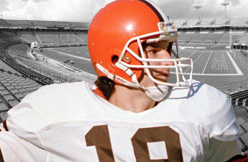
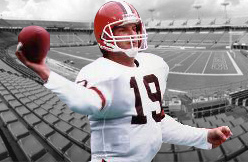
No. 25, BERNIE KOSAR, quarterback, 1985-93
Browns fans might be the most loyal and patient of any in the NFL, despite getting little reward for their devotion over the last four decades.
Beginning with 1974, Cleveland has had 11 winning seasons, two .500 seasons, 23 losing campaigns and three years without a team.
Save for the exciting "Kardiac Kids" seasons and 1994 -- which turned out to be an aberration of a season as the Browns went 11-5 and posted their last playoff win a year before they were moved to Baltimore -- there has been little of consequence for Cleveland fans to cheer.
Except for 1985-89, when talented but flawed and often injury-riddled Browns teams made the playoffs each year, won four AFC Central Division titles and three times came within a play or few of reaching the Super Bowl.
Their quarterback, Bernie Kosar, may have made just one Pro Bowl team -- hardly the measure of a player's quality -- but he played some spectacular games to help the Browns to big games, had some brilliant big-game performances and other fine showings in disheartening defeats. The gangly, 6-5 Kosar excelled despite an unconventional, semi-sidearm delivery, drawing on his accuracy, intelligence and instincts, and a toughness that allowed him to persevere through a string of injuries that in fact sidetracked him prior to what would have been his prime years.
Kosar, from Youngstown, led Miami (Fla.) to the national championship as a freshman in 1983, winning Orange Bowl MVP honors in the Hurricanes' 31-30 upset win over Nebraska. A few weeks after his sophomore campaign, Kosar announced his intentions to enter the 1985 NFL draft and that his hope was to play for the Browns.
At the time, only seniors or college graduates could be drafted according to NFL rules. Kosar had two years of athletic eligibility remaining at Miami but was on track to graduate during the 1985 summer with majors in economics and finance. In the meantime, controversy ensued as teams besides the Browns stated their interests in the 21-year-old quarterback. Missed paperwork deadlines for draft eligibility, threatened lawsuits and other issues further complicated matters as Kosar stood firm in his desire to play for the Browns.
As it turned out, the Browns traded their first-round picks in the 1985 and 1986 drafts, a 1985 third-rounder and a 1986 sixth-rounder to Buffalo for the Bills' first pick in the 1985 supplemental draft. The Browns used it, of course, to take Kosar. Another sidelight to the deal was that it had to be adjusted after controversial but talented Browns linebacker Chip Banks refused to be included in it, threatening to retire if forced to leave Cleveland.
The Browns acquired respected veteran Gary Danielson in a trade with the Detroit Lions to begin the season as the starting quarterback and at the same time tutor the rookie Kosar. Danielson, though, tore a rotator cuff in his right (throwing) shoulder when the Browns were 2-2, prompting Kosar's move into the lineup. Kosar started 10 games the rest of the way and Danielson returned to start one more (a win) and relieve Kosar in two others.
Kosar had a breakthrough game in its efficiency and importance in Week 15, a 28-21 win over the Houston Oilers. He completed 14 of 28 passes for 161 yards, three touchdowns and no interceptions and ran two yards for the other touchdown. The Browns, who had gone 5-11 in 1984, became 8-7 in the game that eventually won them the AFC Central title, though they lost their regular season finale. Then, Earnest Byner's ball-carrying pushed the underdog Browns to a stunning 21-3 lead in a playoff game at Miami, before the Dolphins rallied for a 24-21 win. The run-oriented Browns of coach Marty Schottenheimer employed a cautious and unimaginative pass offense due to the youth of Kosar, who completed 10 of 19 passes -- including a 16-yard touchdown toss to Ozzie Newsome -- with one interception.
The Browns went 12-4 in 1986, the most regular season wins in team history (schedules were expanded to 16 games in 1978) not including the team's days in the All-America Football Conference (1946-49). Kosar and his receivers and line carried the offensive load, as backs Byner and Kevin Mack both struggled with injuries. Kosar, in fact, led NFL quarterbacks with seven game-winning drives in the fourth quarter or overtime, the third most in league history. He was first, too, in comeback wins, games in which the Browns rallied to victory from fourth-quarter deficits.
In games started by Kosar from 1986 through 1989, Cleveland won 35, lost 17, tied one and won three more division championships. He played just 12 games in the 15-game, strike-shortened 1987 season, when "replacement players" formed the nucleus of team rosters for three weeks during the strike while most NFL veterans, including Kosar, didn't cross the picket line.
Kosar sprained his right (throwing) elbow in the 1988 season opener, an injury which sidelined him for six games and had lingering effects for the rest of his career. He missed the final regular season game and the 24-23 wild card playoff loss to Houston, in Cleveland, with a sprained knee.
Kosar set an NFL playoff game record that still stands when he passed for 489 yards during the 1986 Browns' 23-20 double overtime win over the New York Jets at Cleveland Stadium, the team's first postseason win since 1969. Kosar completed 33 of 64 passes with a touchdown. His two interceptions contributed to the Browns' 20-10 deficit, before he completed five passes during a long drive that pulled the Browns within 20-17 with just under two minutes left, then connected with Webster Slaughter for a 37-yard completion to set up Mark Moseley's field goal that forced overtime.
Kosar, who is one of four quarterbacks in NFL history to pass for at least three touchdowns in three straight postseason games, sparkled in two other playoff wins.
He completed 20 of 31 passes for 229 yards and three touchdowns, with one pick, as the 1987 Browns topped the Indianapolis Colts, 38-21, in Cleveland. In a 1989 season playoff game, again in Cleveland, Kosar keyed a 34-30 win over the Bills by going 20 of 29 for 251 yards and three TDs with no interceptions.
Following each of the Browns' three playoff wins, they lost American Football Conference championship games to the Denver Broncos.
Kosar's 48-yard touchdown pass to Brian Brennan gave the Browns a 20-13 lead over Denver with under six minutes to go in the 1986 AFC title game at Cleveland Stadium. Quarterback John Elway then directed "The Drive," moving Denver 98 yards for the score that forced overtime and led to a Rich Karlis field goal and the Broncos' 23-20 win. Kosar, who had turned 23 on Nov. 23 of that season, was 18-of-32 for 259 yards, two touchdowns and two interceptions.
The Browns fell behind, 28-10, in the 1987 conference title game at Denver. Kosar, Byner and their blockers led a compelling comeback that tied the game, 31-31, in the fourth quarter. After Elway drove Denver to the go-ahead touchdown, the Browns started a march on their own 25 with 3:53 left. Byner, who played a great game, appeared on his way to a tying touchdown on the seventh play of the drive, but was stripped of the football just short of the goal line by Broncos cornerback Jeremiah Castille, who recovered the fumble at the 1 with 1:05 to go.
Denver won, 38-33. Kosar had 26 completions in 41 attempts for 356 yards and three touchdowns. His lone interception was early in the game, an on-target pass that bounced out of a Browns receiver's hands.
Cleveland's 1989 season again fell one game short of the Super Bowl with a 37-21 AFC championship game loss at Denver. Kosar may not have played if it had been the regular season. He was hampered all year by a sore right arm and elbow, and he played the title game with a rubber splint on his right index finger. Browns receivers dropped at least a half-dozen Kosar passes, and he finished 19 of 44 for 210 yards with three interceptions. Still, he and Brennan connected for two third-quarter touchdown passes, pulling the Browns to within 24-21 before they faded.
The Browns were an aging and banged-up team following the 1989 season and it showed dramatically in 1990 as they went 3-13. Coach Bud Carson, who had taken over in 1989 after Schottenheimer and owner Art Modell had a parting of ways, was fired with the Browns 2-6 and replaced on an interim basis by assistant and former Browns cornerback Jim Shofner. Kosar was benched by Carson for one game, and he missed the final two games after fracturing his right thumb in the first half of Game 14, a game he finished anyway, a 13-10 Browns' win over the visiting Atlanta Falcons. Cleveland totaled 14 points in the three games, all losses, that Kosar didn't play.
Kosar's final full season of play with the Browns was in 1991, Bill Belichick's first as the team's coach. Cleveland went 6-10 though Kosar had a fine individual campaign, finishing among the NFL's top six in numerous statistical passing categories.
Kosar didn't throw an interception until the 10th game in 1991. In all, dating back to a pick during his final 1990 appearance, Kosar threw 308 consecutive passes without an interception to set an NFL regular season record. It stood until Tom Brady's streak of 358 spanning the 2010 and 2011 seasons for the Belichick-coached New England Patriots.
Kosar broke his right ankle in the second game of the 1992 season and missed the next nine games. The injury occurred during the first half of the Browns' 27-23 home loss to the Dolphins. Kosar limped through the rest of the game, throwing two touchdown passes in the fourth quarter for a short-lived 23-20 Browns' lead, before X-rays revealed the extent of the injury hours later.
Veteran quarterback Vinny Testaverde signed a free agent contract with the Browns prior to the 1993 season, ostensibly as Kosar's backup. Kosar and Belichick had been feuding for some time though, and their communication was strained, to say the least.
Testaverde took over for Kosar during the second half of Cleveland's 19-16 road win over the then-Los Angeles Raiders. The victory made the Browns 3-0. Testaverde and Kosar both played in the Browns' next two games, a 23-10 loss to the Colts in Indianapolis and a 24-14 home loss to the Dolphins. Testaverde went the distance in Cleveland's 28-17 win over the Bengals in Cincinnati as the Browns improved to 4-2.
Eric Metcalf returned two punts for touchdowns to key the host Browns' 28-23 win over the Steelers in the next game, which Testaverde started but had to leave after injuring his right (throwing) shoulder late in the contest. He was replaced by Kosar. With Testaverde sidelined, Kosar played the entire game the next week, a 29-14 loss to the Broncos at Cleveland Stadium. That left the Browns 5-3 and in a first-place AFC Central tie with Pittsburgh.
The day after the Denver game, Kosar was released, Belichick saying the quarterback's skills were diminishing. Belichick also wasn't especially pleased that Kosar said following the game that he had drawn up a play in the dirt during a huddle that went for a late touchdown pass to Michael Jackson.
Testaverde was still hurt, though, and inexperienced Todd Philcox was at quarterback when the Browns lost their next three games and eventually finished 7-9.
When let go, the injury-riddled Kosar wasn't the player he had been. Belichick, though, admitted several years ago that he had handled the release of Kosar poorly.
The resilient Kosar wasn't quite through. The Dallas Cowboys, with star quarterback Troy Aikman out for a couple weeks, signed Kosar right after his dismissal from the Browns. Seven days after his final game in a Cleveland uniform, emergency-starter Kosar completed 13 of 21 passes for 199 yards, a touchdown and no interceptions in the Cowboys' 20-15 win over the Phoenix Cardinals in Dallas.
A few weeks later, a shaken-up Aikman had to leave the Cowboys' National Football Conference championship game against the San Francisco 49ers in Dallas. Before Aikman returned, Kosar stepped in to complete five of nine passes for 83 yards, including a 42-yard touchdown to Alvin Harper that built Dallas' lead to 35-14 in the third quarter.
That finally got Kosar to the Super Bowl. Fittingly, he got in for the final few snaps of the Cowboys' 30-13 rout of Buffalo.
Free agent Kosar then joined the Miami Dolphins. He backed up Dan Marino for three years, throwing 152 passes and then retiring after the 1996 season.
Kosar, 49, has remained visible to Browns fans over the years, including work as a television analyst for the team's preseason games.
Kosar announced early this year that he was being treated for brain trauma, an effect from his NFL career, and that the results were encouraging. He suffered at least a dozen documented concussions as an NFL player.

(cleveland.com)